
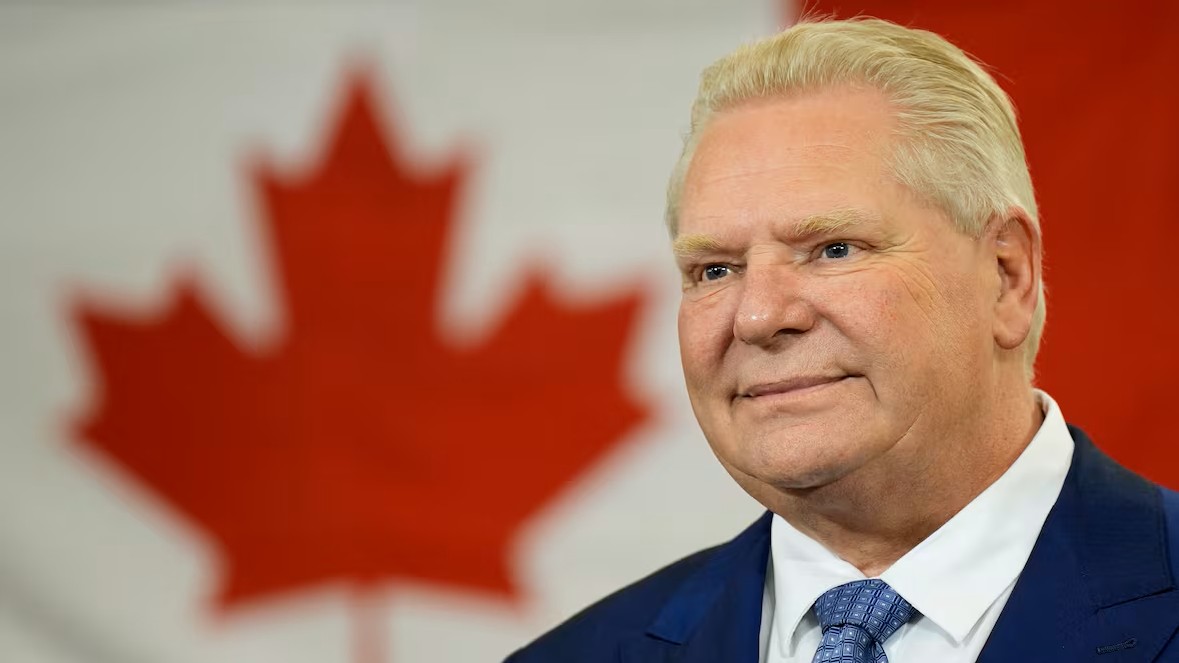
The Ontario government under Premier Doug Ford announced plans to cut OSAP grants to 25 per cent instead of the prior 85 per cent. They also plan to lift the seven-year tuition freeze, which Ford says was needed to fund post-secondary education in Ontario. Ford cites the federal cap on international students as the main reason why he had to pass the policy, but how did Ontario post-secondary institutions become so dependent on international students to begin with?
In a 2025 report by Higher Education, Figure 4 first illustrates how in the span of 40 years, Ontario has consistently provided the least “per-student income from government sources.” Second, it shows a pattern of Canadian post-secondary institutions’ government revenue streams per student consistently declining since 1980, except for a 10-year exception from 1999 to 2009.
This becomes prominent in Figure 7, which compares two datasets of per student post-secondary funding from 1980 to 2022. The first dataset shows funding per student if the number of enrolled students in 2022 was the same as 1980, the second shows funding per student with the correct figures of enrolled student in 2022 and 1980.
Thus, illustrating “from about 2008 onwards […] public investment started falling off […] in per-student terms […] even as overall student numbers continued to rise.” The report states that to get “back to the levels of 1980-81, or even just 2007-08 funding would require a rise between $6 and $6.5 billion.”
Ultimately, the graph demonstrates how, even though government is gradually increasing funding for postsecondary institutions, it is not nearly enough in comparison to the per-student demand.
To explain this underfunding, Council of Ontario Finance Officers’ (COFO) customized reports were used to derive total operating revenues and expenses in Ontario post-secondary education by setting table to “Table 2,” institutions to “Total for System,” fund to “Filter by a single Fund: Operating” and setting “Year as a Row,” to include all years from 2000-01 until 2024-25, and “Source as a Column,” to include all sources.
Enrollment data was derived from Statistics Canada’s customized reports, setting all fields to “Total” and reference period from 2000-01 to 2023-24 and dividing enrollment numbers per year to the relative total operating revenue per year, the total funding per student within the 24 year span is roughly $12,000-$14,000 each year, except for one dip to $9,000 in 2006-07.
The Bank of Canada’s Inflation Calculator was used to adjust all monetary values in terms of 2024 dollars, and Excel was used to organize and analyze the data.
The findings from these reports demonstrate how Ontario’s exploitation of international students compensates for chronic government underfunding.
The total operating revenue gradually increased from $5.8 billion in 2000-01 to $13.6 billion in 2023-24, aligning with the gradual increase in number of enrolled students from 474,600 to 1,019,763, respectively.
This increase maintained per student post-secondary operating revenue at roughly 12,000 to 14,000 within the 24-year span.
Concurrently, “Total Ontario Grants and Contracts” per year also remained at roughly $3 to $4 billion in the 25-year span, meaning there was no increase in provincial government funding even as the number of student enrollment was gradually increasing.
This translates to provincial funding per student decreasing from $6,415.44 in 2000-01 to $3,970.35 in 2023-24, and per student revenue from student tuitions had increased from $4,536.88 to $7,430.00, respectively.
From 2010-11, data breaking down domestic and international tuition fees are available.
In 2010-11, per student revenue by provincial funding was $6,291.79 and per student revenue by tuition fees was $5,315.00, of which $919.51 was from international students’ tuition. By 2023-24, per student revenue by provincial international students’ tuition fees had increased to $3,798.79. In 2010, the provincial government contribution to per-student operating revenues was 6.8 times greater than international students; in 2023 it is 1.05 times greater.
In percentages, total operating revenue by “Total Ontario Grants and Contracts” has decreased from 52 per cent in 2000-01 and 48 per cent in 2010-11, to 29.6 per cent in 2024-25, while operating revenue by tuition has increased from 36.8 per cent in 2000-01 and 40.7 per cent in 2010-11, to 55 per cent in 2024-25.
Furthermore, domestic tuition percentage of operating revenue decreased from 33.6 per cent in 2010-11 to 27.9 per cent in 2024-25 and international tuition percentage increased from 7.0 per cent in 2010-11 to 27.1 per cent in 2024-25.
On page 6 of the Council of Ontario Universities (COU) 2023 report on “Ontario University Sector Financial Challenges/Efficiencies, Student Supports and Outcomes,” there is a graph comparing “University Operating Revenue by Province and Source, 2020-21.”
Compared to the other nine provinces, Ontario has the highest percentage of operating revenue from tuition and the lowest percentage of operating revenue from provincial funding. Additionally, Ontario is the only province where more than half of the operating revenue is derived from tuition.
The 2020-21 report is not an anomaly but part of a long-term pattern of Ontario chronically underfunding post-secondary education. The aforementioned Figure 4 from Higher Education illustrates that from 1980 to 2022, Ontario has consistently provided less per student government funding than the Canadian average.
The impact of this underfunding became especially evident in the 2025-26 school year after the federal government capped international students’ enrollment.
In January 2024, the federal government announced a 35 per cent reduction in new international study permits and a further 10 per cent cut was announced in 2025, setting the cap at 437,000 permits. Simultaneously, Ontario introduced limits in approving new programs and capped the colleges and universities enrollment of international students.
CBC reported the result of these measures, stating, “between January and June 2024, Canada issued 125,034 permits.” Between the same six-month period in 2025, “that fell to 36,417,” a drop of approximately 70 per cent.
This resulted in universities across Canada, specifically Ontario and British Columbia, facing major budget cuts for the 2025-26 fiscal year. The impact of these budget cuts was felt through layoffs, hiring freezes, decreased hours for teaching assistants (TAs) fewer course options and decreased seminar hours, to name a few.
The dependence on international students did not begin with Ford but has been a 50-year pursuit of both the federal and Ontario’s provincial governments.
On Jan. 1, 1977, the Ontario government implemented differential fees for foreign students — a policy that allowed international students studying in Ontario on study permits to be charged a higher for tuition than domestic students.
On May 13, 1976, Terry Collins, student journalist for The Queen’s Journal, reported “foreign students face 150 per cent tuition hike.” The article references the former Minister of Colleges and Universities, Dr. Harry Parrott’s announcement on May 4, 1976, that “fees for foreign students in […] Ontario will go up from $585 to ‘$750 per term or $1500 per two-term academic year for all university programs.’” Parrots reason for the introduction of differential fees in Ontario was to “help defray the costs of post-secondary education” with the estimate of raising approximately $2 million in the first year and $6 million by the end of the decade.
In another article from The Queen’s Journal released on Oct. 19, 1976, by Phil Cheesman, the projected 150 per cent had changed to a tuition hike of 250 per cent for foreign students.
The policy came into effect on Jan. 1, 1977, and for the first time in Canadian history, international students were charged their own tuition rates. Thus, the pathway to dependency on international students had begun in Ontario — and Canada as a whole.
The 1977 policy set the foundation, but post-secondary funding was still relatively stable until 1995, when Ontario elected former Premier Mike Harris and his neoliberal policies which brought forth many changes to the post-secondary funding structure.
In 1996, international tuition fees for colleges were deregulated, allowing institutions to set their own rates without provincial cap, with limited exceptions. This administrative shift allowed post-secondary institutions to retain majority of the revenue and encouraged the institutions to pursue international enrollment as a revenue source amid deep provincial grant cuts.
The 1997-98 fiscal year moved away from the prior Ministry set standard for fees and introduced domestic fee ranges with up to 20 per cent hikes, a two-year policy permitting a max of 10 per cent average annual increases and “additional cost recovery” fees for high-demand programs.
In 2002 Harris retired and was succeeded by former Premier Ernie Eves. Eves capped five-year domestic hikes at 2 per cent annually, with unused increases carried forward.
This increase was halted however, after Liberal Party Premier Dalton McGuinty was elected in 2003 and froze tuition fees at 2003-04 levels for 2004-06, while crafting a new framework and maintaining the deregulation of international students. From 2006-10, regulated domestic hikes reached 4 to 4.5 per cent (up to 8 per cent for high demand programs).
By 2010, the differential and then deregulated fees had resulted in total expenditure of $2.9 billion in Ontario which translated to $1.8 billion contribution to GDP, 29,970 employment and $203 million of government tax revenue.
In 2014, the former Prime Minister and leader of the Conservative party, Stephen Harper, launched a “Comprehensive International Education Strategy.” The strategy dedicated $5 million per year to “branding and marketing Canada as a world-class education destination to audiences within six priority markets.” As well, $13 million dollars over two years was provided to Globalink program which “facilitates student mobility between Canada and Brazil, China, India, Mexico, Turkey and Vietnam.”
The goal of the strategy was to “double the number of international students […] attracting more than 450,000” by 2022, which will in turn create a minimum of 86,500 net new jobs for Canadians, generate economic growth with an expected $16.1 billion rise in international student expenditure and an approximate $10 billion annual boost to the economy.
By 2018, under former Prime Minister and leader of the Liberal Party Justin Trudeau, this strategy had accelerated to 720,000 international students, almost triple the amount from 2014 in half the expected doubling time of 2022.
By the time Ford was elected as Premier in 2018, decades of federal and provincial policies had oriented post-secondary funding around international fees while progressively underfunding the institutions.
However, while Ford did not create this issue, he was a major catalyst in exposing the failures of this system through his numerous restrictions on major sources of operating revenues for post-secondary institutions.
In 2019, CTV News reported that the Ford government eliminated the previous Liberal government’s increases in grants to provide free tuition for low-income students in an attempt to “trim a multibillion dollar deficit,” while also restructuring the six-month grace period for OSAP loans was such that interest could accumulate over the six-month period and be applied to the base loan afterwards.
The CTV report also mentions the announcement of 10 per cent reduction in domestic tuition fees and then to be followed by a tuition freeze. The report highlights that “a 10-per cent tuition cut would take about $360 million away from universities and $80 million from colleges.”
To account for these cuts, post-secondary institutions turned to international students. International fees as operational revenue saw its highest single year increase between 2018-19 and 2019-20, with a $500 million increase from $2.59 billion to $3.10 billion.
The Local reports that “between 2018 and 2025, the average undergraduate tuition for international students in Ontario rose from around $35,000 to just under $50,000.” Most Ontario universities tuition fees for international students are four to six times greater than domestic as affirmed by Statistics Canada.
After the COVID-19 pandemic impacted economies across the globe, including Canada’s, the result was an additional increase of study permit holders. In 2019 there were 637,780 permit holders, with the number gradually increasing by less than 100,000 students per year from 2000 to 2019.
2020 and 2021 saw a dip of 527,195 and 616,585 respectively due to COVID, then, in 2022 to compensate for the post-COVID economy, the number rose to 804,370, increase of nearly 200,000. In 2023, the number increased by more than 200,000 to 1,040,985.
In 2022, to address the labour shortage, Sean Fraser, Minister of Immigration, Refugees and Citizenship, announced that international students “who have off-campus work authorization on their study permit will not be restricted by the 20-hour-per-week rule” from Nov. 15, 2022, until Dec. 31, 2023.
The “2023 Annual Report to Parliament on Immigration” explicitly states that “immigration is essential for Canada, […] accounts for almost 100 per cent of labour force growth, and […] is projected to account for 100 per cent of population growth by 2022.” The demand for immigration is high in Canada due to Canadian citizens aging population and low birth-rates.
Between 2022 and 2023, the dominant narrative was that immigration is necessary for Canada and international students are necessary for post-secondary funding, but by 2024, immigrants — and international students specifically — had become scapegoated to take all blame for the affordability crisis.
This narrative by Canadian governments led to Canadian citizen growing frustrations with the abundance of international students, whom they blamed as being the cause for resource precarity.
While the frustration regarding the affordability crisis is valid, strictly blaming international students for the dilutes and misrepresents the complex economic relationship between Ontario’s post-secondary institutions and international students — and the relationship between Canada’s economy and migrants in general.
International students in Ontario became a pillar for post-secondary operating revenues, as illustrated by the abrupt increase in study permit holders and changes in labour laws for international students, to keep post-secondary institutions afloat in the post-COVID economy.
The blame thus should not be placed on the students who are struggling with the same affordability crisis, but rather on the politicians who brought in unforeseen numbers of students without any material plan for how to upkeep housing, food and other necessities with the increased population.
So, rather than politicians taking accountability for the errors in their short-sighted plan, they scapegoated international students, leading to the 2024 and 2025 federal government’s cap on international students.
This led to mass program cuts and campus closures across Ontario’s post-secondary institutions, and growing demand for the provincial government to increase post-secondary funding.
Instead of listening to demands, Ontario introduced Bill 33 in 2025, which received Royal Assent by late 2025. The Canadian Federation of Students Ontario (CFSO) critiqued the Bill, labeling it “a distraction to the underfunding of post-secondary education.” The Bill grants the Ministry far-reaching oversight on institutions ancillary fees which CFSO opposes, stating that “ancillary fees fund vital services students depend on — such as mental health services, sexual violence centres, food banks and more.”
The Bill also emphasizes merit-based admissions and requires outlined admission policies from colleges and universities. CFSO argues this emphasis undermines the independence and autonomy “vital to the health and strength of academic integrity” and “erodes decades of advocacy for underrepresented groups to be represented in post-secondary education.”
Then, on Feb. 12, the Ford government announced that maximum OSAP grants would decrease from 85 per cent to 25 per cent, and the seven-year-long tuition freeze would be lifted in September.
Ford’s justification for these changes was that he faced “massive pressure from the [education] sector,” due to “the federal government cut[ting] off foreign students coming in,” creating a problem for post-secondary funding. This announcement led to the “Hands off our education” rally organized by CFSO on March 4 and an upcoming second rally on March 24 at Queen’s Park.
Rather than increasing provincial funding, which is what international fees evidently compensated for, the burden is being shifted onto domestic students.
The abundance of misinformation in media, lack of accountability by politicians and misplaced anger by citizens is precisely why Ontario post-secondary institutions are incessantly underfunded.