

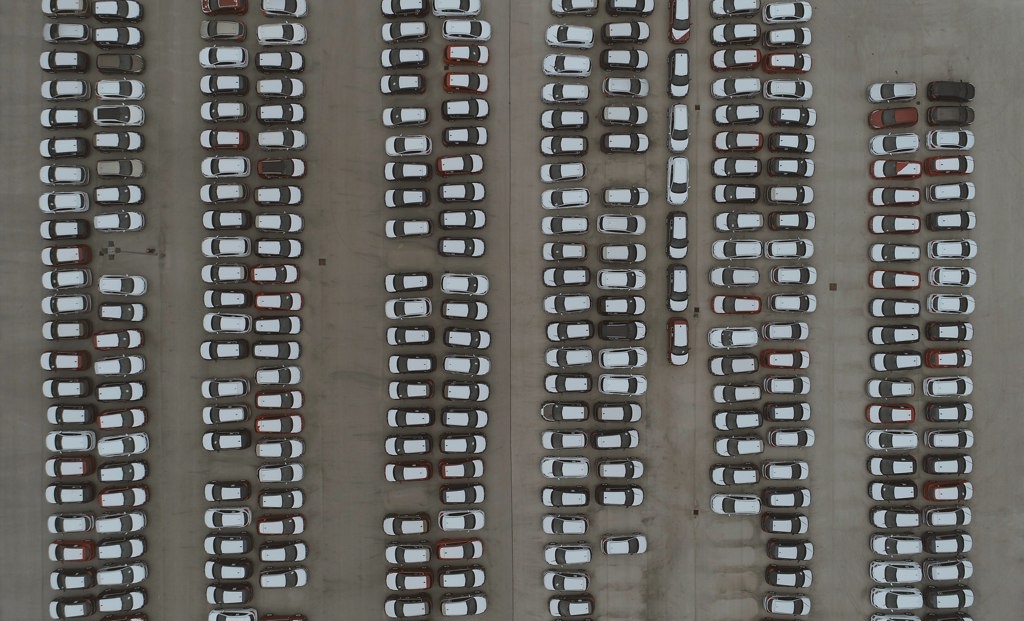
Brock’s campus loves cars, perhaps a little too much.
Automobile traffic is constantly moving in and out of campus, filling up its massive parking lots. While many students commute to Brock via car, the act of getting around on foot on the campus seems to be a battle with passing vehicles.
Due to a lack of large, pedestrian-friendly pathways, students often cross whenever is convenient as opposed to using crosswalks. At first glance, the students may be to blame, but the issue lies in Brock’s heavy emphasis on making it easier for cars to traverse campus as opposed to its student population travelling on foot.
The concern for Brock’s car-centric design is especially relevant for students living in the heart of campus on residence. Brock’s village residence houses approximately 868 students a year, most of whom are walking throughout the residence between dining halls, classes and social events. Directly through the residence runs Village Road, which has two marked pedestrian signs and a speed limit of 30 kilometres per hour. Ideally, these limits would be followed, but drivers often exceed them.
One student who chose to remain anonymous has paid close attention to the layout of the residence and how cars respond to these signs:
“People will often speed, revving their engines and failing to slow for pedestrians. At night this is more frequent,” said the student.
They later went on to describe instances of seeing drivers come close to hitting students numerous times at night.
For an area designated as a student residence, cars seem to have the upper hand.
At night, when visibility is decreased, drivers may not be able to see students walking or crossing the street. A speed limit or pedestrian sign will not necessarily cause drivers to slow down. This design puts an arbitrary trust in the driver at the expense of student safety.
A solution to these concerns among students could be speed bumps or stop signs at each pedestrian crosswalk. They would prompt drivers to be more mindful of their speed in a pedestrian-heavy area and allow students to cross the roads more safely, particularly at night.
Additionally, Brock’s priority towards cars compromises the beauty of campus. Situated in parking lot A is a massive pedestrian walkway where everyday hundreds of students walk to access the East Academic building. The walkway is marked by yellow markings and concrete barricades were added to either side where cars formerly drove over the walkway. For an area with high pedestrian traffic, one would expect more effort to be done to design a walkway that is visually appealing, but sadly, this is not the case.
Since this pathway extends all the way to Brock’s bus loop, the likelihood of it being removed is rather low. Removing a small amount of parking spaces around the walkway to create beds for grass would be one solution to this; doing so would not sacrifice most of the parking lot’s space.
In an ideal scenario, the car-dependent flaws in Brock’s campus could be solved without much friction, but the car-centric issues extend beyond campus. The crosswalks at the intersection between Sir Isaac Brock Way and Schmon Parkway serve as a major resource for students living in Foundry and Parkway Lofts to access campus and nearby amenities. On several occasions, I noticed the pedestrian walk signals were not being displayed when they should have, yet a group of students continued to walk. This is a major call for concern for pedestrian safety, and it has happened more than once.
North America has an issue with car dependency, which is precisely why many public transit systems outside of major cities tend to be lacklustre. Even if Brock were to remove itself from a rampant car-centric ideology, local public transit would have trouble transporting an increase of students in the St. Catharines/Thorold area. Due to the widespread nature of subdivisions, buses must travel a far distance and make many stops, leading to longer trips and susceptibility for traffic without additional buses.
Car-dependent urban design has an iron fist over North America. While immediate extreme changes to Brock’s campus are unfathomable, the seeds of change may be planted by implementing small improvements. Spreading awareness of the dangers of car-centrism and calling for change is how the big picture should be approached, so people can get from point A to B safer.