

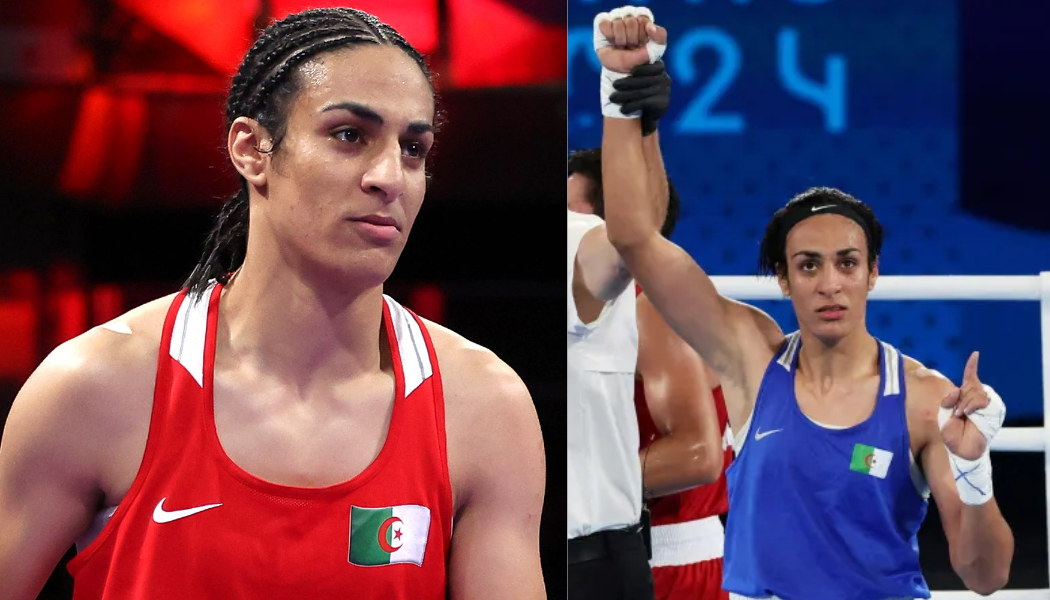
Imane Khelif’s position in international boxing has become one of the most contested issues in sport. The Algerian boxer, who won gold at the 2024 Paris Olympics in the women’s 66 kg division, now finds herself at the centre of legal disputes, regulatory battles and global debate about gender eligibility in athletics.
Khelif first came under intense scrutiny in 2023 when the International Boxing Association (IBA) disqualified her from the Women’s World Championships, citing failed gender-eligibility tests. The decision was never accompanied by transparent scientific evidence, and the International Olympic Committee (IOC) later rejected the IBA’s findings as arbitrary.
As a result, Khelif was permitted to compete in Paris, where she won gold amid controversy. Her quarterfinal bout against Italian boxer Angela Carini ended abruptly when Carini withdrew after less than a minute, intensifying speculation on social media and leading to widespread commentary questioning Khelif’s place in the women’s category. In response to the personal attacks directed against her, she filed a legal complaint in France for moral harassment, framing the treatment as a smear campaign that violated her dignity.
The issue resurfaced in 2025 with the emergence of World Boxing, a new governing body established to replace the embattled IBA. In May, World Boxing announced a new policy mandating genetic sex verification for all athletes competing in its sanctioned events.
While the regulation was framed as universal, officials explicitly named Khelif in their announcement, effectively making her the public face of the new testing regime. The result was her exclusion from the Eindhoven Box Cup in June and her removal from eligibility for the 2025 World Championships. After criticism, World Boxing’s president issued an apology for naming her directly, acknowledging that the decision compromised her privacy and added to reputational harm, though the policy itself was not retracted.
Khelif has responded by turning to the Court of Arbitration for Sport (CAS), filing an appeal in August challenging the legality of the World Boxing decisions. She argues that mandatory genetic testing is both discriminatory and unsupported by sound scientific or ethical reasoning and that the policy has denied her the ability to continue her career at the highest level.
CAS formally registered her case but rejected her request to suspend the ban while arbitration proceeds, meaning that she remains excluded from competition. Written submissions are currently being exchanged, with a hearing anticipated in the coming months. Though no interim relief has been granted, the immediate consequence is that Khelif has been barred from the 2025 World Boxing Championships, further intensifying the sense that the dispute is already shaping her career trajectory before the final ruling is reached.
The broader implications of her case are significant. First, it exposes the scientific and procedural instability underlying many eligibility decisions in sport. The lack of public evidence supporting the IBA’s earlier ban or World Boxing’s current policy highlights how contested the notion of “verification” remains, particularly when applied selectively. Second, it raises questions of due process. By denying her provisional eligibility pending the CAS decision, the legal system has effectively imposed punishment before adjudicating the substantive merits of the case. Third, her treatment shows the privacy and dignity issues that arise when athletes are made symbols of regulatory form.
The decision to name her directly in World Boxing’s policy announcement demonstrates how individual careers can become collateral in institutional struggles over legitimacy.
At the same time, the Khelif case underscores the institutional fragmentation in boxing. The IOC previously deemed her eligible, citing flaws in the IBA process; World Boxing has taken the opposite approach, embedding stricter requirements into its governance structure. The tension between Olympic standards, federations and independent regulators reveals the absence of a unified framework for handling gender eligibility. This disunity not only affects athletes but also erodes trust in the legitimacy of sporting institutions.
As Khelif waits for CAS to hear her case, the stakes go past her personal career. A ruling in her favour could limit the ability of federations to impose mandatory genetic testing and set precedent for greater scrutiny of eligibility policies. A ruling against her could entrench stricter regulatory regimes, affirming the right of federations to enforce broad testing requirements even at the expense of individuals participation. Either outcome will influence the direction of international sport at a moment when debates about sex, gender and fairness are central to institutional credibility.
Imane Khelif’s exclusion is not just about one athlete’s ability to step into the ring; It represents a contest over science, law and governance in sport, where questions of fairness intersect with rights to dignity and participation. As her case moves forward, the outcome will shape both her career and the evolving framework by which women’s sport defines inclusion and legitimacy.