

Thursday, December 25, 2025
Brock's Only Independent Student Newspaper
One of the only worker-managed newspapers in Canada

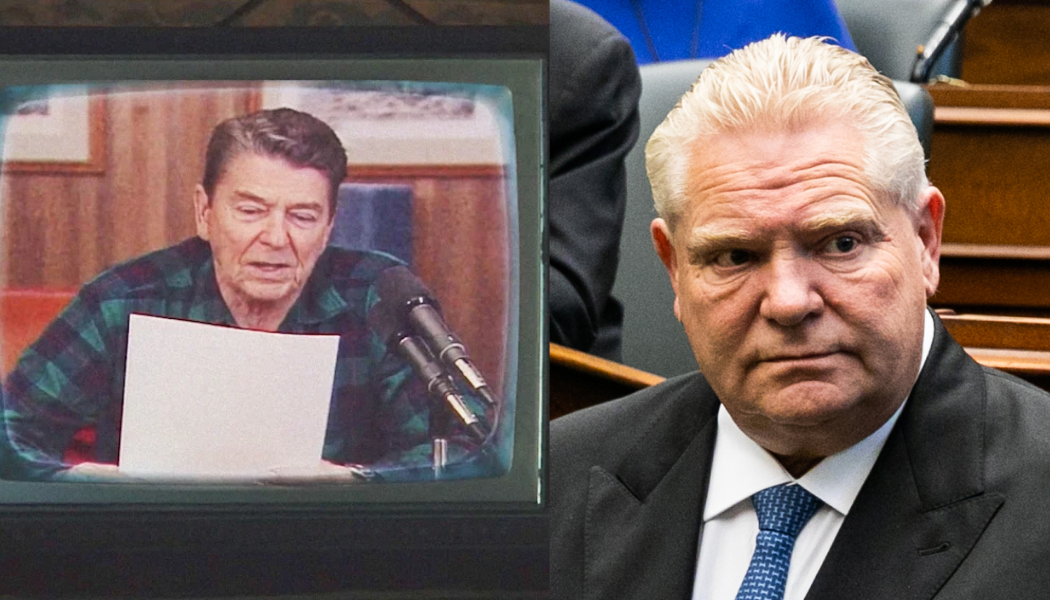
Ontario spends $75 million on Reagan ads that target Americans  

|
|

The Government of Ontario has announced that they intend to continue their anti-tariff advertising campaign across the border with $75 million in fresh funding for ads targeting Americans.  

The campaign has been ongoing since the trade war began earlier this year and is aimed at educating Americans about the negative effects tariffs have on the globalized economy.  

This latest round of ads contains clips of former U.S. President Ronald Reagan warning fellow Americans about the impacts of tariffs. Reagan has been historically considered the U.S. president under which neo-liberalism was adopted.  

Neo-liberalism is a political paradigm that supports lowering trade barriers, increasing privatization and austerity policies as well as trends towards globalism, which is in slight contrast to the more isolationist policies that the current Trump administration is following.  

In the video, Reagan explains how tariffs may work at first, but their benefits recede when nations place retaliatory tariffs and “markets shrink and collapse businesses, and industries shut down, and millions lose their job.” He goes on to say that the way to prosperity is “rejecting protectionist legislation and promoting free and fair competition.”  

The ad campaign is situated in an ongoing global trade war where things have remained unpredictable. On the Canadian side of the issue, Trump has most recently added an additional 25 per cent tariff on truck imports through USMCA exemptions.  

Corporations have been among those willing to shift to the president’s desires. Stellantis, a U.S. automaker, has moved its planned facility from Brampton, Ontario to Illinois as part of its initiative to shift investments towards the U.S. 

Opposition parties in Ontario have criticized Ford’s ads, with the Ontario Liberals saying that the ad campaign simply won’t work and that the money should be spent elsewhere. 

Stephanie Bowman, the Liberal critic for Finance and Trade, said that “the $75 million being spent on more useless feel-good ads would be better spent supporting the 3,000 workers in Brampton who will not be returning to work, and others like them,” as per a Toronto Now interview.  

In the same vein, Ontario NDP leader Marit Stiles made a post on Instagram stating that “taking $75 million out of people’s pockets to dress up broken promises and failures with a shiny new American ad won’t lead to a single job saved or made. No plan. No vision. No jobs.” 

According to Ford, the ads are to be played on most American T.V. channels, with the exception of CNN.  

U.S. tariffs haven’t been the only concern for the nation. China has maintained a canola tariff since Aug. 14, at a rate of 76 per cent. The tariff has had devastating impacts on Canadian canola farmers in Manitoba and Saskatchewan.  

The Chinese ultimatum in the canola tariff saga has drawn in auto-manufacturing in Ontario. The Chinese government would like Canada to drop its 100% EV tariff in exchange for dropping the canola tariffs.  

Premiers Wab Kinew of Manitoba and Scott Moe of Saskatchewan have championed the ultimatum with Ford decrying it.  

As the trade war wages on, Ontario remains a significant but increasingly unstable hub of auto manufacturing in North America. 

More by this author

RELATED ARTICLES

Bill 33: what students should know 

Ontario’s Bill 33, Supporting Children and Students Act, 2025, received Royal Assent on Nov. 20, creating a set of postsecondary law changes that will take effect only if and when the government proclaims Schedule 3. The schedule would require publicly assisted universities and colleges to publish admission criteria and access applicants on merit, authorize new regulations on admissions and student fees and require institutions to develop research security plans subject to ministerial directives. 

Aubrey Reeves presents findings on Canada’s Arts and Culture Sector 

On Dec. 1, the FirstOntario Performing Arts Centre (PAC) hosted local arts leaders, policy advocates and community members for a presentation on new national research, highlighting the economic and social contributions of Canada’s arts and culture sector.

2025 Ontario environment policies: the battle between competitiveness and accountability 

The Canadian federal and Ontario provincial governments’ 2025 policy decisions were focused on affordability and competitiveness-focused responses to trade pressure and rising electricity demands. The influence of this on Ontario’s climate can be seen in all of the climate adjacent policy decisions made regarding energy, infrastructure, land-use and fiscal decisions that either increased the pace of low-carbon buildout or weakened environmental guardrails and climate accountability, depending on the file.

What’s happening with Canada’s latest pipeline proposal? 

The Canadian Federal Government is moving in lockstep with Alberta’s Provincial Government towards establishing a new bitumen pipeline through to British Columbia’s northern coast despite objections. 

Here’s what the Auditor General’s report reveals about Ontario’s healthcare  

The Auditor General of Ontario, Shelley Spence, provided a news release on a newly tabled report that audits performance in healthcare related areas across the province. The news release highlights physician billing, medical schools and access to healthcare with the procurement of personal protective equipment also making headlines separately.  

Kick off the semester with Frost Week and more 

Before the winter term kicks into high gear, BUSU aims to make sure that you still get your fill of Brock fun — meeting new people, reconnecting with friends and getting some much-needed social time through Frost Week.

Toronto’s Union Station using facial recognition for targeted advertising 

Reports of Toronto’s Union Station implementing the use of facial recognition software to better target advertising made media waves a few weeks ago. Here’s what students who may be using the station during this upcoming break should know.  

Alberta’s alarming dependence on the notwithstanding clause 

On Nov. 18, Alberta invoked the notwithstanding clause for the second time in under a month — a retaliatory move in the face of pushback from the judiciary that threatens the rights of trans youth and young women across the province.