

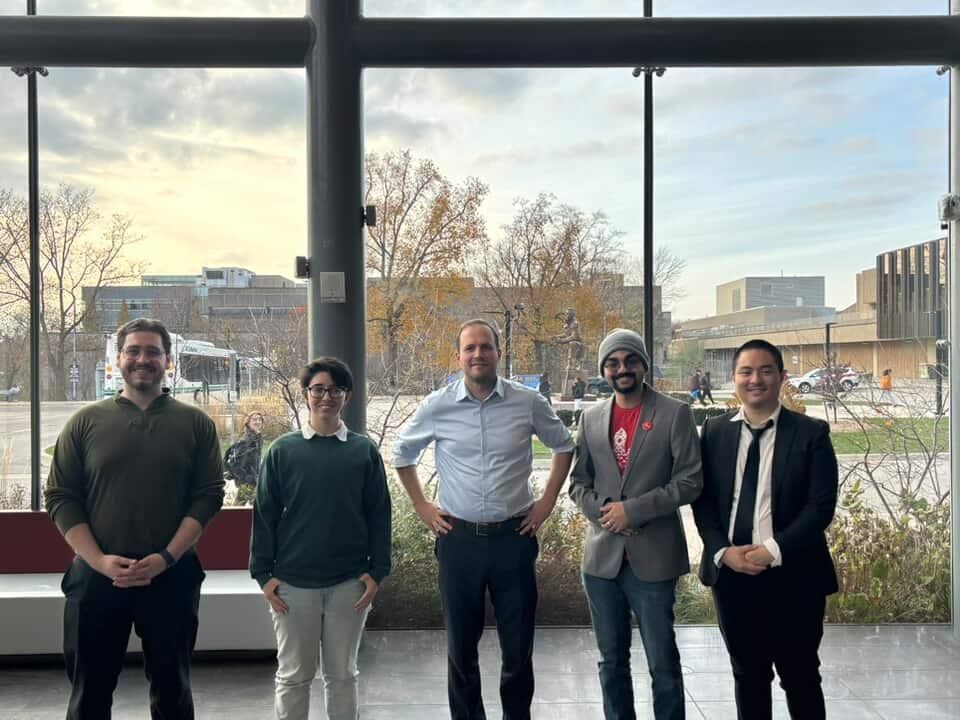
On Nov. 21, in the Goodman Atrium from 1 p.m. to 3 p.m., The Brock University Young Liberals (BUYL) club hosted federal member of Liberal Parliament and former housing minister Nate Erskine-Smith as part of a club social.
Nate Erskine-Smith is a federal MP who served as housing minister under the 43rd and a little into the 44th Parliament before being shuffled out.
He represents the riding of Beaches-East York and has been known for hosting the podcast Uncommons, taking a left-leaning approach to politics and occasionally breaking away from his party on certain issues.
The social was an intimate affair with a modest showing. Attending members sat in a circle around Erskine-Smith to briefly discuss the need to engage youth in politics. Erskine-Smith discussed how he got into politics and encouraged participants to get involved in politics at any level before opening the floor up to questions.
Questions varied from detailed inquiries on university independence as private institutions and its effects on human rights to economic concerns such as housing, political alienation and budget comments on items like old-age security contribution levels.
Erskine-Smith responded with an emphasis on encouraging well-meaning people to get into politics. He explained that many people experience different struggles in life, but when those struggles are traced back and socially contextualized, they are often rooted in politics.
When responding to a member who asked about housing affordability by explaining that his sister and her husband are renting an apartment with no hope of ever purchasing a house and have given up on having children for that reason, Erskine-Smith responded by acknowledging the struggle.
He explained that political solutions, such as stronger renters’ rights to increase housing security, would offer a temporary generational solution and may allow the small family to feel comfortable with having children.
He stated that he wasn’t sure that housing prices could be lowered without a total market crash in enough time for the family, but that other political solutions do exist to meet people’s needs.
Erskine-Smith spoke of a “generational squeeze.” Both a social feeling explored by the political think tank, the “generational squeeze” is the reality that the youth of today have less opportunities than previous generations.
Erskine-Smith is not affiliated with the think tank but expressed political interest in their advocacy over the generational squeeze.
In essence, the concept is indicative of a sense of generational inequities that politicians should aim to address, according to Erskine-Smith.
Before the event began, The Brock Press had the opportunity to interview Nate Erskine-Smith on his political stances.
In describing the event, Erskine-Smith explained that his “goal into the fall and hopefully into the new year is to visit campuses, to hear from students and to channel those concerns and sometimes frustrations.”
“Certainly the issues that young people want advocated for, I want to channel those issues through my advocacy in Parliament,” said Erskine-Smith.
When explaining what role university students play in Canadian politics, Erskine-Smith stated that one cannot “walk into a classroom without students caring about a range of different issues, whether it’s housing, whether it’s climate action, whether it’s addressing homelessness […] there’s so many issues that people care about and they don’t always draw the straight line connection to being involved in politics and the necessity of participation in politics.”
He iterated that no matter what issue an individual cares about, politics will be one of the most important ways to engage with that issue.
“Politics happens with or without you, and so the answer is participation,” said Erskine-Smith.
In addressing the role of political clubs like BUYL in youth politics, Erskine-Smith explained that “young liberals overall, including clubs like the one here at Brock, are at their best when they’re pushing the party to be the best version of themselves.”
For Erskine-Smith, these clubs play a role beyond simply helping a local Liberal candidate get elected.
“Whether it be legalization of cannabis or medical assistance in dying [MAID], there are issues where young liberals have led change within the party,” he noted.
“The more that we see young liberals that attend conventions and help shape the party’s policies, the better off we are for it. Young people, including young liberals, there’s a huge role for them to play in pushing the party to be more ambitious around generational fairness.”
Erskine-Smith detailed how youth involvement in the party has driven a greater focus on housing policy over the last 10 years in part because of a “deep seated feeling of generational unfairness that young people have. In particular, that the housing market served their parents and their grandparents, but it isn’t serving their generation.”
In addressing the question of youth alienation from politics, Erskine-Smith held by generational unfairness: “education is expensive, but job prospects aren’t as available. Compare 50 years ago, [the] number of years it took to save up a downpayment for a starter home versus today in most places in Ontario and across Canada — [there’s] a huge gulf from what was fair then and what is unfair now.” Erskine-Smith understands why someone might want to disassociate from politics here in Canada, but urges that the solution for these problems requires the opposite reaction.
“You’ve got to participate, you’ve got to push our politics in the direction you want to see it and there’s no substitute for that,” said Erskine-Smith.
For youth looking to get involved in politics, Erskine-Smith states that “in many ways, it’s just the act of showing up.” He explained how he once ran for city council back when he was a student at Queen’s University. Though Erskine-Smith lost the electoral race, he explained that the experience was an act of involvement, and one that came with political lessons for him.
For Erskine-Smith, you want to understand the community you’d like to represent. If you attend youth councils, campaigns or clubs on campus, you can add your ideas to the conversation.
“Our politics should be about ideas, and the more people [that] can show up, participate and make our politics more about ideas, we’re all better off for it,” said Erskine-Smith.
Erskine-Smith stated that a local perspective on political issues matters in a time of big interests.
“The whole idea was to go to bat for the community where I was raised, and where I’m now raising my family [in] the only community I’ve ever seriously known […] to be a voice for my community. […] That kind of grass roots politics is essential.”
Honouring a local perspective signifies the importance of advocating for your communities in politics, not just agreeing with a popular consensus in Parliament, says Erskine-Smith.
“I’ve been a Liberal MP for 10 years, and I take the accountability function really seriously. I’m not just there to say yes to everything; I’m there to go to bat for my community, shape the agenda, add ideas and sometimes disagree,” said Erskine-Smith. “Our party is better off for it and our country is better off for it if we make our politics about ideas in that way and we go to bat for our local communities.”
On the current political climate marked by polarization, Erskine-Smith said that political figures are far kinder to each other “when the cameras stop rolling.”
“It’s a lot of theatre, unfortunately,” said Erskine-Smith.
In the midst of the media-driven political landscape, Erskine-Smith hosts the podcast Uncommons to discuss political issues with MPs “across party lines,” with some sharing drastically different views from the host himself. “I think that making our politics about substantive debate rather than cheap slogans in question period is the enduring goal, though it’s hard when so many function on the sound bite,” explained Erskine-Smith.
Erskine-Smith went on to advocate for avoiding the use of “cheap shots” in politics, citing the recent case of opposition leader Pierre Poilievre’s suggestion that the RCMP was corrupt as an example of an unserious but corrosive move in politics.
“I do think we all have to recognize that institutions around us matter, that we’re trying to build trust in what we’re doing. […] The way we conduct ourselves in politics either builds trust or sews distrust, and I think we’ve got to all be better in this system at how we engage each other,” said Erskine-Smith.
When asked how his political work benefits the youth, Erskine-Smith brought up housing as his prime example, describing it as a major area of frustration for young people. He explained how he has focused “significant efforts on advocating for a more ambitious housing policy, for advocating for a different way of thinking about housing policy.”
Erskine-Smith brought up the policy of cutting red tape and getting government out of the way with the idea, being “that we treat housing as a home first and investment second because it is incredibly frustrating seeing investment dollars competing with folks just trying to buy a place to live.”
Erskine-Smith gave insight into how to avoid jurisdictional ping-pong — a political reality in federations like Canada, where provinces and the federal government will pass off political issues as outside of their jurisdiction, leading to inaction.
Erskine-Smith addressed it as “an age-old question in Canada […] what you want to do, I think, whatever level of government you operate at, is you want to do everything you can within your own jurisdiction; you want to work collaboratively where there’s shared jurisdiction; and you want to be crystal clear about what other levels of government can and should do in their area of jurisdiction and leave it to them.”
“So long as you’ve done everything in your own backyard, you can more credibly point to inaction in others. […] It’s not acceptable to just point a finger and say it’s the other persons problem or if there are areas in your own jurisdiction that you haven’t acted on.”
In addressing how the government plans to navigate a multi-crisis across jurisdictions, Erskine-Smith explained that the government is trying to focus solely on the question of sovereignty in handling workers, businesses, military spending, infrastructure and productivity challenges.
In response to concerns that the current budget sacrifices Canada’s youth in allocating the majority of spending to those in retirement, Erskine-Smith said that “the budget could have certainly done more around addressing […] generational fairness.”
Erskine-Smith explained that there is money in the budget for youth employment and policy leavers that the budget commits to on climate action, though with no new dollars being allocated that way. He stated that the core focus of the budget was sovereignty both in terms of defense and economic strength.
Erskine-Smith did, however, elaborate on a new bill he was working on to address old age security (OAS), stating “one out of every seven dollars, soon to be one out of every six dollars, that the federal government spends, we spend on old age security.”
He explained that providing seniors with dignity in retirement continues to be important and needs strengthening yet.
“Old age security at large […] means it’s a system that sends cheques — thousands of dollars — to seniors that make $90,000 or $100,000, and that’s got to change.”
“We need to reform old age security so that wealthier seniors aren’t receiving significant cheques out of the general revenue and that we are using those dollars to support low-income seniors and end seniors in poverty.” As Erskine-Smith explained, he is currently working with Generational Squeeze to hammer out the details of the bill.
When asked about potentially changing the tax code to increase taxes on the wealthiest one per cent, Erskine-Smith explained that in the past he had “introduced a motion around taxation. The wealthiest one per cent in this country own a quarter of the country’s wealth; is that okay for folks?”
Erskine-Smith said that he thinks “it’s incredibly important to be fiscally sustainable; […] you can run significant deficits in operational ways when there’s a downturn and when you’re trying to have a stimulative effect. Generally speaking, though when you are running a deficit in better times, we should be focused more on capital spending. We should be focused on long-term infrastructure projects with a proper return.”
“It doesn’t make sense that you increase operational spending by way of a tax cut, for example, and you deficit finance that tax cut, I think that is not the responsible approach that we need,” said Erskine-Smith.
Erskine-Smith concluded by encouraging the youth to get involved in politics. The event concluded with a group photo being taken of attendees with Erskine-Smith.