

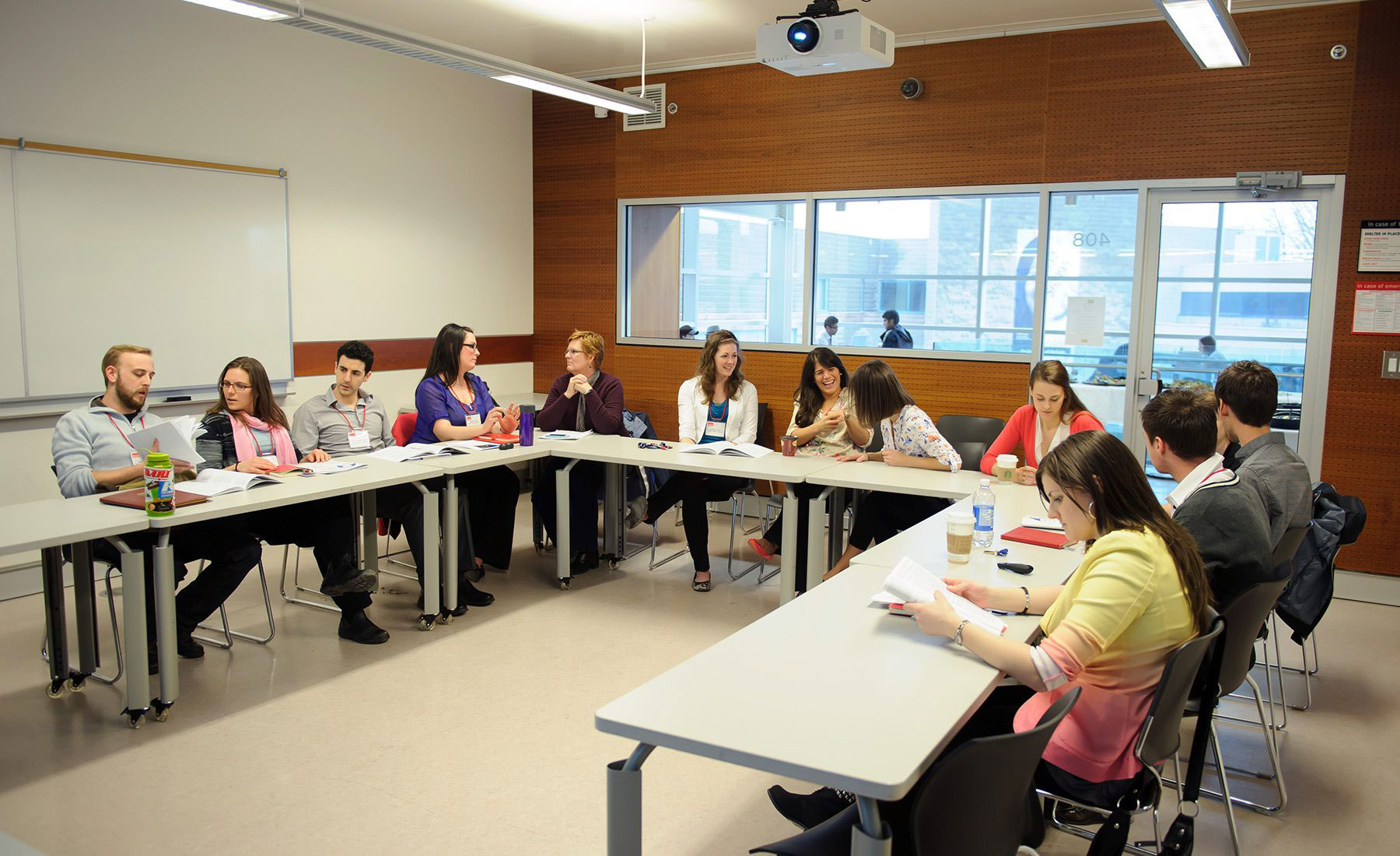
While the rumours circulating amongst history students that laptops will be banned from the department’s seminars as a bid to prevent the use of artificial intelligence (A.I.) during seminar have been debunked, the prospect of unplugged seminars prompted discussions surrounding education and technology.
Regarding the validity of this rumour, The Brock Press reached out to the Chair of the Department of History, Dr. Tami J. Friedman, who said that the claims swirling around are “not really” true.
“Certainly, the department isn’t making any decisions about how everybody should manage their classrooms,” said Dr. Friedman.
Dr. Friedman explained that individual instructors have the freedom to make policies that they deem appropriate for their classes, and “it is certainly possible that an instructor could say that they don’t want students bringing laptops into seminars.”
The rumour over seminars sparked interest in the history student body, with The Brock Press interviewing history student Ethan Huffman for his opinion on the role of laptops in seminars.
Huffman explained that students were let in on “insider information” that “[professors] were talking about potentially removing laptops […] from seminars.”
According to Huffman, students were told about the idea by Professor McLeod of the history department, which sparked concerns within the student body. “We don’t know how long they’ve been happening, but the talks have been there, and the conversation is in the air,” said Huffman.
Huffman described himself as one of many students in the history department who disagrees with laptop-free seminars. “We as the student body rely on laptops for our notes [and] our textbooks. We are a digital generation, and we rely on digital means of education to succeed in university.”
Huffman believes that the motivations for this decision are a result of students using A.I. on their laptops during seminars, with laptops also being a source of distraction, preventing the facilitation of “free-flowing discussion.”
For Huffman, “seminars are perhaps the most important thing for us as history students and students of the humanities to freely discuss ideas […] I don’t know why we need to make changes to an already established format.”
For Huffman, laptops remain a key tool in making the most out of seminars. He explained that he uses his laptop for note taking and cross-referencing online textbooks.
Regarding A.I. usage in seminars, Huffman described that the department has “seen a scary amount of students utilizing generative A.I. [which] gives goodwilled, honest students a bad rep and prevents them from truly succeeding by grouping them in with a larger crowd of people not pursing their academics the way they should be.”
For Huffman, “A.I. is being used as a weapon to disregard the wider history community at Brock University.”
Huffman says the idea that the removal of laptops from seminars would be ableist as it singles out students with accommodations from the university’s Student Accessibility Services, which could severely impact the lives and mental health of those students.
Dr. Friedman took some time to explain the reasoning behind the rumoured department-wide ban, noting that her own seminar policies don’t allow laptop use, though she isn’t currently enforcing this.
For Dr. Friedman, there are reasons behind not wanting laptops in seminars. “We want students to be able to engage in in robust discussion about reading […] we can see that the presence of electronics is a distraction from engaged conversation. In addition, I would say that artificial intelligence has made it more problematic to have electronics.”
When further addressing the circulating rumours, Dr. Friedman stated that the removal of laptops is “sort of a thought experiment kind of exercise that maybe a couple of faculty members have floated past students to see what their reactions would be.”
While individual instructors have freedom over how class seminars are administered, for the removal of laptops to become a department-wide policy, Dr. Friedman said that it would be discussed in a departmental meeting and would go through the department’s teaching committee.
Dr. Friedman stated that, “it would be highly unlikely for an entire department to agree to impose some kind of course policy on everyone in the department.”
Dr. Friedman explained that essay guidelines — such as what constitutes an A or B level essay — is the closest thing that the history department currently has to a department-wide policy. However, rubrics and grading schemes are within the instructor’s jurisdiction.
Dr. Friedman acknowledged that A.I. usage helped fuel the laptop-ban rumour, but doesn’t feel that it is the sole cause.
“I think it is a reason because some of us and our teaching assistants have been seeing students with A.I. software open on their laptops in seminars and in lectures,” said Dr. Friedman.
For Dr. Friedman, the “other big reason is that we want to facilitate engaged conversation. A.I. is a much bigger problem, I think, than one faculty member or department can solve. There are a lot of discussions happening among faculty members across Canada.”
One of the methods for discouraging the use of A.I. in courses, according to Dr. Friedman, is to try and incorporate material that is not easily accessible to A.I. in coursework.
When addressing the origins of the rumour, Dr. Friedman’s understanding is that “there was some discussion among faculty who are coming back from leave about how to deal with some anticipated problems in seminar discussion and that a colleague asked a room full of students what their reaction would be if they […] faced a requirement like that.”
“In other words, nobody was saying we’re doing this in this class, and nobody was saying we’re doing this in the department. It was simply asking students [for their] opinions, which I think is totally appropriate and the right thing to do.”
Dr. Friedman said that the history department is interested in hearing student opinions and concerns about their policy. According to Dr. Friedman, the idea of banning laptops from seminars has come up previously amongst other faculty on campus, based on studies exploring the negative effects of laptop use in lecture halls.
However, “one of the difficulties with a ban like that is that students with disabling conditions that need accommodation to be able to type their notes would be outed in a class with a blanket ban on laptops. So that is something that faculty members need to be cognizant of,” Dr. Friedman said.
Dr. Friedman discussed the challenges of policing A.I. use in courses, mentioning that “we really need support from the administration. […] The academic integrity manager was fired several months ago […] that responsibility is being shifted onto the teaching and learning area of campus but there isn’t any person in that position anymore.”
“I don’t know where this is going to go. But it is my understanding that the leadership of the teaching and learning office on campus are interested in the possibility of using A.I. as a sort of way to support equity and diversity and inclusion and I think that there needs to be a much more robust discussion about the problems with A.I. that we are seeing.”
Dr. Friedman said that for the 2026-2027 school year, the faculty of the Department of History has managed to successfully push back against the Dean’s office and reinstate seminars for third year courses. In this current year, third year seminars were cut from the history department, and it has been a high priority for the faculty to get them back.
Dr. Friedman states that “there’s no guarantee that they won’t be removed again or that we won’t be engaged in this struggle again and again but they were on the chopping block for this year. We were not able to stop that, but we’ve stopped it for next year.”
Dr. Friedman encourages students interested in discussing this topic further to reach out to her at tfriedman@brocku.ca, or the Brock University Historical Society for a more student-led discussion.