

The Canadian Federal Government is moving in lockstep with Alberta’s Provincial Government towards establishing a new bitumen pipeline through to British Columbia’s northern coast despite objections.
This follows several energy proposals that have been floated recently, including the establishment of interprovincial transmission lines and east-west fossil fuel pipelines. Notably, the proposed new bitumen pipeline — slated to run from Alberta to a northern B.C. export port — is the most controversial.
As it stands, Prime Minister Mark Carney and Albertan Premier Danielle Smith have signed a memorandum of understanding (MOU) which states several promises between the federal and provincial government.
The MOU reiterates a commitment to net zero greenhouse gas emissions by 2050 but reinforces a “shared objective of establishing Canada as a global energy superpower, unlocking the growth potential of Western Canada’s oil and gas,” while recognizing the obligation to consult and accommodate Indigenous Peoples where appropriate.
The MOU further states that the pipeline project would have to be privately constructed and financed, with plans for Indigenous Peoples co-ownership to be agreed upon.
Also included in its project list is the construction of the Pathway carbon capture project, a plan to store carbon underground in a storage hub near Cold Lake Alberta.
Alongside Pathway, the MOU includes a project to construct “thousands of megawatts of A.I. computing power, with a large portion dedicated to sovereign cloud for Canada and its allies.”
In the commitments section of the MOU, the Government of Canada agreed to “not implement the Oil and Gas Emissions Cap […] suspend immediately the Clean Electricity Regulations (CER) in Alberta pending new carbon pricing agreements.”
The MOU also noted that the project is in national interest, allowing the government to refer it to the Major Projects Office to be fast tracked through the Building Canada Act.
Additionally, the MOU included a provision to “if necessary,” make “appropriate adjustments to the Oil Tanker Moratorium Act.”
However, the MOU between the federal and provincial government has become controversial, with leader of the Green Party, Elizabeth May — whose riding of Saanich Gulf Islands is located on the B.C. coast — expressing a sense of betrayal and describing her decision to provide crucial support for the Liberal budget as a mistake.
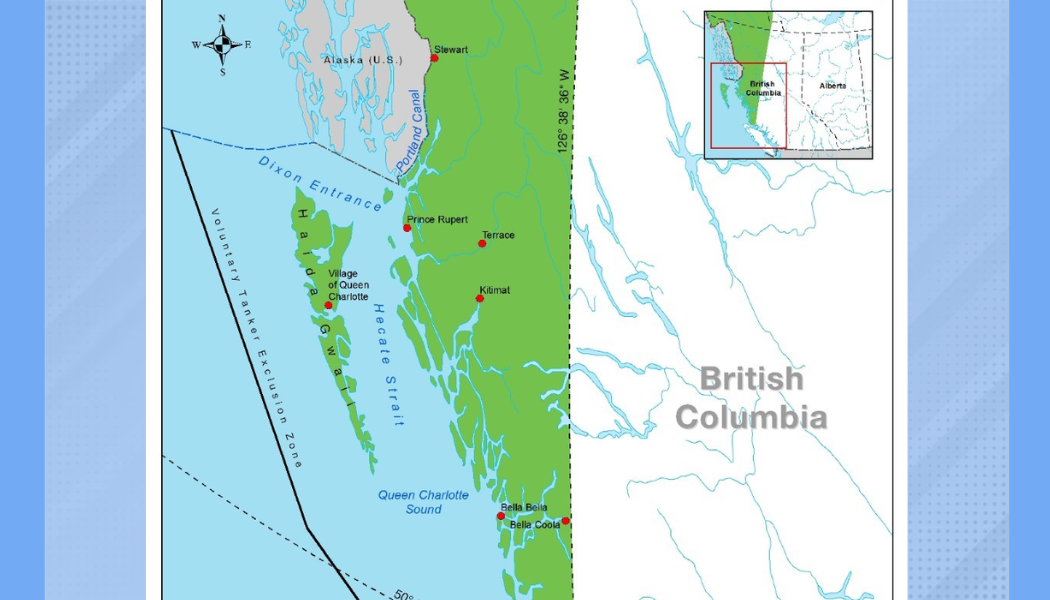
The provision to change the Oil Tanker Moratorium Act was passed in 2019, banning oil tankers carrying “more than 12,500 tons of crude oil or persistent oil” from stopping at ports along the B.C. coast from Alaska to the north of Vancouver Island.
The Act has to do with the dangers associated with the Hecate Strait, which has been described as “the fourth most dangerous body of water in the world” by Environment Canada, as well as the ecologically unique area surrounding the exclusion zone.
The moratorium on oil tankers isn’t new either; it’s been around for 53 years, originating in unanimous 1971 B.C. legislature and 1972 House of Commons motions that opposed oil tankers along the B.C. coast.
This resulted in a voluntary Tanker Exclusion Zone, which the 2019 Oil Tanker Moratorium Act enshrined in law; an agreement that has been in place for 50 years.
Premier of B.C. David Eby has expressed frustration with the federal government’s exclusion of the province from pipeline talks. Eby said at a news conference that “this is not something that would happen to Québec.”
Currently, Premier Eby has stated an openness in discussing the pipeline proposal, but only if the Oil Tanker Moratorium remains unchanged.
Costal B.C. Indigenous Groups remain starkly opposed to the pipeline project, with the Union of B.C. Indian Chiefs (UBCIC) stating that they will be “loudly objecting” to the agreement, as it was done without consultation of coastal First Nations in British Columbia.
However, several Indigenous communities in Alberta have signalled support for the pipeline project, with Alberta Métis eyeing potential ownership in the pipeline proposal.
The MOU represents the first step towards building the pipeline amongst a flurry of objections.