

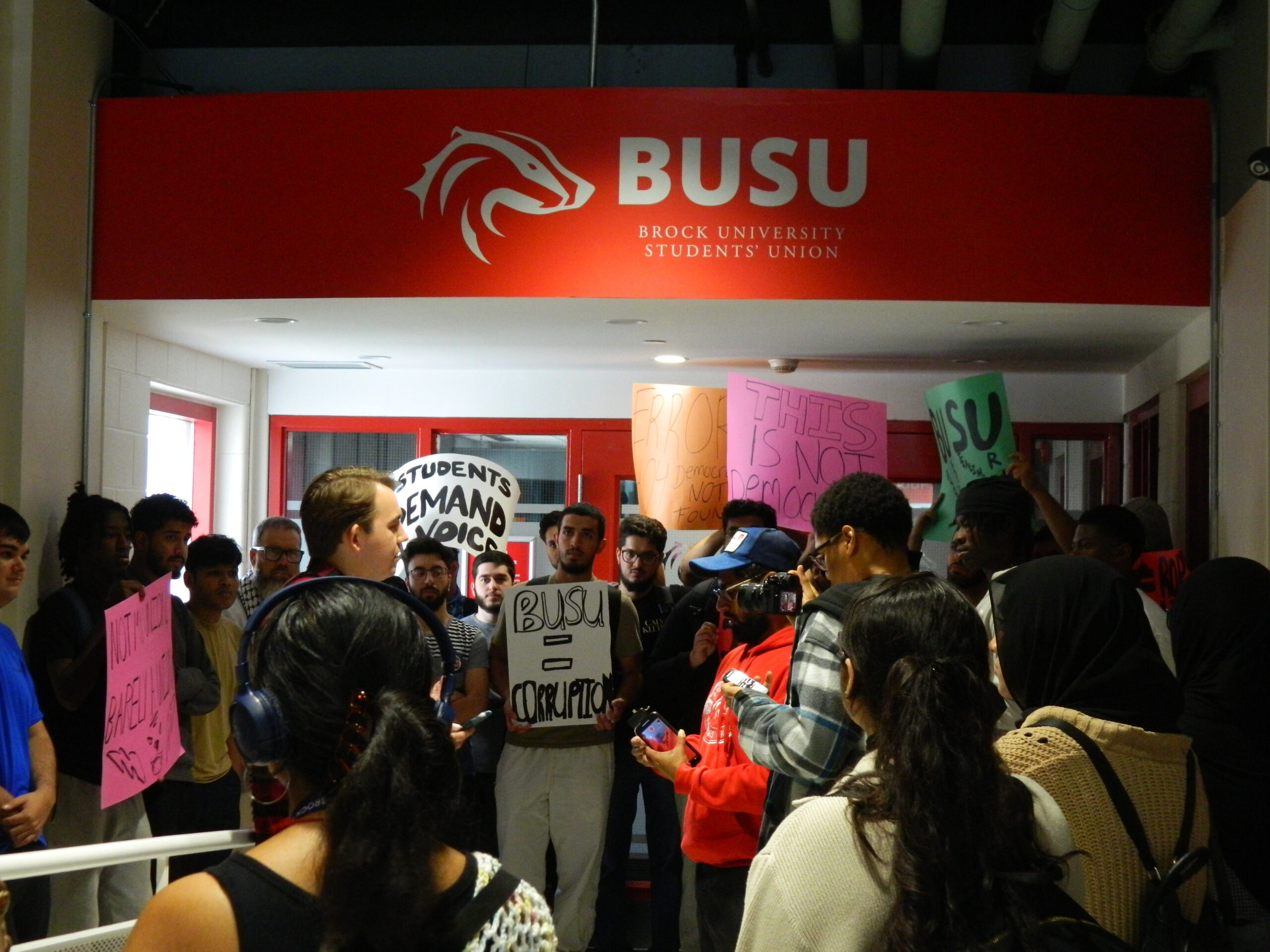
Students across Brock University and the Muslim Students’ Association are demanding change from their students’ union after Omar Rasheed was abruptly removed from his position as BUSU Board Chair during a controversial September meeting.
Rasheed’s removal as BUSU BoD Chair and subsequent election of Tomas Oviedo as new Chair — Sept. 18, 2025
On Sept. 18, 2025, the Brock University Students’ Union (BUSU) held their second meeting of the 2025-26 school year. The meeting — which has been made available for public viewing as per BUSU’s policies — has garnered backlash due to an impromptu addition to the agenda near the end of the meeting in which Board members voted to oust Rasheed, head of the Muslim Students’ Association (MSA), from the Chair position and replace him with second-year BUSU Board member Tomas Oviedo.
The first hour of the meeting proceeded as normal, with the Board approving various meeting minutes and speaking with an auditor in accordance with the agenda that was provided to all Board members in advance. After the standard portion of the meeting was completed, Oviedo motioned to enter an in-camera session. This was met with resistance from a few Board members as the meeting had already surpassed its scheduled duration and an in-camera session was not mentioned in the agenda.
This spurred a disagreement within the Board. Rasheed noted that he had an external commitment that meant he would need to leave the meeting shortly and suggested that the business could be discussed at a future meeting. Another Board member pointed out that several special meetings held in the summer had gone over time. Still, Rasheed responded that since this was a scheduled meeting, it should stay in accordance with the original agenda to accommodate Board members with class commitments.
Ian Bhimani said he was “excited” to hear what Oviedo had to say and added that it was not abnormal for additional points of discussion to be added to Board meetings in the past. Conversely, Abdulrahman Al-Naqeb agreed with Rasheed, saying that he had a class to attend and would not be able to stay past the scheduled timeslot.
Oviedo responded to Rasheed’s concerns by saying that special meeting minutes had not been respected in the past. He added that “this isn’t more of a, you know, ‘can we do it, can we not do it?’ If we get two members to approve on it, we are going to do it, whether you’d like to be a part of it or not. That’s completely up to you.”
Oviedo said that adding an item to the agenda would be in accordance with BUSU’s by-laws and suggested that the Chair responsibilities be passed onto Vice-Chair Olivia Gillespie for the rest of the meeting if Rasheed could not be in attendance.
Notably, section 4.05 of BUSU’s by-laws do allow Board meetings to continue in the absence of their Chair as long as the Vice-Chair is present, which was properly completed in the second Board meeting with Vice-Chair Olivia Gillespie taking over as temporary Chair. Furthermore, section 4.09 of BUSU’s by-laws stipulate that meetings of the Board adhere to the parliamentary procedure outlined in Robert’s Rules of Order, a commonly used standardization guide to procedures in governance. In accordance with Robert’s Rules of Order, a meeting agenda can be amended at any time by an assembly if a director moves to amend the agenda and the motion passes by majority vote.
Although two additional Board members needed to leave for class, Oviedo and fellow Board member Irene Charley moved the motion followed by an ordinary resolution process. This initiated a vote to determine whether the meeting would continue with an in-camera session. The vote passed in favour of the meeting’s continuation with seven members for and four members against.
At this point, the meeting turned in-camera, meaning that the recording was disabled and the remaining Board members held a private discussion that was not visible to the public. The online recording picks back up at 12:21 p.m., indicating that the in-camera session lasted approximately 55 minutes. When the recording started up again, several Board members had already left, including Rasheed.
Bhimani was then given the floor. He addressed his next message specifically to the students of Brock University:
“A lot of the time, we’ve heard the term ‘fiduciary responsibility.’ In our first Board training, we learned what fiduciary responsibilities are and what would happen if you breached your fiduciary responsibilities. Now, personally I’ve seen a lot of moments in this Board where the Chair — I’m going to talk about Omar — has breached his fiduciary responsibilities. Time and again, Tomas and I have been reminding Omar that there is a right to all voting [and] non-voting members to be invited to the meetings. Even if they fall under a conflict of interest, they have the right to attend the meeting. Omar has never given me a straight answer on that; I have never gotten a straight answer on that; and conflict of interest in this institution since this new Board came has been demanded by the Chair, and not asked. And just as a point of clarification, conflict of interest is something that you cannot demand out of anyone. And we’ve seen that happen a lot from Omar.
“A meeting that [BUSU president Fiona Seabrook] attended actually, there was no opportunity given to her to speak, and she was forced out of the meeting — she said that she wanted to speak, she had points she wanted to bring up. But she was forced to go out of the meeting. And I feel like that is very disrespectful. You’re talking to the president of the Brock University Students’ Union. She’s the president. She is in a position to help the students, and that’s how you treat them? I don’t go ahead with that idea. […] And that was proof of a situation where conflict of interest was demanded.”
Bhimani continued by saying that there was “one moment he would love to mention” before going quiet and cutting his speech short.
Oviedo invited the other present Board members to share their opinions before introducing the next motion: a vote to elect a new Board Chair to replace Rasheed — who, again, was not present for this portion of the meeting.
The seven present Board members — Bella Bai, Ian Bhimani, Irene Charley, Kelela Dennis, Olivia Gillespie, Kira Simmons and Tomas Oviedo — then voted unanimously to remove Rasheed from his position as Chair. Oviedo nominated himself as a contender for the Chair position and became the sole nominee to become Rasheed’s replacement. He gave a statement prior to the subsequent vote for his election:
“I believe this Board has overcome a lot of obstacles within the early parts of the year, and I’m honestly genuinely sorry to the student population, and to us as Board members, for all the organizational problems that have been occurring. In general, I think the Board should be a place for students to express their own interests through their elected membership and do it in such a way that their services and their quality of life are being improved. I currently didn’t see that within the former Board Chair [Rasheed], and I’m not taking this position for any, you know, glory or resume addition. I genuinely just hope to articulate the interests of students and hopefully move forward and progress the Board to a body that can really support the students and be a voice for student advocacy here at Brock.
“Again, sorry that it has to come to this — for everyone, including our membership — but at the same time, I do genuinely believe that the Board is moving in the right direction and ideally we can really get some work done with student accommodations and student advocacy.”
The Board members present for this portion of the meeting then voted. Six were in favour of Oviedo as the new Board Chair, leading him to officially replace Rasheed in the position. All Board members present for this portion of the meeting voted to elect Oviedo as the Board’s new Chair except for Oviedo himself, who abstained from the vote.
Notably, this does not mean that Rasheed is removed from the Board of Directors; he has been removed from the position of Chair but maintains a presence on BUSU’s BoD.
The nature of the vote — namely the fact that Rasheed and several other Board members were not present for this portion of the meeting, and therefore unable to defend Rasheed’s position as Chair during this unplanned motion — has created significant controversy, leading students to rally behind Rasheed and demand an overhaul of BUSU’s Board of Directors.
Students and MSA respond; protest takes place on Brock campus — Sept. 26, 2025
Over the following weeks, the r/brocku subreddit became a popular forum for Brock students and alumni to express their dissatisfaction with BUSU’s actions.
“BUSU feels like it exists more for the benefit of the students running it than the ones it’s supposed to represent,” writes one critic. Other posters have called on the Board members to resign and run for re-election, demanding a “clean sweep” of the students’ union.
Former Brock students have also used this situation to express pent-up frustration towards BUSU, with one alleged Brock alum arguing that the students’ union “has killed student advocacy and engagement in a systematic way.” Others have created conspiracy theories that Rasheed’s removal was a takedown orchestrated by unelected BUSU officials.
In true Reddit fashion, some critics have flexed their creative muscles by creating various memes, largely poking fun at Oviedo as well as Bhimani.
Additionally, an online petition demanding that Brock University “investigate corruption” at BUSU has gained over 440 signatures as of writing. The petition calls on Brock to complete a “full and immediate investigation into these acts of misconduct” as well as the resignation of the seven directors who were present for the vote to elect Oviedo.
The student body’s frustration toward BUSU left the screens and took to the streets with a protest outside the Student-Alumni Centre on Sept. 26, 2025. The protest was organized as a loosely coordinated effort by a group of anonymous individuals.
One speaker at the protest was Andrew Hawlitzky, one of the students whose BUSU BoD campaign was removed from voter ballots without explanation during the students’ union’s February election.
Hawlitzky, a former copy editor at The Brock Press, spoke aloud to a crowd of approximately 60 people at the protest. Attendees included members of the MSA, the Accounting Students’ Association, the Sri Lankan Students’ Association and Brock Pride.
In his speech, Hawlitzky condemned the “unelected staff, puppetted executives and resume-building directors who let down every student who voted for them.” He expressed frustration toward Oviedo, who he said “removed Binoy [Mahmud] and me from the election, cut your clubs’ funding, has spoken against bringing back elections and defended the indefensible corrupt actions of the staff.”
Hawlitzky called for change within BUSU’s governance structure, demanding the resignation of the seven directors who voted against Rasheed, for those seven seats to be opened for re-election in October, for BUSU President Fiona Seabrook and Vice Presidents Aaditya Gupta (External Affairs) and Natalia Rodrigues-Rana (University Affairs) to resign, and for General Manager Robert Hilson to step down “immediately.”
The Brock Press reporter Hannah Barton was present at the protest and spoke to several students at the scene, many of whom had learned about the protest through Reddit.
One such student was Mikayeel Bashar, a second-year Brock student who was left upset after watching the Board’s September meeting.
“I’m very disappointed that [BUSU] would treat us like that; [they] would treat our brother Omar who is beloved by the community here — by not just the MSA, but a lot of people here love him. So, it’s very disappointing to see that.”
Bashar also expressed discontent with BUSU having ended their executive election process, a move that has proven unpopular amongst Brock’s online community.
“I’m just here to demand that we bring justice, accountability [and] transparency from the students’ union, and to bring back the elections for the executive positions,” said Bashar. “We want to bring back elections, we want to make sure that you know exactly what’s going on in BUSU with the leadership within it, and make sure that they’re transparent.”
Fourth-year student Rofyda Bassiouny also spoke with The Brock Press at the protest.
“We’re here because this is not our first time dealing with something [like this],” said Bassiouny. “We have votes for a reason. And the reason is that we want people who represent the students, nobody else. Because we’re only here for, like, four years, but this is systemic. Other students are coming as well; we don’t want them to get used to this.
“Because outside, there is so much corruption in the world. But our own university has to show us that corruption can end, and that as students, we can end it.”
Bassiouny said that BUSU has an issue with transparency and believes that the union does not value students as much as they say they do. “It’s called the students’ union; it’s supposed to represent students. But that’s not what’s showing.”
Bassiouny also mentioned their frustration with BUSU’s funding for various clubs, echoing a common student sentiment that the funding allocation is insufficient for many clubs at Brock, and a complaint that BUSU continues to grapple with.
“We don’t have any idea about the funds that we’re paying,” said Bassiouny. “I’m seeing so many things online, on Reddit, about how there’s no transparency. I’m seeing funds that have no explanation. And so many clubs that are representing their own students, not just the MSA, but even more students are not getting funds for their clubs. I feel like clubs are there to represent the students and help them enjoy their lives, and feel represented on their own campus.”
The Brock Press also spoke to Hasnain, a student in a master’s program at Brock. Hasnain echoed the previous sentiments that BUSU has an issue with “transparency.” He said that the Board had a “one-sided story” during their removal of Rasheed as Chair. In reference to the group of Board members who needed to leave the meeting, Hasnain noted a lack of Muslim representation on the Board while the vote to remove Rasheed was made.
Hasnain’s concern over the lack of Muslim representation in the decision is one echoed by the MSA, one of Brock’s largest clubs. Notably, Rasheed is the current president of the MSA.
The Brock Press obtained an email sent to BUSU executives, Board members and various Brock faculty on Sept. 22, 2025 by Hasan Rana, Vice President of the MSA. In the email, Rana calls for Brock’s Human Rights & Equity Office to “do more than issue statements,” citing a need for “active measures.”
“The way Omar Rasheed was removed from his role as Chair in the absence of several board members from marginalized backgrounds has shaken not just MSA, but a wider circle of students across Brock,” Rana wrote in the email.
“Regardless of technicalities, the optics matter. It looked orchestrated, there were staff present and seen using phones during the meeting, and it felt targeted. When multiple marginalized voices are excluded or silenced in one sitting, it raises serious questions of equity and fairness. I would also like to point out that BUSU has a history of removing and targeting leaders, whether it be removing them from the ballot in the middle of elections or any titles they hold in their Governance structure.”
Rana continued by saying it is “very hard to encourage engagement in campus governance when the structures in place appear unsafe or unwelcoming to us,” and that the BUSU BoD’s conduct “risk[s] discouraging an entire generation of students especially those from underrepresented backgrounds from ever stepping into leadership at Brock.”
BUSU BoD fails to pass subsequent meeting agenda attempting to address student concerns — Oct. 5, 2025
This concern was discussed at BUSU’s third Board meeting of the school year on Oct. 5, 2025. The meeting was intended to address the intense backlash faced by the BoD after the previous meeting in which Rasheed was removed as Chair. However, this meeting quickly went off course after the Board declined to approve the pre-arranged agenda, leaving it unclear as to how the meeting should proceed or whether it should proceed at all. Ultimately, four members voted in favour of the agenda and five voted against, with Abdulrahman Al-Naqeb, Mentalla Elgerf, Yasmin Elgerf, Mariam Ben Omrane and Omar Rasheed voting against the agenda — all five of whom were not present for the vote to remove Rasheed as Chair in the previous meeting.
The subsequent motion to approve the previous meeting’s minutes was also declined. The failure to approve the agenda and the previous meeting minutes was met with significant confusion and deliberation amongst Board members, with some members becoming frustrated that they were not able to voice their opinions while others called for the meeting to be cancelled entirely.
Olivia Gillespie, Vice Chair of BUSU’s BoD, hoped to respond to backlash from students during the October Board meeting. “I’m sure everyone’s been seeing stuff circulating; students are very confused, so I thought this meeting was supposed to be to help clear up some of the misinformation,” said Gillespie. “I thought that’s what the meeting was about, so I just don’t really understand why we can’t go ahead with that.”
Oviedo then allowed Board members to voice any concerns about the meeting’s agenda, which he said was an attempt at an “open discussion to account for student transparency, accountability, of all Board members within the organization” and to allow members to “air any grievances” and “re-align the Board” while addressing student criticism.
This marked something of a tonal shift in the meeting, with various Board members beginning to speak more candidly.
The first person to respond was BUSU President Fiona Seabrook, who had become a target for criticism online. She said that many Board members had been receiving hate online and that it was “not fair to anyone,” and that the move to decline the meeting’s agenda unfairly prevented those members from speaking openly to the student population.
“I think this meeting was very important, and to not have been given a reason as to why we aren’t having this meeting is just confusing to me,” said Seabrook. “And I think it’s a little bit disrespectful [toward] the people who have had their names hated on, and haven’t been able to speak up for themselves in a way that we include the entire Board and let us all have an equal discussion.
“Yeah, I’m upset about that. That’s my point. I don’t mean to get emotional on the Board, but I think this is a really important discussion and we haven’t [said] the points that need to be made.”
Yasmin Elgerf, one of the Board members who was not present for the vote to remove Rasheed as Chair, mentioned that the backlash was affecting everyone on the Board regardless of their view on the controversy. Al-Naqeb condemned the hate experienced by the members of the Board but noted that the controversy was a result of “some of the Board members’ actions in the last meeting,” calling it a “reaction from the community.”
Rasheed took the floor and acknowledged that the past few weeks had been difficult for him.
“I’m in a position right now where I have been publicly humiliated as well,” said Rasheed. “In fact, I have been the core of this public humiliation, where I have been humiliated publicly between my community and been acted against in a discriminatory manner. You could call that racist, you could call that discriminatory; nonetheless, it is very evident and clear [that] certain people in the meeting were laughing and mocking me in the last meeting.”
Rasheed added that the treatment he experienced had a “severe impact on [him] as an individual” and that it had affected him both professionally and in his university life.
Rasheed also alleged that the Board had not been properly following by-laws, saying that a previous meeting had not been posted within a week as per BUSU’s policies. He called the Board’s management “incompetent” and expressed frustration that several Board members had been treated in an “absolutely unacceptable way.”
Ian Bhimani expressed sympathy toward Rasheed for the public humiliation he had faced. Bhimani mentioned that he had been receiving threats to his email, saying that his email address had been circulated on public forums, and that he was hurt by the accusations of Islamophobia because he identifies as Muslim and had recently completed his prayers.
Rasheed said it was “ironic” that Bhimani had recently completed his prayers because he was one of the people who Rasheed believed had acted in a “discriminatory manner.” He added that he appreciated Bhimani’s apology but called it “contradictory.”
Oviedo reminded staff that Board members were welcome to “constructively criticize” other members but asked for comments to maintain “a level of respectability” — though he followed by saying Rasheed had not violated this request. Oviedo added that the Board would never tolerate any form of discrimination, highlighting the “incredible amount of student diversity” on the Board, and told Rasheed that he was “very very sorry” that he had those concerns.
Oviedo’s remarks did little to quell the arguing.
“I just wanted to say that, the reason why I said sorry, Omar, was not because I was agreeing that I was being racist towards you,” said Bhimani. “The reason why I said that I’m sorry is because I’m sorry for whatever’s happening to you and how it’s affecting you.” Bhimani argued that the decisions made in the previous meeting had nothing to do with who Rasheed is as a person, nor for his religious beliefs.
“I follow the same religion as you, buddy, and that has nothing to do with it,” Bhimani added. He asked Rasheed to think with a “broader perspective” that might spur some type of agreement.
Gillespie said that she had not made any decision based on Rasheed’s religion, and added that she had responded to several student emails on the matter but had not received responses.
Al-Naqeb alleged that there was a Board member who had breached a policy and asked what action the Board would be taking against her. He said that if the Board would not take action against this unnamed Board member, then “[Oviedo’s] claims of being ‘diverse or inclusive’ is discrimination and racist, and baseless.”
Oviedo would not elaborate on the situation “out of respect” for the unnamed Board member. He said that he would rather have those conversations in-camera to respect the individual’s privacy, though he acknowledged the importance of the issue. Al-Naqeb re-asserted his stance, citing a need for transparency.
Later in the meeting, Al-Naqeb would accuse Oviedo of “dodging [the] question” about the accountability of this Board member. This prompted a back-and-forth between the pair, in which Oviedo would deny “dodging accountability” while Al-Naqeb felt it was inconsistent that the Board would address Rasheed’s situation while not addressing the unnamed Board member.
Yasmin Elgerf said she felt that the Board’s actions in the previous meeting were discriminatory. She felt that some Board members’ conduct had violated the fiduciary duties that members had been trained to adhere to throughout their previous meetings.
Kira Simmons — one of the Board members who voted Rasheed out of his position as Chair — said that everyone “was invited” to the discussion in which the vote to remove Rasheed as Chair took place. She noted that no one was forcibly removed from the conversation. Gillespie corroborated Simmons’ statement and suggested the conversation be re-directed to discuss the situation of Board members feeling targeted in the previous meeting.
Rasheed acknowledged that it was his decision to leave the previous meeting but said he wasn’t informed of the nature of the vote that would be taking place. He agreed with Al-Naqeb that it was inconsistent for the Board to not publicly address the unnamed Board member who allegedly violated their fiduciary duties “in the same way the Board publicly humiliated [Rasheed] in front of all the students.” He called this a “prime example of discrimination” that proved “certain people are treated differently from others; maybe it’s not the extent of pure racism, nonetheless, it is very evident and shown.”
Oviedo cited “mixed messages or maybe miscommunication” as potential factors across the Board influencing why it made the decisions it did. Oviedo asserted that the Board did not engage in discrimination but acknowledged how it could be perceived that way. He said that he appreciated all Board members and stated his aim to work as a team to advance BUSU’s goals for all students.
Rasheed told the Board that he would be leaving the meeting due to the Board’s failure to pass the agenda. Oviedo said that he was unsure how to proceed due to the unpassed agenda and asked the Board for their thoughts. Al-Naqeb left soon after for the same reason as Rasheed, and Oviedo announced that the meeting would soon end. Seabrook agreed that the meeting should be adjourned due to Rasheed’s absence, and several remaining Board members provided their student emails in case students wanted to reach out. The meeting concluded with Oviedo re-affirming the Board’s stance against racism, sexism and other forms of hate.
On Jan. 8, 2026, BUSU posted the out-of-camera portion of its fourth Board meeting of the year, held on Nov. 28, 2025. Most of the meeting was spent in-camera with 110 minutes allotted within the agenda for private discussion between Board members. Aside from some abstentions and dissentions on the approval of the meeting agenda and previous minutes, the public portion of the meeting proceeded as planned in the agenda.
Seabrook and Rasheed release statements
In the week following the third Board meeting, Seabrook released a public statement written as though it represented the views of the entire Board, though she had not received approval from all Board members upon posting the statement. In the statement, Seabrook clarified some of the Board’s rationale for removing Rasheed as Board Chair in the Board meeting on Sept. 18, 2025. She listed four reasons as to why the Board decided to remove Rasheed from his position:
- “Over the summer the former Board Chair called several, last minute meetings that were entirely in-camera and therefore not able to be shared on our channels. Not all Directors were being notified of the meetings. This is in direct violation of BUSU By-Laws.
- External individuals (including non-students) were invited into meetings by the former Board Chair without the consent of the full Board, which raised concerns regarding governance practices and alignment with the Chair’s responsibility to act in the best interests of the organization and its student members.
- There was a very clear and direct relationship between at least one of the external individuals, the former Board Chair, and several other Board members that was not declared. This violates the directors’ fiduciary responsibilities regarding conflict of interest.
- The topics being discussed presented significant risks to BUSU’s ability to deliver on the new Student Centre voted in by the student body in 2019 and 2024. The proposed changes were being acted on with a clear lack of proper due diligence which exposed the organization and all the board members to unnecessary risk.”
According to the statement, these concerns led several Board members to “want change in that role to protect the organization and the interests of students.” Seabrook said that the motion to re-elect a new Board Chair followed BUSU’s by-laws and its governance obligations.
Seabrook’s statement contained a reminder that Rasheed is still present on the BUSU BoD. The statement said that the Board “stands by its decision to remove the former Chair based on legitimate governance concerns” and that BUSU denies allegations of “racism and financial improprieties” connected to the decision to remove Rasheed as Chair.
The statement also said that BUSU would collaborate with Brock University to strengthen the organization’s accountability by completing:
- “An independent third-party investigation into BUSU’s Board practices and conduct.
- A financial review conducted by Brock’s internal auditors in accordance with BUSU’s contractual obligations, to ensure fiscal responsibility and compliance with financial management standards.”
The Brock Press reached out to Brock University’s media relations department to inquire about the process of the ongoing investigation but has not received a response.
The statement concluded by saying that BUSU “remains dedicated to its mission of representing and supporting all Brock students.”
In response, Rasheed released his own public statement soon thereafter, titled “RESPONSE TO THE FALSE STATEMENT – FEW INNOCENT QUESTIONS IN THE SPIRIT OF TRANSPARENCY & ACCOUNTABILITY.”
Rasheed’s statement opened by stating that “the message released from personal accounts of [a] few Board member(s) including the President is NOT a Board statement, NOT made on behalf of the BUSU Board of Directors, and DOES NOT reflect the truth.” Rasheed stated that Seabrook’s statement — which he called “a personal communication made without authority [that] should be treated as such” — was a “blatant misuse of authority” and “yet another instance of the individual(s) acting unilaterally and misusing the position.”
Rasheed’s statement asserted that Seabrook’s post did not reflect the views of everyone on the Board despite it being presented as such. In his statement, Rasheed said that he wanted to ask a few “innocent questions”:
- “How can individual(s), even as President or a Board of Director(s), release a public statement on behalf of the entire Board without consultation, discussion, or approval from the Board? Is this consistent with transparency? Does this represent good governance practice? And most importantly, is this even lawful?
- The President indicated in her communication with the Board that that [sic] her role comes with considerable pressure from various individuals, and an external party, for a few weeks has been asking her to release ‘some sort of statement’. Is this why she chose to issue a baseless and defamatory communication to divert attention from other unresolved issues and make me the centre target? If the Board including the President could not manage that pressure, why did it become the only solution to publicly target and humiliate me without facts or even without Board approval while the statement is falsely made on behalf of the Board?
- Why has the President and the Board remained silent on the formal complaints filed against some Board member(s) by our students/membership, a matter involving serious breaches of fiduciary duty, BUSU Bylaws, and internal policies? Is this sudden statement instead an attempt to divert attention from those existing complaints, which the Board appears to have taken no visible action on or is it an attempt to discourage and silence our student voices, making an example out of this situation so that no one else will feel comfortable raising concerns in the future?”
In terms of the claims made against Rasheed in Seabrook’s statement, Rasheed wrote that he has always acted “in the best interests of the students and the organization [he] represent[s].” He said that he had not violated any policies, adding that the “external individuals” referenced in Seabrook’s statement were students and former Board members who had submitted “complaints that were serious in nature.”
In response to Rasheed’s statement — which confirmed that not all Board members approved of Seabrook’s statement — Seabrook made an offer to the Board to redact her statement and repost it with clearer language, clarifying that it only represented her individual stance rather than that of the entire Board. Seabrook told The Brock Press that the five directors who expressed concern about her statement did not respond to her offer, nor did they take a position on whether the initial statement should be redacted.
The Brock Press interviews BUSU BoD members about controversy
The Brock Press reached out to Omar Rasheed, Tomas Oviedo, Fiona Seabrook, MSA Vice President Hasan Rana and BUSU General Manager Robert Hilson about the controversy.
The Press was unable to organize an interview with Rasheed despite repeated attempts at contact and did not hear back from Rana. Hilson declined an interview.
The Press was able to hold interviews with Oviedo and Seabrook.
The Brock Press speaks with new Board Chair Tomas Oviedo — Oct. 9, 2025
Tomas Oviedo is one of the central figures in the ongoing BUSU controversy. He replaced Omar Rasheed as the Chair of BUSU’s BoD during the Board’s second meeting of the 2025-26 school year during a portion of the meeting in which Rasheed was not in attendance. The Brock Press sat down with Oviedo to discuss the implications of the controversy and have him respond to common student concerns.
Oviedo described frustrations that arose within the Board under Rasheed’s leadership. He mentioned that meetings became “impromptu” with less organization or planning than he was used to in his previous year on BUSU’s Board. He alleged that during Rasheed’s time as Chair, there were “procedures that weren’t necessarily being followed” in terms of “respecting time constraints, respecting confidentiality, and just in general, respecting our fiduciary obligations to our membership.” He said that several members of the BoD felt that the Board’s fiduciaries were not being upheld, preventing BUSU from “serving the student body as well as we could have been.”
While he noted that he was “not trying to toss Omar under the bus,” Oviedo described a disorganized and unprepared environment in Board meetings under Rasheed’s leadership. Oviedo felt that members’ time commitments and constraints were not being respected.
While he wouldn’t call the relations on the Board adversarial, Oviedo said that some Board members felt neglected during this time. He found himself surprised at “the lack of cooperation” across the Board, something that conflicted with the team-oriented environment he had been used to in the past.
Oviedo doesn’t believe that he and Rasheed have competing goals — according to Oviedo, they both ultimately want to support the student body. But he acknowledged a conflict in the directions that different Board members wanted to move forward with.
For those wondering whether Oviedo has kept up to date with the online controversy, rest assured that he’s been paying attention. While he expressed that some “less-than-nice messages” have had a negative impact on his mental health, he is ultimately happy that the Brock community is expressing their thoughts openly. “I’d rather [have] a community that feels inclined to criticize me,” said Oviedo.
He did, however, caution students that “the dominant narrative online might be out of something of echo chambers.” He said that BUSU takes the criticism seriously, but “in spite of criticism, we still have a job to do.”
As someone who understands that BUSU is no stranger to controversy, Oviedo wasn’t necessarily surprised that the Board’s decision was controversial. He was, however, caught somewhat off-guard by the memes that filled the r/brocku subreddit throughout the controversy.
“Sometimes [the memes have] hurt me a little bit more. I know other members, Ian [Bhimani] and Olivia [Gillespie] as well, have also been kind of surprised about having their name specifically called on some of these events.” Despite the surprise, Oviedo says that the Board members have tried to take it in stride.
Oviedo believes that BUSU’s inner operations have been subject to “blatant disinformation and misinformation.” He said that Robert Hilson, General Manager of BUSU, is “not taking millions of dollars from the student population — you can see his audited financial statements.”
After our interview, Oviedo shared this link for students to see BUSU’s financial statements.
He further stated that “there is no head-honcho staff member or some puppet master pulling the strings in the whole operation,” seemingly in reference to a theory that Hilson has complete control over the organization. “Each member is there, and each member has their own individual power, and equal power and responsibility within the organization.”
Oviedo denied that there is a “anti-student coalition” or a “pro-staff coalition” within the students’ union. He said that his election as Chair at a meeting in which Rasheed wasn’t present was not a violation of any of BUSU’s by-laws since there was a majority vote, adding that if he was doing a poor job as Chair, he would “hope that the membership would depose [him] of [his] position.”
Oviedo was reserved about why the Board was frustrated under Rasheed’s leadership, saying that there were some things he was not permitted to share. He did, however, say that “the previous leadership was placing a significant amount […] of money at risk,” though he would not share a number. Like Seabrook shared in her statement, Oviedo says that previous leadership was “jeopardizing the development of our student centre, which, again, the majority of our student body voted on in elections.”
“So again, just maybe not necessarily upholding the best interests of students’ finances, following necessary precautions as a Board member to ensure safety within the organization, whether that be legal or asset safety,” said Oviedo. He also quoted “adherence to policy within our by-laws” as a major issue and said that Rasheed’s leadership “jeopardiz[ed] the organization as a whole or [put] the organization at risk. And I mean that in actually the literal sense of the organization of BUSU as a whole.”
He would not clarify whether this was a financial matter or something different.
As for whether the move to remove Rasheed as Chair was a premeditated effort, Oviedo says that he “had no prior knowledge that [Omar and his friends on the Board] would be leaving.” He said they would “never try to intentionally disinclude [sic] or, again, not include all Board members.”
When asked whether the Board considered that it might be more appropriate to push the vote to de-elect Rasheed to a later meeting in which Rasheed could be present, Oviedo said “we didn’t want to have to schedule another meeting in order to basically accrue all the Board members.” He added that “we were all there — we were all, you know, pretty much present.” (Oviedo was seemingly referring to the in-camera portion of the meeting before the vote to remove Rasheed as Chair took place.)
When asked whether he saw it as contradictory to say everyone should be represented on the Board but not have Rasheed and his associates present for the vote to remove him as Chair, Oviedo advised that he did not. He said that “all members were present in the meeting and all members were asked to be present […] because again, no one was kicked out of the meeting. No one was asked to leave. That includes Omar and his membership.”
I pushed Oviedo on whether other Board members knew that the vote would be taking place prior to the meeting, but did not receive a clear answer. “I believe it was a surprise to everyone. I can’t speak to [whether] other members were surprised,” Oviedo said.
He acknowledged that several members left after the in-camera session, but made a “very, very crucial distinction” that they left by choice rather than by force. Oviedo said this is why he made a motion for the Board to be able to re-elect a new Chair.
“I wanted their opinions to still matter,” said Oviedo. “That’s the reason that motion got put forward, [it] was essentially like, ‘we acknowledge the fact that these people aren’t here,’ but it’s also an acknowledgement that the majority of the Board would still like to go on with this because we did due process and we tried to include all members.”
According to Oviedo, during the in-camera portion of the meeting, Rasheed and his associates were made aware of the vote that was going to take place, but they chose to leave anyway. Oviedo said that he “compelled all members to stay and state what they want to say throughout the entirety of the meeting.”
As for accusations of unprofessional behaviour by Board members who were seemingly giggling during the vote to remove Omar as Chair, Oviedo said that the giggling was “taken out of context.” He believes that the giggling happened because the lengthy meeting was drawing to a close and people could finally go home. He said that the Board “would never want to humiliate one of our members.”
When asked how Oviedo could justify removing Rasheed as Chair when he was not there to defend himself, Oviedo said that Rasheed “had every opportunity to attend said meetings, so there was no restriction on him to not attend the meeting.” He added that there was “absolutely no restriction on him running for Chair against me” during the out-of-camera portion where Rasheed was no longer in attendance.
“He himself chose not to be present for said vote,” said Oviedo. “There was nothing stopping him from attending or from running against me. There was nothing stopping him from speaking his mind.”
(Notably, when Rasheed left the meeting, he did so after the planned meeting end time of 11 a.m. noted on the meeting agenda. He did not leave the meeting any earlier than the time that was planned in advance — when Oviedo proposed a new item be added to the agenda, it was already after 11 a.m.)
Oviedo denied online insinuations that he attempted to take over the Chair position as “revenge” for losing to Rasheed in the original Chair election on May 21. He said that he has “no problems with Omar” and called Rasheed an “upstanding member of the Brock community.” He clarified that he reached out to Rasheed to congratulate him on his victory after the May election and was “more than happy to collaborate” with Rasheed as Chair. According to Oviedo, the Chair re-election process was not the result of any personal grudge; it was to “restore some stability” to a Board that Oviedo felt was increasingly in violation of fiduciary responsibilities.
I also asked Oviedo about the elimination of executive elections within BUSU, a decision that has proven controversial amongst students. Oviedo acknowledged that there are “pros and cons to both systems of hiring and elected executive membership [models].” He said that it is ultimately the decision of the students to determine which system they would prefer.
Oviedo believes that the current model has “yielded some strong executive members,” but added that the current system is by no means “stagnant.”
“You know, Brock is adaptable, BUSU is adaptable, that is just currently the way it is, and it can always change,” said Oviedo.
I asked Oviedo about the concerns that several of the Board members who needed to leave the second Board meeting prior to the Chair re-election vote identify as Muslim, and whether he perceives this as Islamophobic. Similar to what he said in the subsequent Board meeting, Oviedo denied allegations of Islamophobia in the Board operations, saying that “racism, Islamophobia, bigotry has absolutely no place within our organization.” He added that if any member was found to be demonstrating bigoted values, the Board — which does “absolutely not tolerate that kind of discrimination” — would “take immediate action to solve any concerns.”
“I obviously can’t speak [for] all Board members here, but what I will say is the Board made a decision with its diverse student body of Black, Latino, Muslim, male and female students to essentially make a decision based off of previous Board meeting minutes and based off of previous motions, which had been passed within the organization, and that was the sole basis for that decision making process.”
Oviedo expressed disappointment that the third Board Meeting’s agenda failed to pass. He believed it was “a shame” that they were unable to hold their formal proceedings as planned, which he hoped would be a step toward “transparency.” He said that he forwarded the meeting agenda to other Board members two weeks in advance, giving them ample time to review the agenda and reach out with any concerns, leaving him surprised when the agenda failed to pass.
“I’m also a little disappointed with other [members], because I mean […] there wasn’t a lot of reason for denying the agenda within that meeting,” said Oviedo. “It was just more of a denial and a dissension from these members, and I think it’s a little bit interesting that there was no justification towards why the agenda item itself was denied.”
Nonetheless, Oviedo said that he is committed to working with all members of the Board, including Rasheed. He said that he is “more than happy to hear out Omar, and hear out his own opinions, and [he] would love to see his perspectives on the matter.”
As of our interview on Oct. 9, Oviedo had not yet heard back from Rasheed despite attempts to reach out.
Oviedo requested that his contact information be included in this article so that students can reach out. He can be reached at his student email nj22hy@brocku.ca, his BUSU email chair@brockbusu.ca or at @ovietoma394 on Instagram.
The Brock Press speaks with BUSU President Fiona Seabrook — Oct. 27, 2025
Fiona Seabrook recently graduated from Brock and now serves as the president of BUSU. While she is not a voting member on BUSU’s Board, she is still a member of the Board of Directors as well as Brock University’s Board of Trustees. The Brock Press spoke with Seabrook about her perspective on the controversy and common online criticisms.
We first spoke about a few special meetings under Rasheed’s leadership that took place over the summer, which were not made visible to students. Seabrook explained that she was left concerned by the content of some of these meetings, and while she tried to be a “voice of reason” in one of those special meetings, she was ultimately removed from one of them without being given a reason why.
According to Seabrook, during one of the summer’s special meetings, she asked that an addendum be made to the agenda so that she could address some of her concerns. Seabrook alleges that she got “maybe two minutes” into her concerns before being cut off and told that due to the re-passing of a motion from a previous meeting, non-voting members — like Seabrook — would no longer be allowed in the meeting. She alleges that as the Chair, Rasheed was the one “lead[ing] the discussion” and amongst those who voted to remove Seabrook from the meeting. Seabrook was hurt.
“Even though I’m non-voting, I am a director. And I deserve to have a voice. I deserve to be there,” said Seabrook. “I’m the informant for the Board. So, I am there to give them information on the decisions that they’re making. And to be picked out — for lack of a better word, to be kicked out of that meeting — was really hurtful to me, because I was trying to help the Board make decisions that are best for the students. And that was completely disregarded.”
During the meeting, Seabrook asserted that she had not been given a reason as to why she needed to leave. She was told that the vote determined she needed to leave the meeting, but she initially refused. Seabrook said that some of the other Board members supported her in her refusal to leave.
According to Seabrook, she was eventually told that her continued presence was the reason why the meeting couldn’t proceed. She finally agreed to leave, but she doesn’t believe that the request for her removal was fair.
As a director, Seabrook still has access to the meeting minutes. After the meeting, she checked BUSU’s Boardable site and read through the motions. While she wasn’t able to hear the discussion around the points due to her removal from the meeting, she saw some “risks associated with them.” She hoped to tell the Board what her concerns were, but she alleges that she wasn’t given the opportunity.
Much like Oviedo, Seabrook warned me that there were some things she would not be able to disclose due to her “fiduciary duties.” At this point, I asked Seabrook to further define these fiduciary duties that clearly take an important role in this controversy. The following is an excerpt from BUSU’s Board training PowerPoint, read by Seabrook:
“The word ‘fiduciary’ is one who stands in a special relation of trust, confidence, and/or responsibility in certain obligations to the corporation,” read Seabrook. “So, a summary of it would be duty of care, duty of loyalty and duty of obedience. So, a fiduciary duty is to act in good faith, trust, honestly and loyally, to exercise power in relation to managing the corporation, to obey in accordance with the statutory and common law, to respect confidential information is a big one, to avoid conflict of interest and to continue in relation to obligations that continue for a time after resignation.” In short, Seabrook said that fiduciary means the duty to act in the best interest of the organization.
Seabrook felt that several Board meetings were not “conducted appropriately” under Rasheed’s leadership, leaving her feeling that there was “a lot of hostility in the Board meeting environments.” She also addressed the alleged laughter by some Board members during the controversial September meeting — an action she said happened because “the Chair [Rasheed] told them that they had ‘low logic.’” She speculated that some Board members laughed because they were surprised by the way they were treated during the meeting.
“People emote in different ways,” said Seabrook. “It wasn’t funny [like] ‘ha ha,’ it was funny [like] ‘what’s going on?’”
In Seabrook’s opinion, BUSU’s Board of Directors don’t know what proper governance looks like. She doesn’t fault the Board members, many of whom she acknowledges are new to the Board in the 2025-26 school year. She believes that this school year’s Board procedures were disorganized from the beginning, adding that the Board did not undergo a mock meeting where they would have the opportunity to see how a Board meeting usually functions.
In terms of breaches of fiduciary duties in the Board under Rasheed’s leadership, Seabrook echoed her public statement, saying that the Student Centre Project — a project that she said BUSU has already invested $2.25 million in — had been put at risk.
Seabrook said that BUSU has a conditional term sheet with TD Bank, in which the bank will loan BUSU $21 million to fund the student centre. The other half of the budget needed to construct the centre, Seabrook said, comes from student funds. She said that “in the conditions of that term sheet, there were some motions that were brought forth that conflicted [with] those conditions,” stating that the contract was ultimately being put at risk.
Seabrook was clear that she doesn’t fully blame Rasheed for this. She said he “led the discussion,” but he was still “acting in what he thought was best interest.” She doesn’t believe Rasheed had any malicious intent in the conflict. However, because Seabrook was not present in the meeting, she was unable to inform the Board of her concerns.
Seabrook was asked questions about her opinions by some Board members after the meeting that she was removed from, and she was able to share her thoughts about the student centre being put at risk. As for the people that didn’t ask her for her thoughts, Seabrook “assumed that they didn’t want that information.” Seabrook said that by talking to Board members after the meeting, she was fulfilling her duty as the informant for the Board, adding that she was not given that opportunity within the meeting she was removed from.
During our interview, Seabrook took some time to address some common student criticisms against BUSU, many of which she said are a result of misinformation.
She said that contrary to a Reddit thread alleging such, student executives do not make a $60,000 salary. (An online document shows the salary for the president of BUSU’s student executive team to be $42,169.) She cited BUSU’s audited financial statements as evidence that BUSU is not embezzling funds. She mentioned that several of the staff perks that have been subject to controversy are paid time off and health and dental benefits.
Seabrook also addressed the controversy around BUSU staff’s paid cell phone plans. She said that staff members regularly use their phones for work, adding that she has “grown to hate [her] cell phone” because of the difficult work updates she sometimes receives after work hours.
The online posts about BUSU caused Seabrook a lot of distress, especially because she felt she could not go online and defend herself given her position. Eventually, Seabrook stopped checking Reddit once she realized it was taking away attention from her executive duties.
“It absolutely sucks that people are online and spreading misinformation about me,” said Seabrook. “But at the end of the day, the people who know me as Fiona know me as a good person and know that I would never do anything to hurt another person, especially a fellow student. […] I choose to be more confident in the real-life interactions that I have with people versus an anonymous person online saying that I’m not qualified for this job.”
Seabrook is aware of the allegation that there is a “pro-staff coalition” led by Oviedo fighting against a “pro-student coalition” led by Rasheed. She acknowledged that the Board is currently divided but denied that anyone on the Board is operating from a “pro-staff” mentality.
“I don’t think anyone is pro-staff,” said Seabrook. “None of the Board of Directors actually […] interact with the BUSU staff at all. So, to say that they’re pro-staff and anti-student is really confusing to me, because where are you getting this information? You know, how are they anti-student? What are they doing that is hurting students?”
Seabrook told me about the statement she released on social media, taking ownership for her failure to seek all Board members’ approval before posting the statement — a statement that was posted because Seabrook felt the Board “had been silent for so long that something needed to be said.”
“I signed only my name to it, but I did start the statement by saying the Board wants to address concerns,” said Seabrook. “And while everything in my statement was factual and was true, I did not have approval from some Board members before I put that up. And the way I worded it was not correct. I should have said that this is my personal statement and I shouldn’t have brought the rest of the Board into it, but that was an oversight on my part. And I am deeply apologetic for that.”
Seabrook had been asked about the conflict by Brock’s Board of Trustees, and Brock administration gave her some suggestions on how to address the issue. The ideas to conduct an internal audit on BUSU and hold a governance review were suggested by Brock administration, Seabrook said.
As for the posts going around, Seabrook is confused about why she has become a target for online ridicule given her status as a non-voting member of the Board. She pointed out that she was not present for the majority of the second Board meeting because a Brock Board of Trustees meeting was occurring simultaneously, and that she was only able to join for the portion of the meeting in which Rasheed was removed as Chair and replaced with Oviedo.
“I didn’t have any voice in that conversation. I don’t have a vote,” said Seabrook. “I genuinely don’t understand why people are mad at me. I don’t know what I did, and I would love to know what it is that I did that [online critics] are upset about, because I’m all for fixing my actions. If I make a mistake, I want to rectify that mistake. If I have hurt someone, I want to apologize, and not just apologize, I want to take action to show them that I mean it. And right now, it seems that it’s a lot of, ‘oh, she’s affiliated with the seven Board members, and so she’s automatically a problem.’”
Seabrook said that the Board created the Advocacy Volunteer Group as a way for students to advocate to BUSU executives. She thinks that students should join that group to voice their concerns rather than going online so they can “[go] to the people that can actually make the change.”
Speaking of making change, Seabrook noted that she appreciated the student protest because students were taking action in a cause that they deemed important. She did, however, say that the protest “didn’t have necessarily a direction on how things were to progress,” and added that some of the protestors’ demands were unrealistic or downright impossible.
The idea of Brock withholding student fees from BUSU would be impossible because the money has already been delegated and students are currently benefitting from those services, said Seabrook. Losing perks midway through an executive member’s term would be illegal, she added, because they were already stipulated in their contracts from the outset of the term.
Seabrook doesn’t believe that the vote to remove Rasheed as Chair had any personal motivation from any Director who voted against him, adding that she doesn’t believe the situation has anything to do with race or religion. She speculated that the decision to remove Rasheed as Chair “was strictly because the way he was conducting [operations] as a Chair was not productive for the Board.”
As for having Rasheed and his associates’ voices unrepresented in the final portion of the second Board meeting where Rasheed was removed as Chair, Seabrook acknowledged that “the optics of it are not good.” Furthermore, she doesn’t believe that “the conduct of removing the Chair [Rasheed] went very well,” adding that she believes it would have been preferable to hold the vote for Rasheed to be de-elected during that meeting but hold a re-election at a later meeting in which everyone was available — that way, Rasheed would have been present for the opportunity to re-nominate himself. “I think that would have been a much better way of handling the situation, but hindsight is 20/20,” said Seabrook.
She pointed out that the Board followed BUSU’s by-laws in conducting the vote because they maintained quorum even after Rasheed and his associates had left, and cited a “sense of urgency” as a potential factor as to why a new Chair was elected within the same meeting. With that said, Seabrook doesn’t “think it was conducted in the best way.”
Seabrook denied that Islamophobia played a role in the Board’s decision-making process. She mentioned that Ian Bhimani, a Board member who identifies as Muslim, was present during the vote to remove Rasheed as Chair. She told me that she sees everyone as equal regardless of their religious background.
Seabrook doesn’t think that Oviedo’s self-nomination as Chair came from a grudge against Rasheed. She called his nomination “completely valid,” adding that as a member of the Board in the previous school year, he has more experience than the majority of the other students on the Board.
Seabrook described Oviedo as a “level-headed” person who is “very democratic.” She did, however, acknowledge that the “optics” of having only one person nominate themselves for the Chair re-election and have everyone come to an agreement “doesn’t look good — at all.”
Seabrook alleges that during the Board training process, Rasheed pushed the Board to elect a Chair and Vice-Chair right away, something that Seabrook said is unconventional for an incoming BUSU BoD. Normally, the Chair is elected at the first Board meeting of the year, and Rasheed had allegedly pushed for that meeting to be held earlier than usual. However, because the request was made in-line with BUSU’s by-laws, the Board ultimately extended their training process and quickly found a new room to hold the meeting in, seeing as the room they had booked for Board training had only been reserved until a certain time.
Seabrook calls the initial Chair election a “rushed decision.” She felt that this unexpected lengthening of Board training meant that potential Chair candidates did not have adequate time to prepare arguments as to why they should be elected. As for the re-election process in the now infamous September Board meeting, Seabrook said that “people have the right to change their mind” on who should be Chair.
“I think that with the [initial] Board Chair decision being made so quickly, you know, maybe after a few meetings and recognizing that that wasn’t how [Board members] wanted the meetings to be conducted, that it’s in our by-laws that you can re-elect a Chair,” said Seabrook.
As of our interview in late October, Seabrook had reached out to Rasheed to discuss the conflict, but she had not received a response.
I asked Seabrook about the elimination of elections for executive positions within BUSU and whether BUSU has any plans to restore the election process. As for critics of the new hiring system, Seabrook “completely see[s] where they’re coming from.”
Seabrook pointed out that the referendum over BUSU’s hiring process had the lowest turnout of any referendum that BUSU has ever conducted, adding that she doesn’t think “that [the referendum] properly encapsulated all the student voices, and maybe students do want hiring — and maybe versus elections — maybe they want elections, but we wouldn’t know that unless we did another referendum.” Seabrook hopes to bring this up at a future meeting to “giv[e] students the opportunity to voice that concern, because it was a very small turnout for that referendum.”
“And so if we brought it forth again, and people are actually involved and actually want to advocate for that, they’ll show up this time,” said Seabrook. “And then we’ll get an actual answer.”
Seabrook sees pros and cons in both the election and hiring models. She personally prefers the hiring process because she believes elections can become a “popularity contest,” whereas the hiring process places a focus on credentials and merit. However, she also “completely recognize[s] that students deserve to choose who represents them and who they want their student voice to be.”
Seabrook ultimately hopes that the issue is brought back to referendum and students are educated on the pros and cons of each system so that they can make an informed choice. Seabrook said that there are two ways of bringing an issue to referendum: either it goes through BUSU’s Board of Directors; or a student would need to create a petition amassing support from 15 per cent of Brock’s undergraduate student population — according to Seabrook, around 2,400 signatures would be required, and this would immediately trigger a vote, completely bypassing the Board of Directors.
“There are ways for students to still advocate for their belief and for what they want,” said Seabrook. “It just depends on how many students are willing to back that argument.”
Seabrook concluded by saying that BUSU is “constantly evolving,” and that the Chair re-election controversy “has helped [BUSU] highlight areas of improvement, and ultimately I think that this conflict will help us get to a better point where we can better represent students.”
She added that the backlash that comes with being on the Board is “not fair to anyone, but it does help us learn.”
“We can come out the other side better, and better for the students, better for ourselves, better for BUSU,” said Seabrook. “We’re trying to manage it in a way that we think is best for everyone, but everyone is going to have different opinions. And not everyone is going to align on everything. So, the struggle that comes with that is finding that common ground and seeing how we can be better together, and what we can agree on.”
“Anger is a form of passion, and I think that being passionate about a concern means that you actually care and that you want change,” said Seabrook. “And for a student to want change, and to advocate for change, is exactly what Brock is trying to build. Brock wants students to be prepared to exit university and be prepared to face the world. And to do that, you have to be confident, and you have to speak up for what you care about, and you have to have your own voice. And so, I think that in this whole situation, people are finding their voices.”
I asked Seabrook if she still enjoys her position as BUSU’s new president. She admitted that the situation with the Board of Directors has her stressed out, but she’s “actually really excited about” the other things that she’s working on — things that she thinks will “really help students.”
“I know that people are telling me I’m doing a good job, and I’m here to represent the students,” she said with a laugh. “And if the majority of the students think that I don’t suck, then that’s pretty good for me.”