

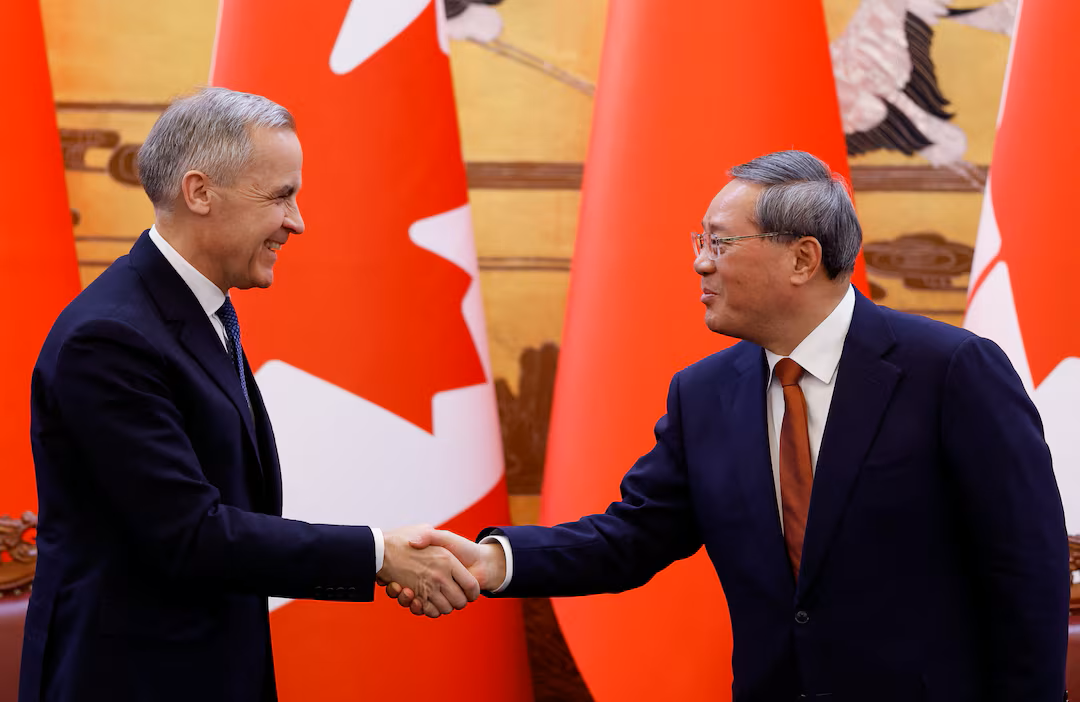
Canada has just signed what many are calling a landmark trade agreement with China, after a meeting between Prime Minister Mark Carney and Chinese President Xi Jinping. The meeting was the first between the two countries in nearly a decade.
The resulting trade agreement has come with mixed reactions internally as Canada navigates a shifting global political landscape, primarily driven by uncertainty from U.S. President Donald Trump.
For the past few months, Canadian canola exports have faced a near 100 per cent tariff placed by the Chinese government in response to Canada’s 100 per cent tariff on Chinese electric vehicles (EVs) in 2024.
The move to place tariffs on Chinese EVs was made in lockstep with the previous U.S. government under President Joe Biden as a bid to slow the growing global dominance of the Chinese EV auto-sector, which, as of writing, has surpassed the U.S. company Tesla in the global EV market through units sold.
Critics of China’s EV auto-sector have expressed that the influx of government subsidies the Chinese government has given to its auto-sector has made market competition unfair. These subsidies make Chinese vehicles amongst the most affordable vehicles in the world for their specs, which often forces other manufacturers to create cheaper vehicles to compete in markets open to Chinese vehicles.
From a Canadian labour standpoint, concern over allowing Chinese EVs into the country has centered around job loss. The cheaper vehicles are believed to shake up Ontario’s domestic auto-manufacturers.
Premier Doug Ford has called the move a “self-inflicted wound to an already injured Canadian auto industry.” Ford called on the Prime Minister to “fix this mess” by “ending the electric vehicle mandate, harmonizing regulations with key trading partners and scrapping federal fees that do nothing but add thousands to the cost of making vehicles and chase away investments.”
However, some have noted that the quote system being employed with Chinese EVs is similar to the approach used with Japanese vehicle manufactures in the 1980s, which eventually provided the federal government with the leverage to push for Canadian factories.
Even if Chinese auto factories were opened in Canada, the level of automation employed in these factories translates to relatively few new jobs created compared to more conventional auto manufacturing.
Nevertheless, Canadian auto-manufacturing continues to be in trouble as the U.S. pushes to end economic ties with Canada.
The auto-sector in Canada had a recorded direct employment number of around 125,000 as of the last reported from 2022.
The current focus for the federal government remained on the canola tariffs and Chinas current agricultural tariffs — currently sitting at around 25 per cent — on Canadian pork and seafood products.
These tariffs resulted in a pause in canola exports from farmers in the prairie provinces, with Saskatchewan among the hardest hit.
In March of 2025, the prime minister briefly met with President Xi in Korea for around 40 minutes to briefly discuss the tariff situation, which led to the Prime Minister securing the formal meeting with the President in Beijing that took place on Jan. 16, 2026.
During the past few weeks, both the U.S. President and U.S. Ambassador to Canada expressed a lack of need to trade with Canada. President Trump stated “we don’t need their products. We don’t need cars made in Canada, we don’t need cars made in Mexico, we want to make them here,” when asked about the U.S.-Mexico-Canada trade agreement.
In addition, the U.S. Ambassador to Canada stated that the U.S. “does not need Canada” during his visit to Montreal.
Prime Minister Mark Carney’s visit to China — apart from being the first visit since 2017 — marks a shift in Canadian foreign policy, as over the last decade, China has been regarded as a hostile state that is not to be trusted.
However, the shifting world order from the once dominant United States centred liberal democratic trade — not to be confused with political liberalism, but instead economic liberalism — to a more pragmatic reality has been described by Carney as marking a shift in China’s political position in relation to Canada.
The world order was the rules, norms and institutions that the world began to adhere to following the resolution of the Second World War.
The world order has been described as rules based and adhered to the liberal democratic order that valued trade, sovereignty, the rule of law and individual freedom. This was established by the U.S. and its allies to prevent the same chaos that resulted from World War II.
That world order has largely been declared dead by experts in international relations following the unilateral invasion of Venezuela and removal of Venezuelan President Nicolas Maduro, an event which was quickly followed by the U.S. decision to withdraw funding from 66 international organizations.
While the phrase “new world order” is associated with a conspiracy theory in terms of the reality of international relations, in this case, it is in reference to the actual rapid changes occurring with the world order.
In his speech at the World Economic Forum in Davos Switzerland, Prime Minister Carney further elaborated on the structure and state of the now “ruptured” world order and what this meant for nations like Canada.
In trade negotiations with China, Prime Minister Carney secured a reduction in canola seed tariffs to 15 per cent by March 1 and a removal of tariffs on peas and seafood from March 1 to the end of the year. However, no changes were made on the 25 per cent tariff on pork or the 100 per cent tariff on canola oil.
In exchange, Carney lowered tariffs on 49,000 Chinese EV imports to 6.1 per cent from 100 per cent in 2024, with a mandate that half of the imported vehicles must cost less than $35,000 CAD.
The number of vehicles allowed under lower tariffs represents around three per cent of the market for new vehicles sold in Canada.
The Prime Minister stated that his government expects the move to drive Chinese investment in Canada to “protect and create new auto-manufacturing careers for Canadian workers and ensure a robust build-out of Canada’s EV supply chain.”
The trade deal is also expected to increase Canadian exports to China by 50 per cent by 2030, with both nations reaffirming support of multilateralism and pledging to explore further opportunities for cultural exchange.
The move has been labelled as the dawning of strategic realism that signals a departure from the previous Canadian trade policy that simply followed U.S. trade policy.
In addition to EVs, the Prime Minister has opened the door to visa-free travel to China for Canadians.
Both governments took the time to discuss the ongoing tensions in the arctic over President Trump’s stated desire to annex Greenland, with the Prime Minister stating that he found “much alignment” with Chinese President Xi Jinping over the threat.