

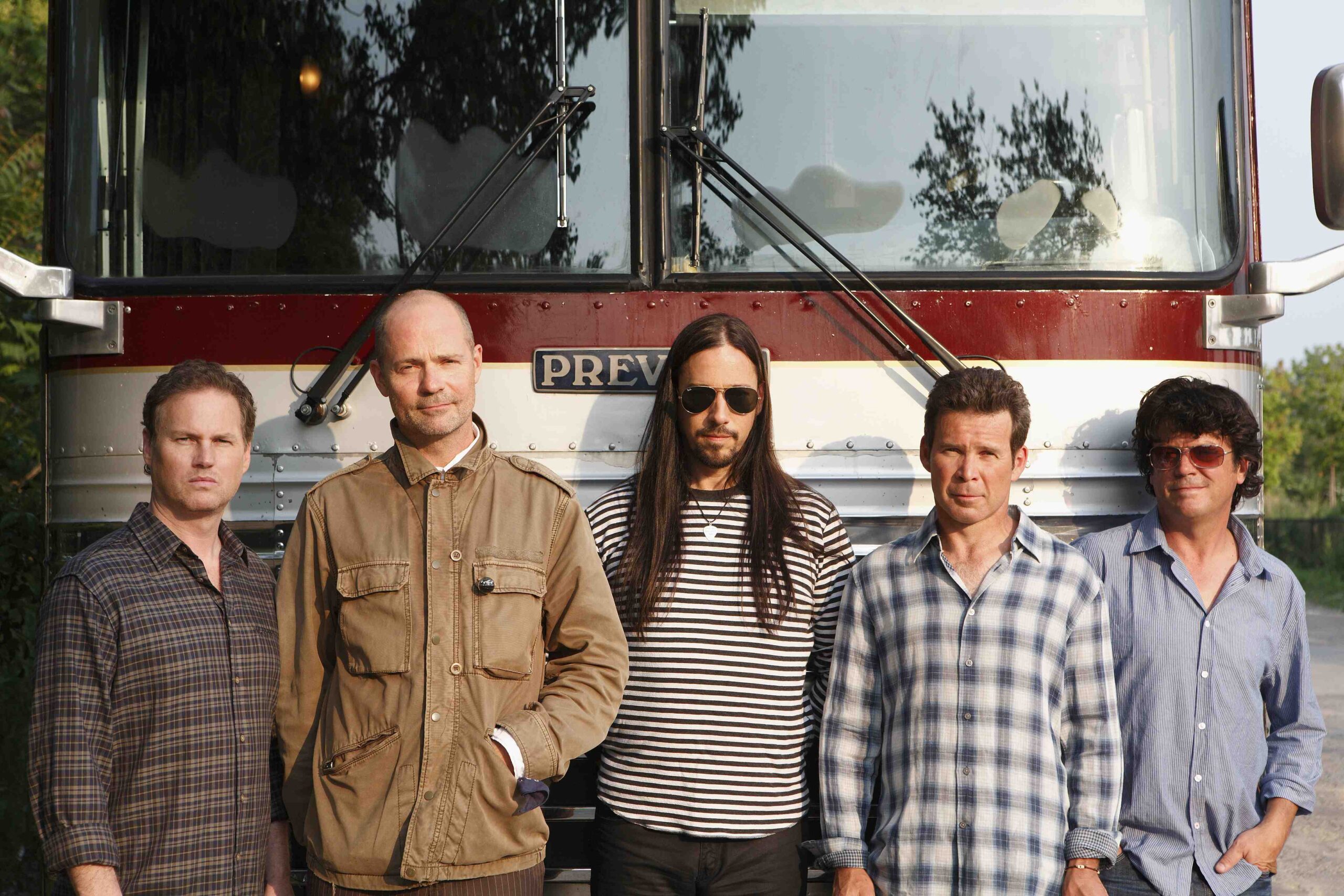
On August 20, 2016, something rare happened in Canada: the country simply stopped. Streets emptied, bars filled and living rooms glowed blue with the light of televisions tuned to the CBC. From coast to coast, Canadians gathered to watch the final performance of The Tragically Hip, broadcasted live from the K-Rock Centre in their hometown of Kingston, Ontario. As frontman Gord Downie sang through visible pain, delivering lyrics that had shaped generations, it felt less like a concert and more like a collective act of listening.
For two and a half hours, Canada mourned, celebrated and said goodbye — together.
The Tragically Hip was never just another successful rock band. Over more than three decades, they became something uniquely Canadian: cultural storytellers, national touchstones and a quiet constant in a rapidly changing country. Their music chronicled small towns and big ideas, blending hockey lore with historical injustice, intimacy with abstraction. To understand the Tragically Hip is to understand something fundamental about how Canadians see themselves.
The Tragically Hip formed in 1984 in Kingston, Ontario, a city defined as much by its limestone architecture as by its proximity to Lake Ontario and the Thousand Islands. The original lineup of Gord Downie, Rob Baker, Paul Langlois, Johnny Fay and Gord Sinclair came together through shared friendships and a mutual love for live performance. Early on, the band built a reputation through relentless touring, particularly around Queen’s University and their local bar circuit.
Kingston itself played a crucial role in shaping the band’s identity. Unlike Toronto or Montreal, Kingston sits slightly outside of Canada’s major cultural centres, allowing the Hip to develop without the pressures of trend-chasing or commercial reinvention. The city’s working-class sensibility and strong sense of local pride mirrored the band’s eventual relationship with their audience. They were never distant rock stars; they were familiar figures, returning home between tours, grounding their success in a place that never stopped feeling like home. This connection to place echoed throughout their music, reinforcing the idea that Canadian stories — no matter how small or specific — were worth telling.
Their self-titled EP released in 1987 hinted at their potential but did not immediately distinguish them from other late-1980s rock acts. What did set them apart, even then, was Downie’s presence. Onstage, he was unpredictable and intense, delivering lyrics that felt improvised yet deliberate, often reshaping songs mid-performance. This rawness quickly became central to the band’s identity.
The Tragically Hip’s breakthrough came with Up to Here in 1989, followed by Road Apples — my personal favourite — in 1991. Songs like “Blow at High Dough,” “New Orleans Is Sinking” and “Little Bones” — the best from Road Apples — became staples of Canadian radio, propelled by the band’s growing reputation as a must-see live act. While many Canadian bands of the era sought validation through the American market, the Hip’s success remained largely domestic — something often framed as a limitation, but one that ultimately strengthened their legacy.
Despite their dominance in Canada, the Tragically Hip’s limited success in the U.S. has often been misinterpreted as a failure to “break through.” In reality, the band made a deliberate choice not to compromise their identity for broader appeal. American audiences unfamiliar with Canadian references, history or geography often missed the emotional core of the Hip’s music. Rather than rewrite themselves for accessibility, the band trusted that authenticity mattered more than expansion. This decision positioned them as a uniquely national act, one whose success could not be measured by international charts alone but by cultural resonance at home.
Rather than dilute their sound or references to appeal a broader audience, the Hip leaned into their specificity. They sang about places Canadians recognized, histories they had learned and emotions that felt familiar. This decision helped cement a deep, enduring relationship with their audience. The Tragically Hip was not chasing global fame; they were building something in their community.
The heart of the Tragically Hip’s impact was Gord Downie’s approach to songwriting. His lyrics were rarely straightforward. Instead, they were elliptical, poetic and layered with meaning. Songs like “Wheat Kings,” which recounts the wrongful conviction of David Milgaard, and “Fifty Mission Cap,” which references the death of Toronto Maple Leaf’s defenceman Bill Barilko, blur the line between history and myth.
Downie’s lyricism also reflected a deep curiosity about power, justice and memory. His songs frequently revisited moments where systems failed individuals, whether through wrongful convictions, colonial violence or quiet acts of erasure. Unlike protest music that demands attention, Downie’s writing asked listeners to sit with discomfort. By embedding these themes within rock songs rather than over political statements, he made difficult histories accessible without simplifying them. In doing so, the Tragically Hip helped normalize conversations about Canada’s past that had long been overlooked or ignored.
Downie resisted easy explanations of his work, often allowing listeners to find their own meanings. This openness invited engagement, turning songs into shared cultural texts rather than fixed narratives. “Bobcaygeon,” one of, if not the band’s most beloved track that I often have on repeat, exemplifies this quality. With its references to the 1992 Yonge Street Riot “that night in Toronto,” the song evokes a sense of quiet reflection and emotional distance without ever spelling out its message.
Musically, the band balanced accessibility with experimentation. Albums like Fully Completely (1992), Day for Night (1994) and Phantom Power (1998) showcased a group willing to evolve without abandoning its core identity. The Tragically Hip grew older alongside their audience, their music maturing rather than chasing trends.
The band’s live performances further distinguished them from their peers. No two shows were ever quite the same, largely due to Downie’s improvisational instincts. He often altered lyrics, added spoken-word passages or interacted unpredictably with the crowd. These moments transformed concerts into shared, fleeting experiences rather than polished reproductions of studio recordings. Fans didn’t just attend a Tragically Hip show to hear familiar songs; they came to experience a moment that was truly one-of-a-kind. This emphasis on presence over perfection helped forge an unusually intimate bond between the band and its audience.
By the mid-1990s, the Tragically Hip had reached a creative and commercial peak. They were headlining arenas, winning Juno Awards and releasing albums that consistently debuted at number one in Canada. Despite their success, they never became complacent. Later records, such as In Violet Light in 2002 and World Container in 2006, reflected a band unafraid to challenge listeners, even as mainstream attention shifted elsewhere.
Their longevity was unusual in an industry that often prioritizes reinvention or spectacle. Instead, the Hip relied on consistency, craftsmanship and trust in their audience. They were a band that assumed their listeners were paying attention — and they rewarded them for it.
In 2015, the Tragically Hip announced that Gord Downie had been diagnosed with terminal brain cancer. The news reframed the band’s future overnight. During their final tour in support of Man Machine Poem in 2016, each performance carried enormous emotional weight.
The farewell tour became a national event, culminating in the final Kingston show that was watched by an estimated 11.7 million Canadians. The Canadian Prime Minister at the time, Justin Trudeau, was among those in attendance. As Downie sang, stumbling yet defiant, the performance transcended music. It was an act of resilience, vulnerability and communal grief.
Gord Downie passed away in October 2017. In the years since, the remaining members of the Tragically Hip have made it clear that the band will not continue without him. The decision reinforced the sense that the Hip were never just a brand or a catalogue, but a specific group of people, bound together by trust and time.
Following the death of Gord Downie, attention turned to his broader legacy, particularly his advocacy for Indigenous reconciliation. His solo work, including Secret Path, brought national attention to the story of Chanie Wenjack and the ongoing impact of residential schools. This commitment further solidified Downie’s role not just as a musician, but as a public intellectual and moral voice.
In the years following Downie’s death, the Tragically Hip’s absence has been felt as much as their presence once was. While tribute concerts, re-releases and documentaries have kept their story alive, there has been a noticeable gap in Canadian music where the Hip once stood. Few bands have stepped into that role, not because of a lack of talent, but because cultural timing cannot be replicated. The Tragically Hip emerged at a moment when Canada was still searching for a confident musical voice of its own, and they filled that space almost by accident — simply by being themselves.
Today, the Tragically Hip remain omnipresent in Canadian culture. Their songs still dominate classic rock radio, appear on playlists curated by younger listeners and serve as a shorthand for shared experiences. They are referenced at hockey games, political events and memorials. Few bands achieve that level of integration into national life.
The Tragically Hip endure because they captured something essential without ever trying to define it. Their music reflects a Canada that is introspective, flawed and quietly resilient. They sang about loss without despair, pride without arrogance and identity without certainty.
In “Bobcaygeon,” and everywhere else, we listened — and we still do. Not because the Tragically Hip told us who we were, but because they trusted us to listen closely and figure it out ourselves.