

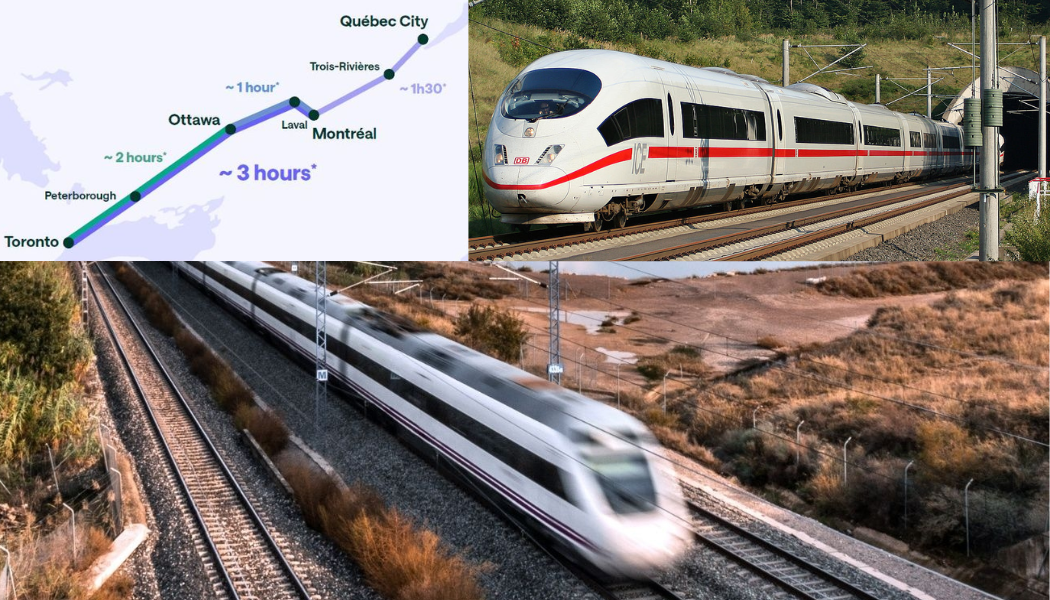
The Alto project is the latest iteration of a long history of Canada attempting to build high-speed rail in its densest and most populated region: the Windsor to Québec City corridor.
Announced in early 2025 by the Trudeau government, the Alto project is an evolution of the proposed VIA Rail High Frequency Rail (HFR) project. Both projects originate out of a desire to address transportation needs in the densely populated corridor, which would have the noted benefits of reducing carbon emissions, unlocking housing and general economic development.
Alto is currently being developed by a consortium of private companies, including Air Canada, AtkinsRéalis, CDPQ Infra, Keolis, SYSTRA and SNCF Voyageurs called Cadence. All of these have partnered with Alto, a newly formed Crown corporation.
Alto explains that it is currently in “the development and pre-construction phase,” which involves public consultations and field studies in regard to both environmental impact and ideal route alignment.
The Carney government has implemented new legislation aimed at fast-tracking the construction of the project, as it is in consideration for being declared as “nation building” in the next phase of projects that the government has planned to undertake.
The Alto project specifies a high-speed rail line capable of speeds of roughly 300 km/h or more on an electrified and dedicated rail that would span about 1,000 kilometres. The project is situated within the optimal business and use case for high-speed rail as is currently understood.
As of writing, Alto has announced that the first segment of construction will be the connection between Ottawa and Montreal, though commenters have noted that details are missing.
Specifics are not known about the potential alignments for Alto as it enters both Ottawa and Montreal. It is unclear whether tunneling or elevated guideways are the preferred routing options, and if the trains will even reach the downtown sectors of either city.
As for why this segment was selected, apart from being significantly shorter than Toronto to Ottawa, transit journalist Reece Martin noted that the politics of the project explain that Ottawa to Montreal means the first segment is a rough split between Ontario and Québec, which would garner political support from the Québec government.
This logic, according to Martin, appears to have been implemented in the whole project. The route extending to Trois-Rivers and Québec City in the first phase proposal appears to be politically motivated, seeking to balance the length of the project evenly between the two provinces, as opposed to a ridership-and practicality-focused route that would have extended further into Southern Ontario, or simply just Toronto-Ottawa-Montreal.
With alignments, the Ottawa station proposal has been widely discussed with the old downtown railway station on Rideau Street, which is currently hosting the Canadian Senate coming into consideration as a potential host for Alto.
The downtown station option has garnered some political support with Mayor Mark Sutcliffe expressing support for a downtown train station.
The current proposed route for Alto avoids running along the lakeshore, bypassing the lakeshore cities that are current customers of Via Rail.
The two proposed alignments are a northern route and a southern route that both run through Peterborough.
The Southern Route has concerns in regard to the Frontenac Arc Biosphere Region, as it would run directly through the ecologically sensitive region. However, it is under consideration because it would avoid the more rugged terrain of the northern route.
Cities like Kingston, however, have been looking to be included in the Alto Project as the current route skips the lakeshore cities.
The Alto project remains in the design phase as various voices are being heard and a tentative first segment has been announced.