

For the most approachable of the EGOT award shows, the Grammys have failed to maintain their prestige.
From constant snubs and industry-planted nominations to eyebrow-raising wins and persistent underrepresentation, it seems that the Grammys’ reputation declines year after year. Artists aren’t vying to capture the approval of voters and listeners don’t seem to recognize a Grammy as the cultural milestone it once was.
Going into the 2026 Grammys, much of the same discourse followed. Categories overcrowded with social media famous artists, major pop acts oversaturated nominations and many outcomes appeared predetermined before the ceremony even began.
These criticisms aren’t anything new. While award show viewership is declining across the board, the Grammys have been hit particularly hard. In the last 10 years, viewership has dropped from 24.95 million to 14.4 million — a major decline for what is still billed as music’s biggest night.
This year, the Grammys featured 96 award categories, which is two more than the previous year. Like the Emmys, most of these awards were handed out during the preshow telecast, leaving the three-hour main broadcast left to present the general field categories and a select few others.
Truthfully, the Grammys main show has become less about the awards and more about the spectacle, celebrities, performances and publicity. This year’s Grammys were particularly poignant, political and forward thinking, offering a glimpse into where the music industry, and its artists, see themselves heading.
Beginning on the red carpet, artists didn’t shy away from making statements on the current events taking place in Minnesota and the complicated political climate in the United States. Many attendees were spotted proudly wearing “ICE OUT” pins, setting the tone for the evening before the broadcast even began.
Inside the Crypto.com Arena, politics took center stage in the speeches and overall tone of the evening.
Host Trevor Noah, who returned to the Grammys for his sixth and final time, began his final show with a comment about Jeff Bezos’ wedding before drawing attention to a notable absence from the crowd: past performer and nominee Nicki Minaj. This comment gained a round of applause due to her recent vocal support of President Donald Trump.
If this was Noah’s final year hosting music’s biggest night, he made sure to leave a mark. Most notably, he pulled no punches in his takedown of President Trump, quipping:
“Song of the Year — that is a Grammy that every artist wants almost as much as Trump wants Greenland, which makes sense because Epstein’s island is gone, he needs a new one to hang out with Bill Clinton.”
In the days following the ceremony, Trump threatened to sue Noah over his remarks.
Award winners also took time in their speeches to make statements against ICE and the current administration. In accepting her award for Song of the Year, Billie Eilish said, “as grateful as I feel, I honestly don’t feel like I need to say anything but that … no one is illegal on stolen land,” Eilish continued, “and f**k ICE.”
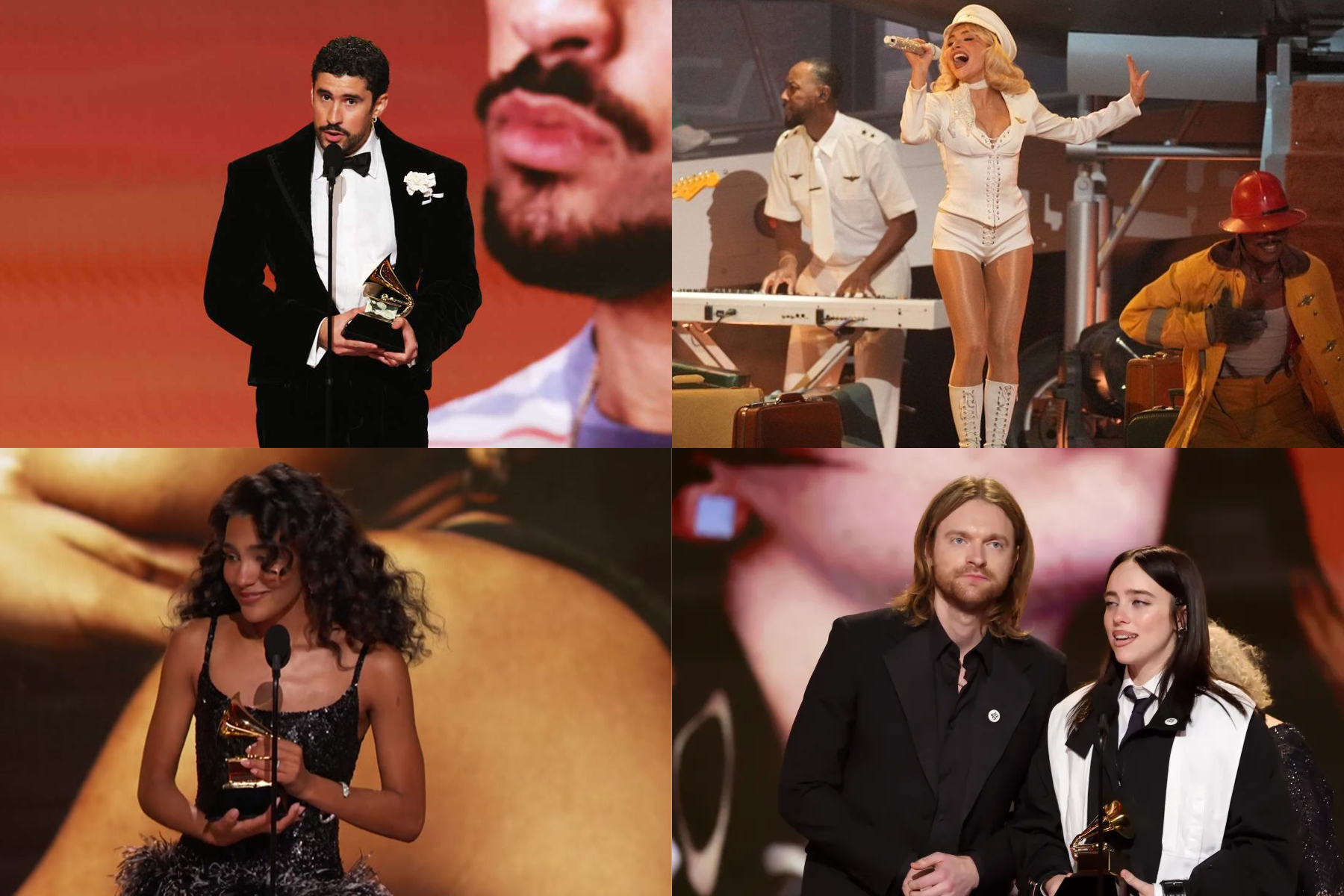
The night’s biggest award, Album of the Year, went to Bad Bunny for Debí Tirar Más Fotos (I Should Have Taken More Photos). The win marked the first time a Spanish-language album has received the Academy’s top honour. Bad Bunny began his speech declaring “Before I say thanks to God, I’m gonna say: ICE out!” He continued, “We’re not savage, we’re not animals, we’re not aliens. […] We are humans and we are Americans.”
Other notable awards of the evening include Best Pop Solo Performance, which went to Lola Young for her TikTok famous song “Messy.” Lady Gaga walked away with Best Pop vocal album for Mayhem and Best Pop Dance Recording for her single “Abracadabra.”
Kendrick Lamar emerged as the most awarded artist of the ceremony, taking home five Grammys, including Record of the Year and Best Melodic Rap Performance for “Luther,” Best Rap Album for GNX, Best Rap Performance for his feature on Clipse’s “Chains & Whips” and Best Rap Song for “TV Off.” With these wins, Lamar became the most decorated rap artist in Grammy history, bringing his total to 27 awards.
One of the night’s most anticipated awards, Best New Artist, is also one of the Academy’s strangest. The only category an artist can be nominated for just once, it attempts to reward proven artistry while simultaneously telling the world that the winner is “the one to watch.”
This year’s category was crowded with internet era names, including Sombr, Lola Young, Leon Thomas, Addison Rae, KATSEYE, Alex Warren, Olivia Dean and The Marías.
In the days leading up to the ceremony, predictions favoured Olivia Dean. Fresh off the release of her second album, The Art of Loving, Dean has positioned herself as the voice of a modern revival of 70s-inspired, jazz-rooted soul music. Her win not only extended the nine-year streak of a woman winning the award but served as a quiet acknowledgment that the Recording Academy still values artistry over viral popularity.
Increasingly, the Grammys have become an artist showcase rather than a traditional award show. As Trevor Noah noted in his opening monologue, the ceremony serves as a front row seat to the best show money can’t buy.
Tyler, The Creator preformed a five-minute medley of his two albums Chromakopia and DON’T TAP THE GLASS. The performance was packed with energy, featuring thoughtful set design and a vivid concept that carried through every moment of the set.
Each year the ceremony gives each of the best new artist contenders their moment to shine. While Alex Warren, Lola Young and Sombr left something to be desired, Olivia Dean delivered an electrifying performance of her hit single “Man I Need.”
Addison Rae kicked off her performance of “Fame Is a Gun” inside the Crypto.com Arena. Riding in on the back of a transport truck while wearing a purple sequin coat, Rae later revealed a matching sequin skirt and bikini before transitioning into a Britney Spears-esque dance break. Immediately following Rae, global pop group KATSEYE performed their hit “Gnarly,” delivering a high-energy, dance-driven set that solidified their ability to captivate an entire arena.
Lady Gaga returned to the Grammy stage for the second year in a row, performing her award-winning song “Abracadabra.” The ceremony also welcomed Zara Larsson, who delivered a vocal powerhouse acoustic rendition of her summer hit “Midnight Sun.”
Other notable performances included Justin Bieber’s stripped-down rendition of “Yukon,” showcasing his live vocals, and Sabrina Carpenter’s high-budget, high-energy performance of “Manchild.”
Taken together, this year’s Grammys — however thought-provoking or high production they were — still feel like a ceremony searching for its footing. Despite the award show offering its viewers moments of genuine artistry and cultural relevance, the Grammys continue to struggle with declining viewership as music consumption is increasingly fragmented in the age of streaming. The industry no longer moves as a monoculture, yet the Grammys remain structured as though it does.
While the 2026 ceremony succeeded as a showcase for emerging talent and offered artists a platform to speak on political and social issues, it remains unclear whether that alone is enough to sustain music’s biggest night. Their continued reliance on traditional network television further deepens that uncertainty. Limiting accessibility for the audiences the academy is dependent on.
Next year marks a pivotal shift. This year’s 68th Grammy awards will be the final ceremony broadcasted on CBS. In 2027, ABC and Disney+ will take over in broadcasting and streaming the award show. This change presents an opportunity to reimagine the Grammys for a modern global audience — whether the recording academy can translate this renewed visibility into renewed relevance remains unclear.
As music continues to evolve into something more niche, more personalized and less centralized, the question is no longer whether the Grammys can reclaim their former dominance in the industry. It’s whether they still offer audience anything meaningful beyond performance and spectacle.