

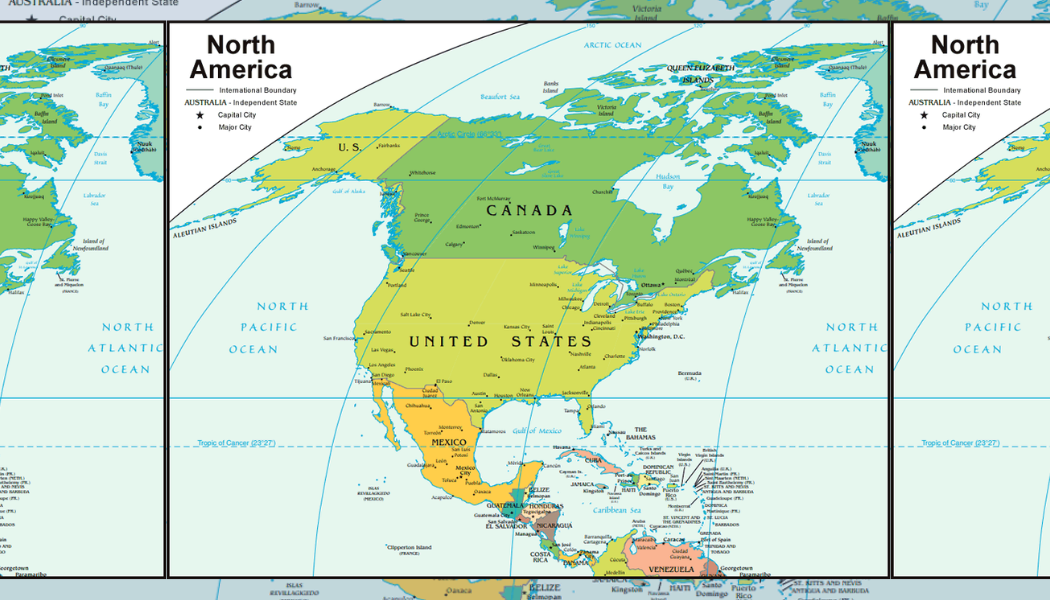
The Canada, United States and Mexico free trade agreement (CUSMA) is set to be under review this year and awaits a potential extension on July 1, amidst the ongoing global trade upset occurring under President Donald Trump.
CUSMA governs the world’s largest free trade zones and has served to protect Canadian and Mexican trade from many tariff effects from Trump’s global trade war.
Most goods from Canada and Mexico are CUSMA compliant. Trump’s tariffs only apply to non-CUSMA compliant goods, as the powers he uses to unilaterally implement tariffs originate from the International Emergency Economic Powers Act (IEEPA).
The IEEPA allows the President of the United States to regulate international trade in response to a declared national emergency involving an “extraordinary threat to the United States.”
While a recent United States Supreme Court decision, Learning Resources, Inc. v. Trump, determined that the IEEPA does not allow a President to unilaterally set tariffs, Trump has bashed the decision and implemented an extra 10 per cent global tariff in retaliation.
Trump originally pushed for the renegotiation of NAFTA during his first presidency in 2016, resulting in the current CUSMA agreement. He has since become a large critic of CUSMA, stating that the deal has been transitional.
Trump has gone as far as to consider dropping the trade agreement altogether.
As for what the United States might negotiate in regards to Canada, Topics such as the U.S. alcohol bans that several Canadian provinces implemented in early 2025 as a response to the original tariffs; access to the Canadian dairy market for U.S. product; and the removal of what the U.S claims to be “discriminatory procurement practices” in Ontario, Québec and British Columbia may be of interest for the U.S.
In addition, vehicle manufacturing and forestry are expected to come up in trade negotiations. CUSMA in particular has been noted as a critical component for expanding Japanese vehicle manufacturing in Canada.
In the period of time preceding CUSMA review, the Carney government has been pursuing a trade diversification policy that seeks to double non-U.S. exports and expand Canada’s global trade over the next decade.
So, what negotiating power does Canada have with CUSMA?
Critical minerals have been described as an “ace” for Canada. The country possesses reserves for all 12 defense critical minerals identified by NATO. Additionally, Canada could play a significant role in diversifying the critical mineral trade from its current, near full, Chinese control.
China currently controls nearly 90 per cent of the critical mineral market, from mining to refinement and processing.
Additionally, the aggressive push for constructing A.I. data centres in the United States has been positioned Canada to provide the energy needed to power those data centres.
On the other hand, Trump’s sector specific tariffs on metals such as steel, aluminum and copper have done real harm to Canadian industry as these products do not fall under the CUSMA agreement.
The future of business will be at the top of Canadians’ minds as CUSMA undergoes review.