

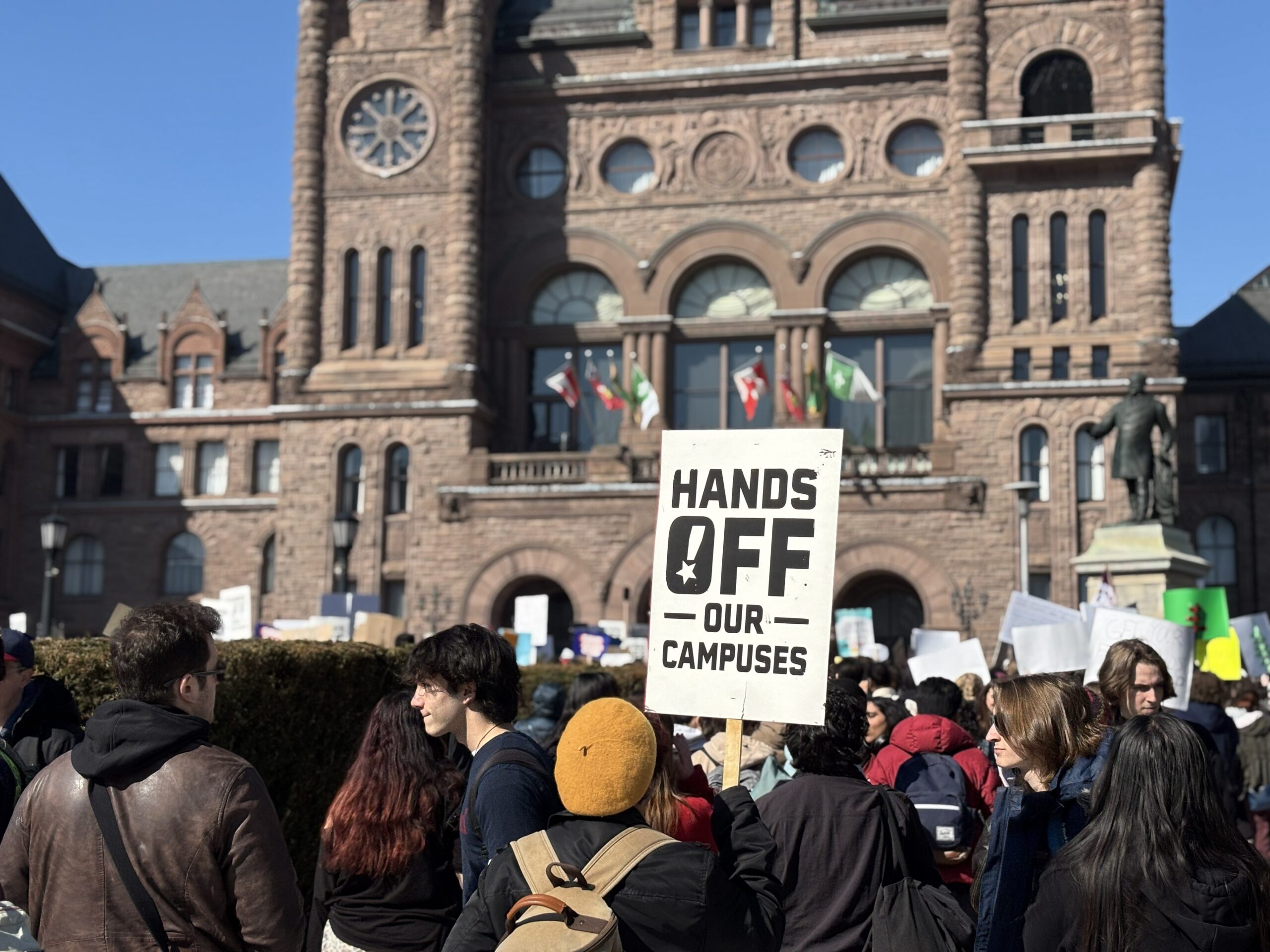
More than 4000 people came marching down to Queen’s Park on March 4 to participate in the “Hands Off Our Education Rally,” organized by the Canadian Federation of Students Ontario (CFSO). The first few hours of the rally remained peaceful, up until a few people vandalized the statue of George Brown in front of the Legislative building, authorizing multiple officers to enter the rally. Most of the people doing this left before law enforcement could reach them, but one individual stayed to write “Fuck Ford” on the statue with red spray paint.
This led to multiple officers tackling the individual into the mud, and as one video shows, three officers forced the individual onto the ground as they made their arrest. Zaid, a political content creator who observed the incident, said that after the officers tackled this individual, the officers were surrounded by participants and began to assert aggressive force onto those surrounding them.
In an interview with The Brock Press, Zaid noted that “the real egregious part in my mind though, is the way that a few, not all, but a few, of the officers were using force.” Zaid highlighted that while most of the officers were “able to maintain their demeanor” and “stay calm in the face of a heightened situation,” this was overshadowed by the officers who “could not handle being yelled at; could not handle what this job requires,” which resulted in “pushing and being aggressive in a way the police shouldn’t be.”
In the aftermath of the rally, videos circulating on social media attested to Zaid’s statement. One video shows an officer intentionally shoving protesters as they walk past, and aggressively pushing back one individual who followed after the officer asking “what the hell?” Another video shows an officer intentionally winding up and hitting a protester in the head with a skateboard.
The second of the two arrests was also caught on video and was later reported to be due to an individual allegedly spitting on an officer.
On March 5, the CFSO posted a statement on Instagram regarding the police violence at the rally, announcing that both arrestees have since been released and that “the Federation confirms that no student will ever be left behind, and that we keep us safe.”
In an interview with The Brock Press, CFSO’s National Executive Representative, Omar Mousa, stated “Students have the right to protest. The students are angry and upset and validly so. We are living through a cost-of-living crisis, and the government has announced even more barriers with regards to accessing education.”
Prior to the escalation, the rally remained peaceful. Momentum began with students from St. Michael’s College marching down the Toronto streets from their college to Queen’s Park around 11:30 a.m., chanting “when education is under attack, what do we do? Unite and fight back!” This set the tone for the protest, as CFSO staff members began leading the chants through their megaphones and drums. By 12:30 p.m., many organizations, including ONA, OSSTF, Students and Workers United, CUPE, students, volunteers and community members had arrived at Queen’s Park, ready for their day of action.
To officially begin the rally, Cyrielle Ngeleka, Chairperson for the Canadian Federation of Students Ontario (CFSO), entered the stage asking, “are we ready to fight back today? Are we ready to say, ‘hands off our education?’ Are we ready to say, ‘hands off our OSAP?’”
Ngeleka continued, saying that, “we know that students have power, and today we here in numbers to show exactly what kind of powers we have.
Mousa joined Ngeleka on stage, saying, “we are distraught, but we are not willing to settle for the conditions that this government has manufactured, […] from Bill 33 to the scapegoating of international students to the decades of chronic underfunding of our education. The reality is abundantly clear: public education in Ontario is under attack.”
The “hands off our education” campaign was a direct response to the introduction of Bill 33 in May 2025. The Bill received Royal Assent in November 2025, granting the provincial government to “require publicly assisted universities and colleges to publish admission criteria and access applicants on merit, authorize new regulations on admissions and student fees and require institutions to develop research security plans subject to ministerial directives.”
In the past four months under Bill 33, seven different school boards have been taken over by the Ontario government’s Ministry of Education.
Matias de Dovitiis, elected Trustee of the currently suspended Toronto District School Board, was in attendance at the protest and stated, “we share a lot of things in common with a lot of students that are angry right here […] I feel that our voice has been silenced and that this government is taking resources from education. As schools get more expensive, there’s less resources, there’s less teachers, there’s less professors, there’s less caring adults to help students and that’s having a really negative impact on the education system and the public system in Ontario.”
Tensions had already been rising due to Bill 33 when Doug Ford’s provincial government announced a new long-term funding model for postsecondary institutions on Feb. 12. This model prioritizes OSAP loans over grants by capping provincial grants at 25 per cent per student and loans to at least 75 per cent per student. This fundamentally restructured OSAP’s grant centric structure, significantly deviating from the prior maximum of 85 per cent grant model.
On the day of the rally, in an interview with The Brock Press, Ngeleka said “Bill 33 […] was an attack on the entirety of the education sector, notably, postsecondary education. They were targeting ancillary fees; they were targeting research security; [and] admission processes.” She continued to say that the recent funding announcement is not an isolated event but connected to Bill 33 and the neglect of education. So, CFSO furthered the “hands off our education” campaign with “renewed demands to meet this political moment.”
Ngeleka states that the CFSO’s hope is “to see that the government reverse course on the decision they made,” citing the Student Choice Initiative (SCI) — which was struck down in December 2019 after CFSO’s legal win. Also in 2019, the Ford government announced changes to post-secondary education including a 10 per cent reduction in tuition fees, freezing tuition and establishing two major changes to OSAP. The first change was to accumulate interest throughout the six-month grace period, such that if loans were not paid by the six-months, the accumulated interest would be applied to the base of loan after the grace period. The second change was reducing the qualification for financial assistance only students from families who earned less than $140,000 a year would qualify — a $35,000 reduction from the previous $175,000.
This progressed to mass program cuts and campus closures, federal government’s cap on international students, Bill 33 receiving Royal Assent in 2025 and the recent restructuring of OSAP along with lifting the tuition freeze — all of which Ngeleka states “goes completely opposite of what students actually want.”
The organizers and attendees of the protest all shared similar sentiments, in that the recent OSAP cuts were essentially the last straw for Ontarians.
While on the stage, Mousa stated, “we cannot talk about the state of education without bringing up international students. For years, governments have allowed our institutions to heavily rely on international students for the massive gaps that our government continues to leave in our education through chronic underfunding.” He continued by saying that “students should never be treated as revenue streams; students should never be used to patch the holes created by lack of government funding.”
This sentiment was further echoed by another member of the CFSO, who said that “cuts to immigrants is not in our interests, they’re in the interest of the people who want to make cuts to education, the people who want to make it more expensive to access healthcare, the people who wanted to profit off of a housing crisis. It’s not international students, it’s not refugees, it’s not undocumented people, it’s not migrants. This is about money to Doug Ford and his millionaire friends.”
They further stated, “it is also Prime Minister Carney’s doing,” saying that Carney “is building a massive deportation machine” through Bill C-2.
“This is more than about tuition; this is more than just public education; this is more than about immigration. This is about the collective vision of the world we want to live in,” said the member.
The cost of living was also a huge contention for many of the attendees, who felt as though the government was gatekeeping education to the wealthy. As Janelle Hines, student from Ontario College of Arts and Design (OCAD), stated, “education is already very expensive and to take away the grant system — which is essentially what he’s doing — makes it even more unaffordable, and I’m just outraged.”
Another student from OCAD, Riley Roche, added, the cuts are “a barrier for education. You can’t make people pay this much money for the rest of their life just because they want to have an education.”
Chris Glover, Spadina’s MPP, member of the Ontario New Democratic Party and former professor at York University, attested to this statement, saying, “what has been happening to students with this cut, [and] previous cuts, [will cause] students to take on decades of debt just to get an education, and it just shouldn’t be that way.” He continued to campaign the Ontario NDP’s policy, saying the party “would convert loans to grants and we would eliminate interest on student debt.”
Ophelia Claire, student at Trent University, brought forth another perspective as they were there “representing the Trent University Native Students Association.” Claire said that “the OSAP cuts are going to disproportionately affect Indigenous students, especially those like me who came off reserve, making less than $10,000 a year, who would not be able to go to university and break generational trauma without the grants given to us by OSAP.”
Mary Connley from Trent University shared their experience as a student living with disabilities:
“I get grants and loans through [OSAP] and I’ve been using it to be able to stay on residence and afford things.” Connley continued to say there were people in her life who “very much rely on OSAP, specifically the grants,” and mentioned her mother “wouldn’t have been able to [go through schooling] without the grants.”
Valentine Hibbert, student at University of Toronto (UofT) and member of UofT’s Communist Revolutionaries, described the OSAP cuts to be “extremely devastating to me as someone who comes from a low-income background.” Hibbert said, “I’m currently in the middle of transitioning to official disabled [student status], so I could reduce my course load while staying full-time.” Hibbert continued to share their experience with OSAP this prior year, saying, “I’ve been told I have the maximum amounts of loans plus grants, which is about $20,000 for a student who lives off campus and works full-time. But that’s literally under the poverty line. I live off campus, I have to pay rent, I have to buy food, I also have to live an enjoyable life, but that can’t happen if the cuts progress.”
Many of the students also discussed Ford’s recent response to the backlash in urging students to stop taking “basket-weaving courses.”
Samuel Rashleigh Torres, student from OCAD and industrial designer, said “I’m kind of intersectional between art and STEM, and I believe that STEM without an artist or designer’s input will not work for anybody because artists and designers, we understand people, STEM understands systems, and systems without a systems designer at the helm or an artist to give work is nothing.”
Mikayla Mifsud, student at McMaster and member of McMaster NDP and McMaster Labour Students Association (LSA), called the cuts an unfair austerity measure:
“Doug Ford claims that people are taking basket weaving course, which is obviously an insult to all sorts of different disciplines and fields and it’s ridiculous […] even if we do take these healthcare courses, engineering courses, STEM courses like he’s urging people to do, the OSAP is still cut whether you’re going into one of these alleged ‘basket weaving’ courses or into STEM courses.”
The roles of student unions were also amplified. Adam Venter, a student at Guelph University, credited the Guelph University Student Union for their support, saying “it’s really nice to have institutional support from the student union to actually progress our goals. Our student union funded two busses to come out here, so we were able to transport 100 students to come here to the rally today.”
Symone Lennon, Vice President of Campaign’s Advocacy at York University mentioned the importance for York University’s Student Union to act after the OSAP cuts were announced, as many students “immediately calling on [us] to do something.” Lennon continued, “this has been a very natural rallying of York students and I think the job of the student union is just to harness the energy and give the tools that [the students] need to properly organize and fight this government so we can win against their cuts that they’re doing.”
Student groups across Ontario have also been organizing in solidarity with Queen’s Park. The Niagara Region saw approximately 100 Brock University students, staff and community members take part in a campus wide protest organized by Brock Young Liberals and Brock NDP. As well, many high school students across Niagara participated in a walkout in protest to OSAP changes.
The CFSO stands firmly that the fight for students and education is far from over, as Ngeleka stated, the rally on March 4 is “only just the beginning; we will not be able to see policy changes without consistent external pressures on the government.” Following the rally was a week of action, then the federation’s goal to preserve and utilize the momentum, to then “come back right here in front of Doug Ford’s footsteps, to say ‘hands off our education,’ again.”
The next rally is set for March 24 at 1:30 p.m., also at Queens Park.