

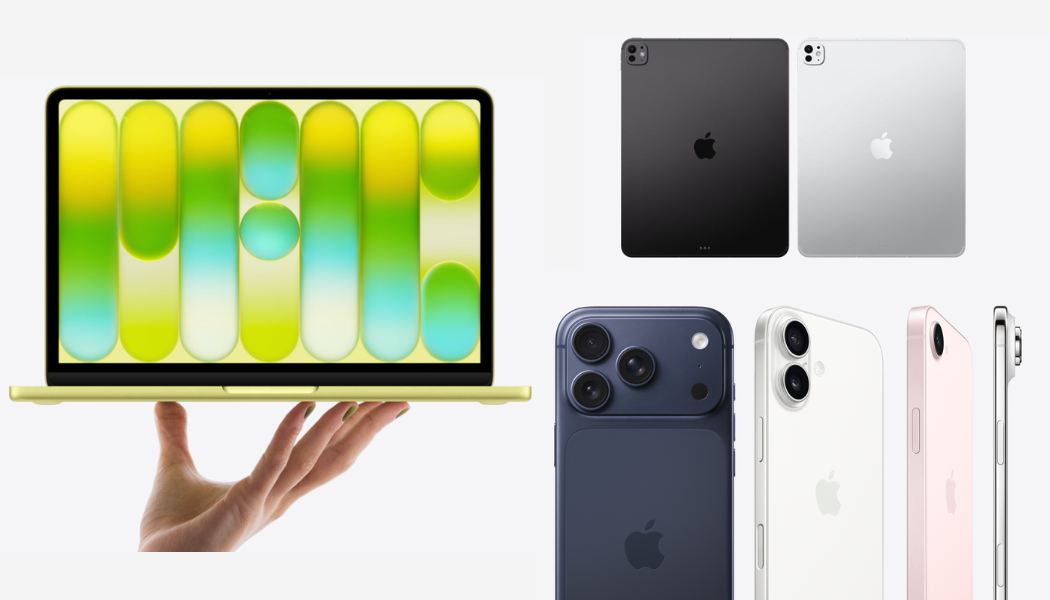
I’m eternally grateful for the technology that gets me through my day. Whether it’s the alarm blaring from my iPhone only to be snoozed a dozen more times; the AirPods that block out the world; the Apple Watch that tracks my sleep, workouts and who knows what other data; the MacBook carrying me through every late-night lab or the iPad that I’ve effectively turned into a very expensive notebook.
In using this tech every day, I’ve concluded that two things are true: My complete dependence on one company’s ecosystem, and that for eight high priced months of the year, my life revolves around the tech I use every day.
I’m not complaining, I’ve worked hard to thoughtfully integrate technology into my everyday life, and I deeply care about each item I use every day. So, earlier this month when Apple dropped flashy new hardware, I had to ask myself, do I actually need any of it?
Somewhere along the way, upgrading stopped meaning progress. Now, it usually means replacing something that already works perfectly.
While I’m not one to overconsume tech, I appreciate upgrading when I’m presented with a reason to. In their week of whisper-quiet press releases, Apple announced a MacBook Air with the new M5 chip which features a faster CPU, GPU, more starting storage at 512GB, Wi-Fi 7 and expanded capabilities for on device intelligence. A day prior, they announced a refreshed variant of the budget iPhone released last year, the iPhone 17e, and a refreshed iPad Air with last year’s M4 chip on board. They also announced new M5 Pro and Max chips to complement their MacBook Pro model laptops.
Truthfully, with how much hype Apple built around this week of drops and innovation, the only thing that made any noise was the new MacBook Neo: a budget ultrabook running on last year’s iPhone chip, the A18 Pro, aimed at a younger market.
The MacBook Neo appears to be a genuine step forward in innovation and calculated risk taking for the company. Sadly, by all comparisons — excluding the colours — it would be a downgrade from my current daily driver. Apple’s newest innovations are happening sideways, which means those with existing Macs are left in a strange limbo: nothing is broken, but there is nothing dramatically better to move to.
Just a week prior at Galaxy Unpacked, Samsung launched their S26 lineup of phones with innovative displays and privacy features that turned heads. If I wasn’t so dependent on my music, fitness, messaging and schooling all being at the hand of one company failing to innovate, the Samsung S26 Ultra with its impressive cameras, privacy display and fresh design wouldn’t just be compelling, it would be an easy choice. It seems Apple is relying on their ecosystem and marginally better performance for everyday tasks to retain their users rather than fulfill them with exciting new launches.
In 2020, when Apple first announced the shift from Intel based processors to their in-house Apple Silicon, it created waves across the industry. Questions of Apple’s performance capabilities and their ability to deliver on their promises swirled across the industry.
In the end, Apple Silicon didn’t just offer a better chipset — it fundamentally shifted what a MacBook could do. While Apple was always favoured by creatives, the transition to M series processors changed how the world viewed the Mac. These M series MacBooks not only came with design refreshes, but light speed performance, endearing battery life and something no one was expecting: a MacBook that could withstand the test of time.
MacBook sales skyrocketed as consumers no longer had to make sacrifices while staying within the ecosystem. Among those sacrifices was the planned obsolescence synonymous with Apple products. Upgrades used to be done out of necessity, but with the absence of throttling or battery degradation and a lack of design changes on the horizon, nothing was driving the upgrade cycle.
Apple created the computers they always wanted to make and, in doing so, they created their strangest problem: what do you sell to consumers who don’t need to upgrade?
Upgrading my iPhone is the one thing that still makes sense to me. Every two years, I’m faced with the decision of turning in my old phone for a new shiny one. Partially exacerbated by predatory financing deals and a market made for degradation-driven consumption, it’s still a decision that makes sense to me.
But even here, upgrades don’t feel like new phones, just the refreshed honeymoon phase of the one I had 24 months prior. So, I have a reason to get the latest phone, but my MacBook doesn’t offer degradation as an excuse to upgrade.
I use my three-year-old M2 MacBook every day, overloading it with Chrome windows, PowerPoints, spreadsheets and YouTube videos. Remarkably, I can’t tell that it’s three years old. I couldn’t say the same when I got my first PC and had it begun to throttle, overheat and constantly need to be charged a year into its life. My Mac is about as good as the day I bought it.
When announcing the refreshed M5 MacBook Air, Apple announced the base model would be shipping at its 2023 price but with four times the storage and more RAM. The latest MacBook Air matches the specs of mine for $1,200 less than what I paid. Pair that with the “leap” Apple claims the M5 offers and the discussion of upgrading becomes a paradox.
I could get the same thing I have, just improved and cheaper. In any other context that answer would be a glowing yes, but here it feels like blind consumerism. Upgrading because it’s cheaper and better feels like a different decision to upgrading because I need to.
My current MacBook runs like it did on day one and I don’t see the capability it offers me fading anytime soon. If I upgrade now, will another laptop come along that offers a better bang for my buck, or will that new M5 Mac last longer than the M2 I have now?
Upgrading has quietly lost its meaning without anyone noticing. As tech giants continue polishing products that are already flawless for the average consumer, the question has shifted from when to upgrade to whether there’s anything worth upgrading to.
For the first time in decades, the smartest tech decision might simply be keeping the machine you already have.