

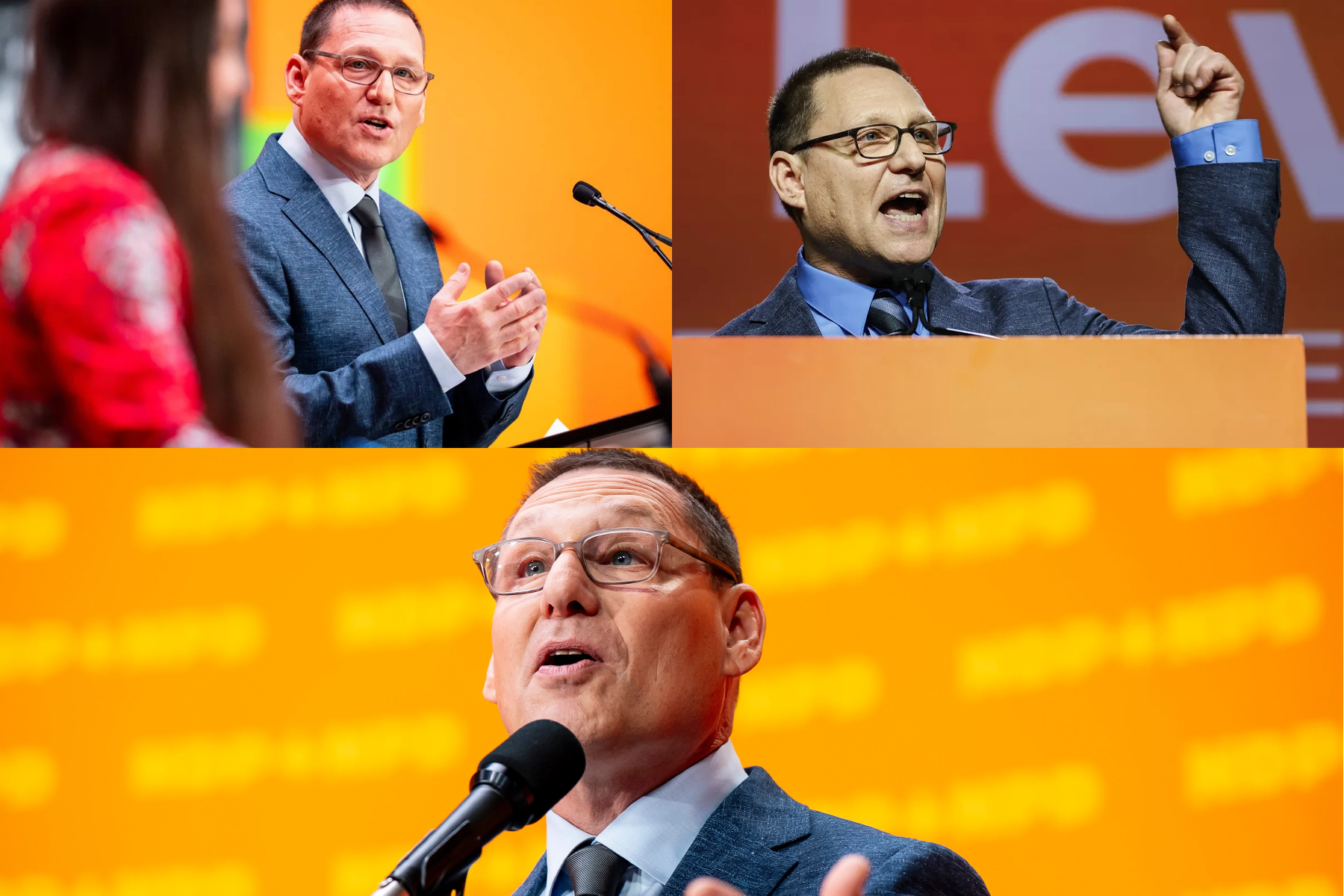
After a month-long leadership race, the federal New Democratic Party (NDP) has selected a new leader: Avi Lewis.
A journalist, documentarian and Associate Professor at the University of British Columbia, Lewis previously ran as the NDP candidate for West Vancouver-Sunshine Coast-Sea to Sky Country in 2021 and Vancouver Centre in 2025.
Lewis takes leadership of the party following a difficult period for the federal NDP. After the April 2025 federal election, the party — which held 24 seats prior to the dissolution of Parliament — was reduced to six seats. The losses included the riding of then-leader Jagmeet Singh, leaving the party without official status and an interim leader, Don Davies, in the House of Commons.
The leadership process formally began Sept. 2, with voting beginning on March 9 and culminating on the final day of the NDP convention on March 28. Leading into the convention, Lewis was widely viewed as the frontrunner, having raised more than double the fundraising of his closest competitor and significantly higher member endorsements.
Lewis won in the first round under the party’s ranked choice voting system, capturing 56 per cent of the vote. The race recorded the highest turnout and largest margin of victory in an NDP leadership race under the one-member, one-vote system. Speaking on CBC’s Power & Politics, Lewis described his victory as “the largest mandate an NDP leader has ever had.”
His campaign focused on rebuilding the party and redefining its political direction through broader populist messaging and economic reform proposals. In his acceptance speech, Lewis said that the NDP would work toward building “a government that works for the many and not the money.”
His platform includes a tax plan targeting high-income earners, including the creation of a new top tax bracket and taxing capital gains at the same rate as employment income. His platform also emphasized ending corporate subsidies and fossil-fuel supports, alongside stronger anti-monopoly messaging.
Housing policy formed a central pillar of Lewis’s campaign, including proposals for national rent caps, expanded tenant protections, construction of one million public housing units and policies aimed at ending homelessness. The campaign also promoted an expansion of public alternatives, including subsidized grocery stores, publicly owned telecommunications providers, pharmaceutical manufacturing and postal banking services.
Drawing on a 2019 documentary short collaboration with U.S. Congresswoman Alexandria Ocasio-Cortez, Lewis also proposed a Canadian version of a Green New Deal. The plan includes investments intended to create one million green jobs, expand public transit, increase residential heat-pump adoption and build new energy infrastructure while avoiding increases in fossil-fuel production.
Some of these climate proposals have drawn criticism from provincial NDP leaders in Alberta and Saskatchewan, who issued open letters following Lewis’ election expressing concern about the economic impacts of the plan. The response reflects an ongoing divide within the NDP movement, as several provincial parties experiencing higher levels of support pursue conflicting objectives under the same party constitution.
The leadership change comes at a challenging moment for the federal party. Despite increased media attention surrounding the race, the NDP remains at a historic low point, holding six seats in Parliament and carrying approximately $13 million in debt. Rebuilding fundraising capacity and organizational strength will be an immediate priority for Lewis as leader.
Whether the party can translate its renewed leadership mandate into electoral recovery remains uncertain as the NDP seeks to redefine its role within a federal political landscape largely shaped by Liberal and Conservative competition.