

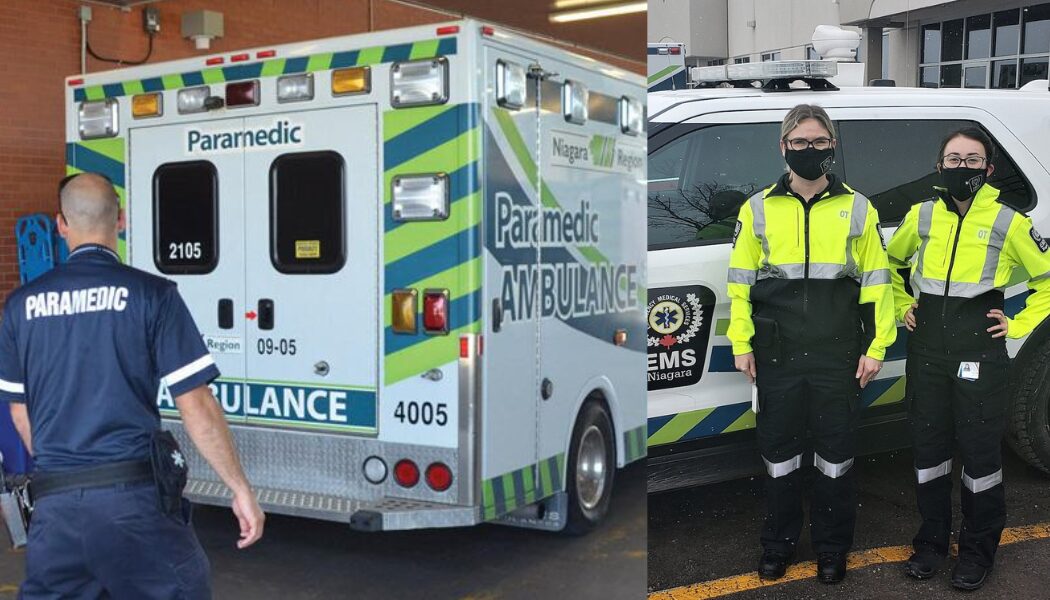
Niagara paramedics have approved a near unanimous strike motion as the region continues to lose paramedics to related fields with alleged better support of personnel.
The Brock Press interviewed CUPE911 President Dave Barnett over the current developments.
Barnett explained that CUPE911 represents “the dispatchers, the paramedics and […] occupational therapists, but only the ones that respond to EMS, emergencies and 911” within the Niagara Region.
Different dispatchers for fire and police are not represented by CUPE911. Only dispatchers that are responsible for ambulances and emergency response vehicles are represented.
According to Barnett, members were drawn to approving the strike mandate because, “essentially, it comes down to […] recruitment, retention and respect, and that’s what the members are looking for.”
“There’s a lot that goes into this. We need more funding for better bases, better locations, we need newer ambulances and that all plays into it,” stated Barnett.
Barnett would not get into specifics on the labour side of demands, something he said would be “bargaining in bad faith.” He could, however, talk about the overarching issues that Niagara paramedics have been facing.
“What we’re seeing at Niagara EMS, especially over the last five years, is a retention issue as well as a recruitment issue,” stated Barnett.
Barnett explained that Niagara EMS had conducted a survey of its members prior to the strike mandate and found that 57 per cent of paramedics are considering leaving Niagara EMS.
Barnett was “pleasantly surprised” by the strike mandate after wondering “if everyone’s thinking about leaving, are people really going to be engaged and want to withdraw their labour and think of the future?”
The strike mandate was approved with a 98.7 per cent willingness to strike, which was rounded up to 99 per cent. “The really exciting part was 81 per cent of our members took part in the polling, which is an amazing turnout in the labour world,” stated Barnett.
“A strike mandate is more like people want change, but a high turnout number shows that people are willing to go make that change, to show up and follow through with it,” explained Barnett.
In the same survey indicating that 57 per cent of members were considering leaving, members indicated that the primary concern is “wages and benefits.”
“[Wages and benefits have] fallen so far behind our contemporaries in the other emergency services that we keep seeing [Niagara] paramedics leaving for other paramedic services but also leaving to become firefighters, police — just moving on to other professions,” explained Barnett.
Exit interviews for Niagara EMS indicate that paramedics are leaving mainly as a result of the benefits.
Barnett explained that being a paramedic is “a very labour intensive, very physically intensive job. […] We might be picking up a 300-pound person in a bathtub — and that’s an incredible strain on your body — or we might be doing CPR all the way from Niagara-on-the-Lake to St. Catharines.”
Barnett also took the time to touch on the mental health aspect of the job, noting that “our members overwhelmingly — especially our part-time staff — are demanding better mental health supports.”
Barnett brought up the difference in mental health benefits between Starbucks and Niagara EMS.
“If you work [at Starbucks for] 20 hours or more as a part time staff member, you can get $5,000 in mental health benefits. […] Now, that is almost double, […] we get $3,000 in a year, but we’ve even fallen behind Starbucks employees for mental health benefits.”
“If you think about what we do for a living, the best way to describe it is […] we have a front row seat to human tragedy for a living. Same with dispatchers, they hear human tragedy for a living. On your worst possible day, we have to go be professional and try to save you, and we don’t always do it, and we have to bounce back and do it again an hour later or a day later,” stated Barnett.
Barnett explained that CUPE911 is looking for a system “that proactively gives us those tools so that we can be mentally and physically able to reset and be able to our profession to be there for the community.”
Barnett explained that Niagara EMS represents four major groups: Dispatchers or SSCs; Primary Care Paramedics, which make up the bulk of the workforce and have about 2 years of college; Advanced Care Paramedics, which have a greater skillset in cardiology meds, sedation and pain relief; and Occupational Therapists, which are the highest paid group. Wages escalate in the order of these four groups.
“The big one we’re focusing on right now with our wage asks and where we’re seeing the biggest discrepancies is our largest group, our primary care paramedics,” stated Barnett.
Barnett explained that Primary Care Paramedics in Niagara are currently making around 20 per cent less than firefighters and police officers with similar levels of seniority. “In fact, when we look at the charts, our primary care medics can be making almost 14 dollars an hour less than the constables and firefighters working in the exact same community.”
“There’s another thing called retention pay that paramedics don’t have. We don’t have any level of retention pay that helps keep people in services for nine years, 15 years or 23 years. These extra bonuses come in and that’s where the pay gap really starts to grow.”
For those who find Niagara paramedics on the Ontario Sunshine list, Barnett urges individuals to keep in mind that the paramedics had just recently received retroactive pay from lump sums awarded by arbitration in 2025.
Barnet went on to say that “one of the best ways to describe the short staffing is, if you do look at those wages, understand that in our survey 60 per cent of our staff reported working overtime in 2025 to make up for short staffing.”
The last time Niagara paramedics freely negotiated a contract was in 2019 with the last two contracts having gone to arbitration. The most recent contract expired in September 2025.
Barnet explained that members have not been satisfied with the arbitration process in contract negotiations.
“Essentially, when we go to arbitration, […] the arbitration process fails to compare paramedics to other emergency services. They will compare us to other paramedic services, but not to police or fire, and this has created a gap that just continues to grow.”
Barnett stated that the union believes that this gap has been affecting paramedic recruitment and retention.
On the recently approved strike mandate, Barnett stated that the members have given very strong mandate, with near unanimous support at a high participation rate of 80 per cent.
The strike mandate was issued Tuesday. Barnett explained that currently, the union is “negotiating an essential ambulance service agreement.”
Barnett stated that the full paramedic workforce would not be withdrawn as that would be “irresponsible and a detriment to the public safety,” but current legislation defines paramedics and their dispatchers as non-essential services that only become an essential service during “bargaining at an impasse.”
Niagara paramedics hit an impasse two weeks ago and are currently in negotiations which could take a few months and maybe be presented to labour boards before any strike action is approved.
“What will happen, then, is us and the employer will agree upon a safe level of staffing that is acceptable to reach the public’s needs, and if we can’t come to an agreement, then we would go to the labour board. The most recent labour board decision we found reduced an ambulances service by 15 per cent, that’ll be 15 per cent of dispatchers and paramedics removed from the front lines,” explained Barnett.
Non-life-threatening calls are often pushed back as a matter of public safety resulting in delays. Working dispatchers and paramedics will still be responding within mandated timeframes for events such as cardiac arrests.
Barnett stated that, “if I got part of this negotiation […] I will not put people who are in critical life and limb situations at risk […] I don’t want the public to be scared that ‘oh the paramedics are on strike, who’s going to answer 911?’ It’s not going to be like that.”
In terms of the challenges that individual paramedics and dispatchers have been facing, Barnett explained that over the last five years, there’s been a drastic increase in call volume.
“In 2020, our call volume was sitting at just over 60,000. […] We did about 100,000 calls in 2024. […] That’s an additional 40,000 calls in just four years,” stated Barnett.
Despite the spike in call volume, Niagara EMS received only a 15 per cent increase in staff over the same time period, which Barnett said is not keeping pace with the increase in call volume.
Barnett said that coupled with periods of leave, mental health breaks and the difficulties in recruiting and retaining paramedics, Niagara EMS has had to begin down-staffing ambulances. Down-staff occurs when an ambulance has only one or no paramedic(s), making it either unable to transport or unable to leave the paramedic base. Though Barnett noted that down-staffing has been an issue for years, it increased in severity throughout 2025.
Barnett explained that what’s changed the most, however, is violence towards paramedics.
“Violence towards paramedics has increased almost 400 per cent, […] and we still believe it’s underreported. […] Our members are fed up with the violence, the assaults, […] the threats, it’s just ridiculous and I don’t know what we do there, but I believe it’s definitely affecting people’s passion for staying in the field.”
Niagara EMS is 50 per cent funded by the province and 50 per cent funded by the Niagara Region municipality.
In discussing government policy, Barnett stated that “at the provincial level, I think a lot of paramedics would agree in that it’s time that our profession be recognised as an essential service, and that’s just for public safety.”
Barnett explained that when a profession is labeled “essential,” its members lose their ability to strike, so paramedics “would have to have a mechanism such as arbitration that recognizes paramedics as an emergency service and actually compares us to our contemporaries in the fire department and police department in order for that to be effective.”
For the municipal level, Barnett stated that CUPE911 is currently in negotiations and trying to enact change through the bargaining process.“If your paramedics are going on strike, if your dispatchers are going on strike, it might sound scary,” said Barnett. “I know you rely on us. But just so you know, we all got into this profession to help others. We are there for you on your worst day.
“But as call volumes spike, and as violence is escalating, and our staffing challenges present themselves — and the others have to work harder and harder for those staffing short falls — it’s becoming harder and harder to make this a viable career, and that’s the reason our members have told us we need to strike for better benefits but also better working conditions, so that this becomes a viable career that actually attracts people into it and they want to stick around for a few years.”
To the Brock students thinking about becoming paramedics, Barnett said, “these dark clouds will pass and if you’re looking for a noble career where you can help the public, consider taking the paramedics program. Come join us and it’s going to get better.”