

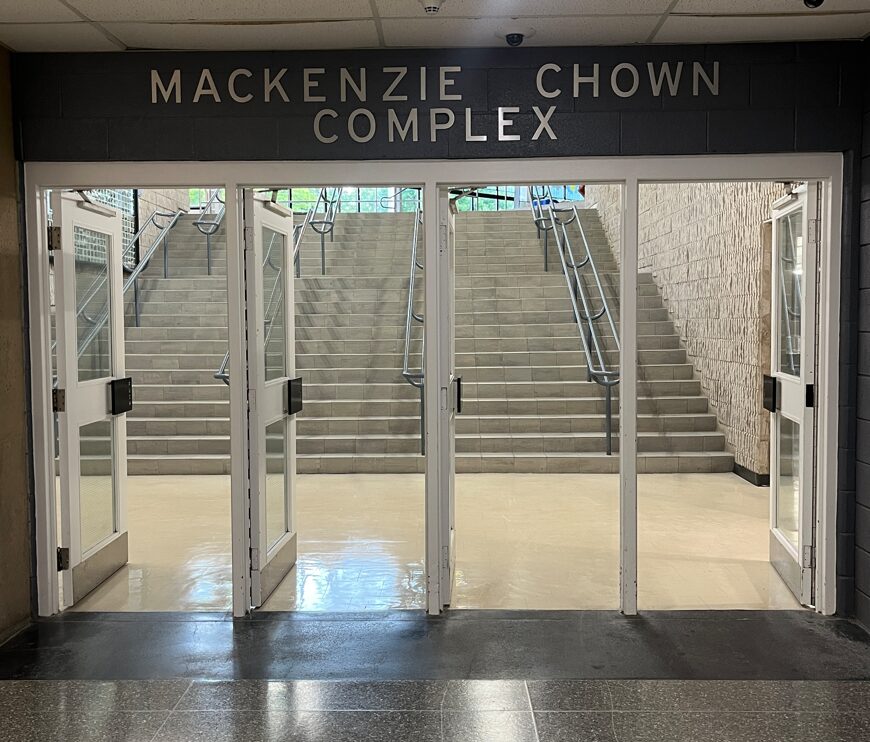
Almost every Brock student shares a universal, humbling rite of passage: wandering aimlessly through the concrete hallways of Mackenzie Chown, realizing that you are going to be 15 minutes late for your very first seminar.
The Mackenzie Chown Complex, commonly known as “Mac Chown,” is the massive, sprawling academic building in the heart of Brock’s campus. With its heavy brutalist architecture and seemingly endless corridors, it is incredibly easy to feel like a rat in a maze while navigating the building.
But don’t panic. Surviving Mac Chown doesn’t require a compass or a flare gun; it requires an understanding of the unique logic behind its incredibly stupid layout.
Understand the alphabet soup that is Blocks A through J
The first thing you need to know is that Mackenzie Chown is not a single solid square building. It is a sprawling network of interconnected wings called “blocks,” designated by letters. The complex starts at Block A and wraps all the way around to Block J (skipping the letter ‘I’, presumably to avoid confusion with the number 1).
The building was designed by architect Raymond Moriyama featuring a set of diamond shaped modules connected with enclosed bridges and multiple courtyards, one of which contains a pond. While that may be a beautiful architectural concept, it also means the hallways twist, turn and occasionally spit you out at unexpected dead ends.
When you look at your schedule, you will see your classrooms listed with a letter and a number. For example, MCD314. The letter is the first place that you should look. Do not just walk into the complex and start looking for room 314; you have to find D Block first. The blocks generally flow in alphabetical order, but because of the building’s curved shape, getting from A Block to H Block requires walking through what feels like a giant horseshoe.
No, it’s not just you; the floors make no sense
This is the secret that trips up almost every first-year student: Brock University is built on the side of a massive hill called the Niagara Escarpment.
Because of this slope, the ground floor is not always “Floor 1.”
If you enter the complex through the Scotiabank Atrium or from the Thistle Complex, you are walking in on the second floor. However, if you walk all the way down the hall to H or J Block, the elevation of the earth outside drops, meaning that the same main hallway you are standing in is suddenly classified as the third floor.
So, make sure that you always check the staircase landings. The university has painted large numbers indicating which floor you are currently standing on at every major stairwell. As silly as it may sound, never assume that you are on the first floor simply because you came in from outside.
Decode your room number
Once you understand the alphabetized blocks and the floor numbers, reading your schedule becomes a breeze. For example, MCD314 can be broken down like this:
- MC stands for Mackenzie Chown.
- D stands for Block D.
- 3 stands for the third floor.
- 14 is the specific room number.
To get there, walk through the main corridors until the overhead signs indicate that you have entered D Block. Then, find the nearest stairwell, check which floor you are currently on and go to the third floor. You can then begin looking for room 14, which is written on the signage as “314,” with “3” representing the third floor and “14” being the room number.
—
Even with the so-called “logic” decoded, Mac Chown can still throw you a curveball.
For the first two weeks of classes, give yourself an extra 15 minutes to get to class. Do not try to speed-walk from the Cairns Complex to Mac Chown J Block with only five minutes to spare. You will get lost.
The complex is built around several inner courtyards. If you are entirely turned around, look outside. The Pond Inlet — a large indoor water feature and event space — is a massive, unmistakable landmark located near Block D. You can use this landmark to reorient yourself.
Also, don’t forget to look up. The university knows this building is a maze, and there are colour-coded directional signs hanging from the ceiling at every major intersection. Follow them blindly.
Beware of the floor traps. Because of how the blocks connect, you cannot always walk from one end of the building to the other on every single floor. Sometimes, you have to go down a floor, cross into the next block and go back up. If a hallway abruptly ends, simply retrace your steps to the nearest main corridor.
At the end of the day, getting lost in Mackenzie Chown is a Brock University tradition. When you inevitably find yourself wandering through F Block looking for a seminar that’s located in B Block, take a deep breath. You can always ask an upper-year student for help — we have all been in your shoes. Within a month, you will be navigating those concrete corridors like a pro.