

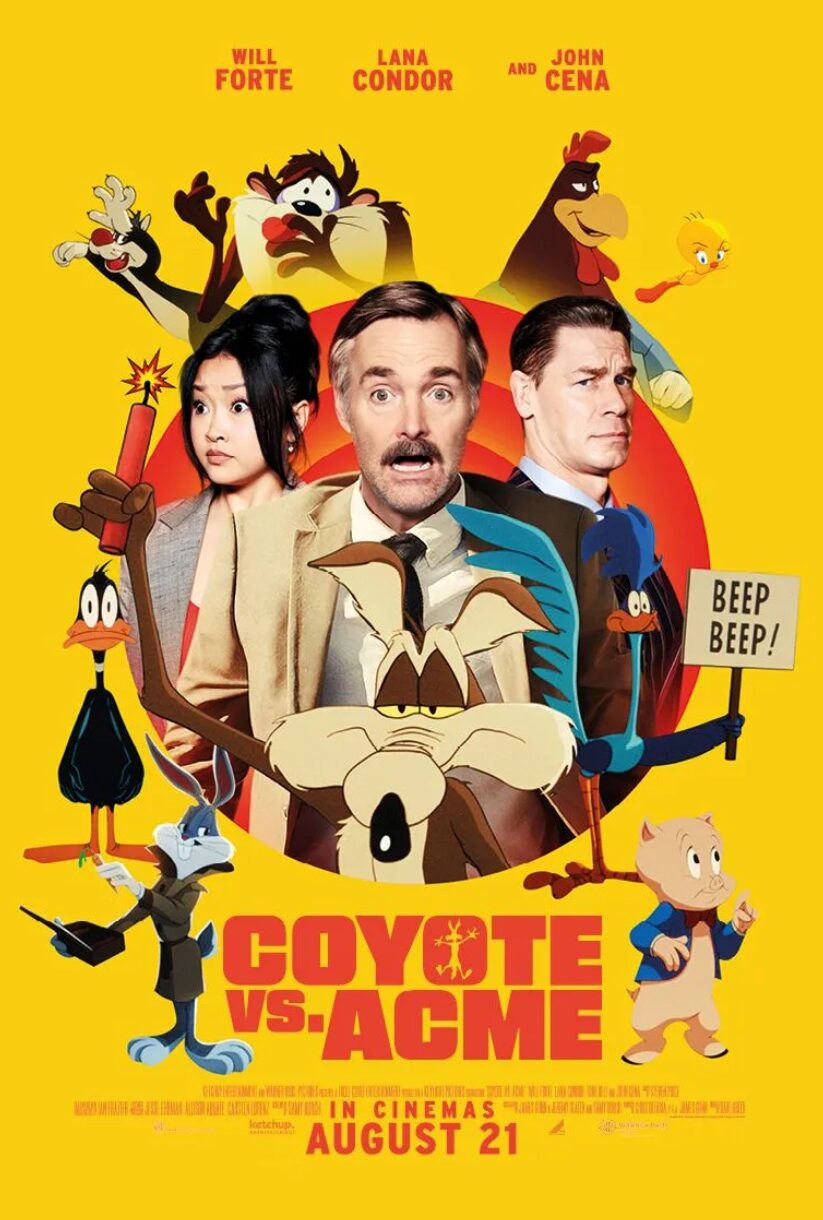
When I first began seeing things about Coyote vs. ACME, the new Road Runner movie with Will Forte, Lana Condor and John Cena, I was apathetic. That is, until I realized the film was supposed to be released three years ago. Then, I wanted to see what it was all about – mostly out of spite.
James Gunn originally pitched Coyote vs. ACME in 2015. After the film was completed, it was scheduled for a theatrical release in 2023. That was until Warner Bros., the studio responsible for its release, decided the film would not be profitable enough to justify the cost of marketing and distribution. A spokesperson from Warner Bros. released the following statement in 2023, when they announced that they would not be going forward with the release of the movie:
“[w]ith the re-launch of Warner Bros. Pictures Animation in June, the studio has shifted its global strategy to focus on theatrical releases […] With this new direction, we have made the difficult decision not to move forward with Coyote vs. ACME. We have tremendous respect for the filmmakers, casts, and crew, and are grateful for their contributions to the film,” the representative said.
Originally, the production company wanted to mark the film as a total loss, claiming a $30 million tax write-off. However, due to uproar from fans. Warner Bros. allowed the filmmakers to sell the movie for $50 million dollars to Ketchup Entertainment. Finally, the film was released at the end of last month.
The movie is based on The New Yorker comics from the 90s of the same name. Based within the Looney Tunes cinematic universe, the film has similar human-animated integration to that of Space Jam and Who Framed Roger Rabbit. It follows Wile E. Coyote as he sues the ACME Corporation for years of catastrophic product failure that has hindered his pursuit of the Road Runner. The irony of the story, following the little guy, beaten down by a corporation, is not lost on me.
The irony doesn’t seem to be lost on anyone else either, and Ketchup Entertainment has used this to their advantage. In the trailer, when the Warner Bros. Logo flashes, they write in asterisks underneath, “a wholly owned subsidiary of the ACME Corporation,” and later write that this is “the movie ACME doesn’t want you to see.”
Coyote vs. ACME has already surpassed Warner Bros. original tax write-off of $30 million dollars domestically, while grossing over $50 million dollars internationally. The success is due in large part to audiences who rallied around the film after it had nearly been shelved.
As profit becomes more important to film companies, opportunities for art and its consumption become scarcer. Theatre has been seen as a dying industry for some time now, especially post-COVID and streaming. In 2025, Canadian box office revenue had dropped over 15 per cent since 2019, before COVID.
Third-party ownership of art also means that corporations get to decide what stories are worth telling. The issue of that ownership seems to be growing. In late 2025, Warner Bros. was supposed to merge with Netflix in a multi-billion-dollar deal. The deal worried lawmakers and creatives alike, concerned about how this would cause a monopoly and less diversity in media. While that deal had fallen through, a new deal brewing between Warner Bros. and Paramount Skydance raises similar concerns.
The pressure to create art that’s profitable changes the nature of creation. It challenges the diversity of art and perspectives that make it so meaningful and connective for people of various identities. I want to live in a world where movies can be strange, ambitious and occasionally terrible, because art should be created for reasons beyond its projected return on investment.
I don’t know if Coyote vs. ACME will be something I enjoy. From what I hear, it’s something that many people have. And yet, I find myself booking a ticket for a showing next week and encouraging you to do the same.