

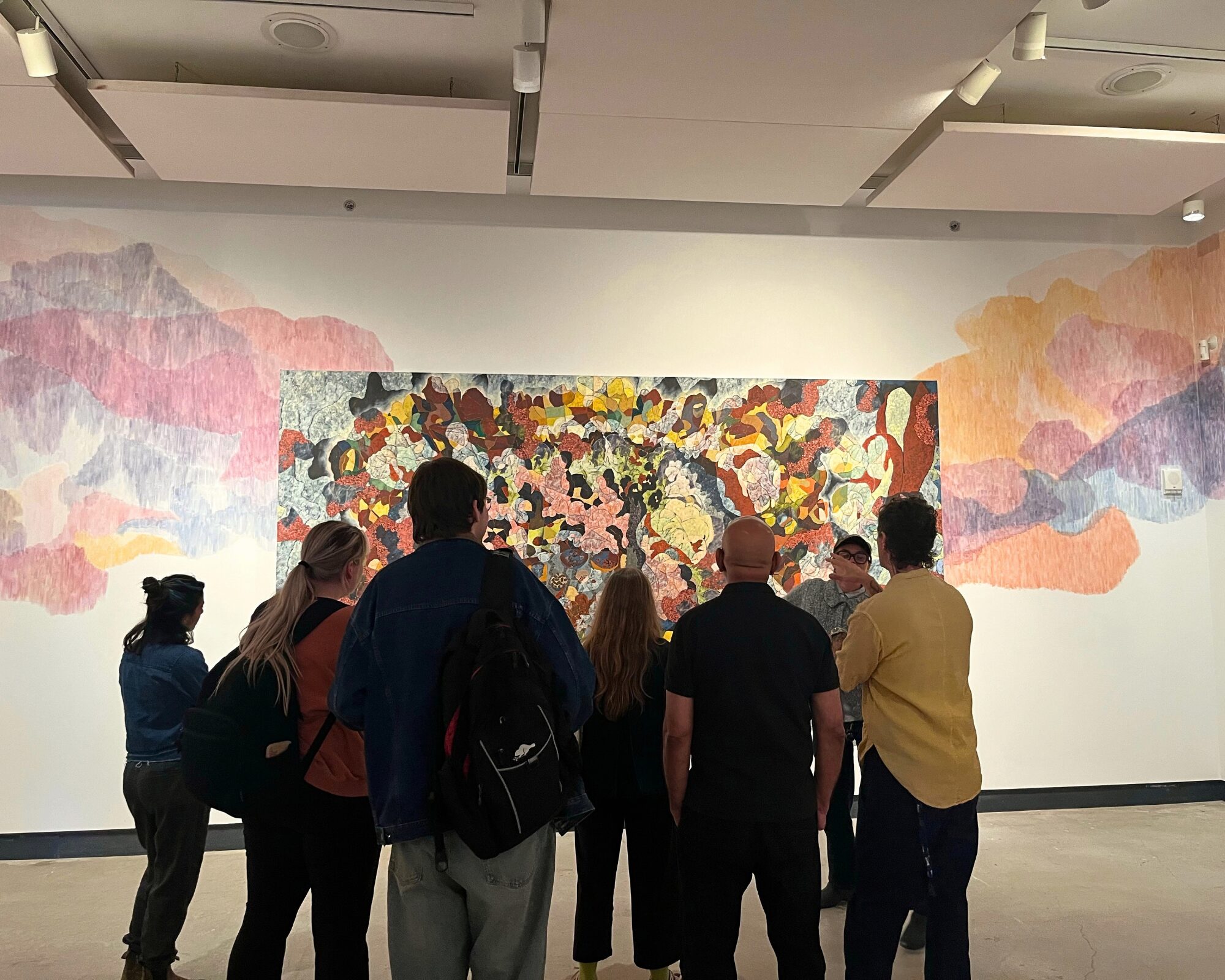
Art can be interpreted in many ways depending on the viewer and what shapes their perspectives. For artist Derek Liddington, that uncertainty is at the centre of his latest exhibition, The Still Cloud, In Anger, In Awe, at Brock University’s Marilyn I. Walker Visual Arts Gallery. Before hosting his opening reception, we sat down to discuss his work and the exhibition.
The exhibition grew from a six-week residency Liddington completed in Banff, where he spent his time studying aesthetics associated with clouds and their representation throughout Western painting, such as 20th-century French abstraction. While using the art created during his residency, Liddington also made an effort to transform the space itself.
The gallery is enclosed by large-scale wall art of various kinds of clouds, making the audience feel what it might be like to coalesce with that space. The clouds vary in colour and size, ranging from the darkness of a storm to the pink hue of a sunrise.
The process took roughly 120 hours and was made in collaboration with three Brock students: Hannah Bourne, Quinn Oberlein and Emily Taylor.
When discussing this collaboration, Liddington wrote,
“We painted a memory together, of clouds, a cloud, the cloud, in collaboration and direction, in trust and in doubt, so that we could see beyond it the colour that was there all along, in a cloud, in a memory, in our memory, shared and fleeting. A cloud.”
Memory, and the way we process it, are intentionally woven through Liddington’s work and persist through this exhibit too. Liddington says that he finds it difficult to completely separate a collective memory from a personal one. He instead refers to cultural memory in his work, shaped by both personal and collective experiences.
He describes something that we might think about passively, like a hot dog, and its ability to be shaped by this cultural memory.
“It might be childlike, it might be working-class, but there’s this idea that the hot dog becomes this image that can be read in specific ways and can also empower it to be read slightly outside of that as well,” said Liddington.
This imagery can be found lurking within the largest piece in the gallery titled, Three flowers. Three clouds. You. Me and a shadow.
Overall, he showed interest in how individual experiences can connect to broader cultural associations and different interpretations. He referred to cloud-watching as central imagery to the exhibit.
“What you bring to it is so different, but then there’s this sharedness in looking at the same thing […] the cloud becomes my memory of the cloud, but also theirs,” he said.
Liddington’s approach to painting and this exhibit are also influenced by his background in different forms of art, like performance and video. That experience continues to impact how he thinks about the spaces in which art is viewed. He compares the gallery to a theatrical stage, where the environment can influence how an audience experiences what is in front of them.
“I think that it’s helpful when looking at art and looking at painting to realize that the context in which it’s painted and in which it’s made, and then in which you’re viewing it, all inform it in different ways,” he said.
But Liddington says that context is not fixed, and that we, the consumer and the artist, are a part of that context too. As the environment and viewer change, so can the way an image is understood.
“Context is really important for looking at images, but it’s a moving target,” Liddington said.
When looking at Liddington’s body of work, there is a connection between the natural world and its landscapes, and the way humans interact with and interpret them.
Earlier in his career, he was interested in the concept of the giant: an image of the human form so blown up that it could no longer be understood as human. The idea allowed him to explore the point at which something familiar becomes abstract.
“I’m always interested in how the natural world attempts to abstract itself,” he said.
For Liddington, even a landscape that appears untouched is still being viewed through a human interpreter. He uses the abstraction in his paintings to explore this.
Liddington draws on Clement Greenberg’s concept of illusion in art. While in realism, sometimes viewers wonder how the art was made, Liddington hopes that within his abstract work in this gallery, viewers instead wonder what they are seeing. That process — the unknowing, and the curiosity that comes with it — all is something Liddington sees immense value in.
This free exhibit will be open to the public until Oct. 9 at the Marilyn I. Walker Visual Arts Gallery.