

The NFL season is only four weeks in, but the injury list is already starting to pile up.
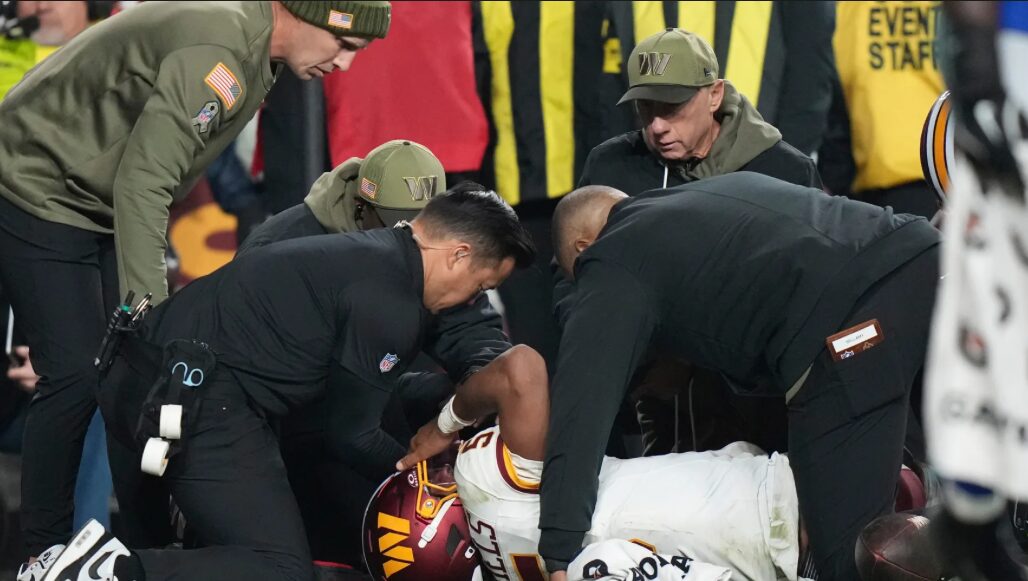
Myles Garrett, Sam Darnold, Caleb Williams, Jayden Daniels and Jaxson Dart are among the biggest names dealing with injuries already, with several facing time away from the field. Williams and Daniels both left their Week 2 games, while Dart suffered his injury on the opening drive of Monday night’s game against the Los Angeles Rams.
And they are far from the only ones.
Puka Nacua missed the Rams’ last two games with a hip injury and is looking to return to the field heading into Week 4, and A.J. Brown was placed on injured reserve after suffering an injury in the Patriots opener.
The list keeps growing, but the number of recognizable names is what makes the start of this season stand out.
Garrett, one of the league’s most dominant defensive players, is already dealing with an injury. Williams and Daniels, two of the most important young quarterbacks in the league, were both carted off the field on Sunday. Daniels missed Washington’s Week 3 game against the Seattle Seahawks and has been considered questionable heading into Week 4.
For the Giants, Dart’s injury is another major setback. The second-year quarterback was injured on New York’s first drive against the Rams and was initially considered questionable to return. Further testing later revealed he will most likely be out for the season.
This does not necessarily mean the NFL is experiencing an abnormal injury rate. Injuries are part of football, and two weeks is far too small a sample to determine whether the league is actually seeing more injuries than it normally does.
What is clear is that injuries are already forcing teams to adjust early in the season.
A quarterback going down can completely change a team’s offense. Losing a star receiver can change how an entire passing game operates. An injury to a defensive leader such as Garrett can force a team to change its defensive strategy.
That is part of what makes injuries so noticeable in the NFL. There are only 17 regular-season games, meaning every missed game carries significant weight. A player missing four or five games represents a larger part of a season than it would in the NHL or NBA with a much longer schedule.
There are also questions about how the game is being played and where it is being played.
Playing surfaces have been part of the injury conversation for years, with several players speaking out about their preference for natural grass.
Bills quarterback Josh Allen said in August he believes grass is healthier for players and that he can feel the difference in his body after practicing on artificial turf. 49ers tight end George Kittle has also been vocal about the issue, stating that the 2026 FIFA World Cup showed that NFL stadiums can accommodate natural grass.
While players’ experience do not prove that artificial turf is responsible for the number of injuries across the league, their concerns have added another layer to the ongoing debate over player safety.
The NFL is an extremely physical sport, and no amount of rule changes, improved equipment or advances in training can eliminate injuries completely. Players are moving at high-speed while being asked to deliver major amounts of contact.
For now, the biggest concern may simply be how many important players are already unavailable or questionable to play.
Four weeks into the season, teams are already adjusting lineups, changing game plans and relying on players who were not expected to carry such large roles this early.
Maybe the injury list will slow down as the season continues. Maybe it will keep growing.
Either way, the NFL has already been reminded of one of the unavoidable realities of football; staying healthy can be just as important as how well a team plays.