

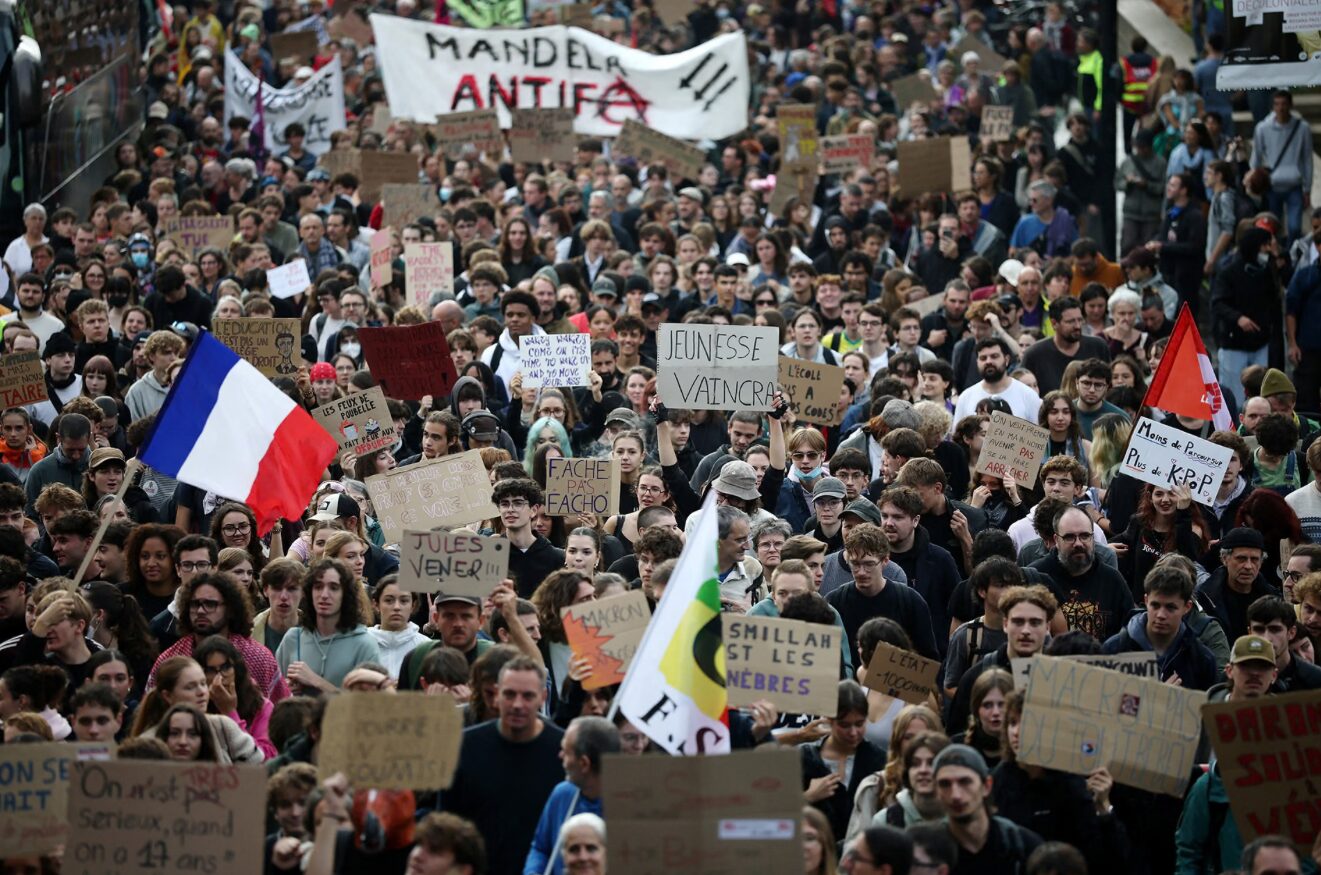
France’s consistent riots over education funding, rising living costs and declining public services have escalated into clashes with police, extreme property damage and disruptions to major tourist attractions, leaving tourists caught in the middle of the country’s worst period of violence in the 20th century.
The riots began in mid-September after students and teachers raised concerns about staff shortages, overcrowded classrooms and deteriorating school conditions.
“National education is really catastrophic,” said a student in Paris in a video by PBS News. “Personally, in my high school, the roofs are open, there’s no heating, the desks are broken. So, we work in really precarious conditions.”
Another student at the same protest added, “the building, the school and the system […] we want change.”
Students have also called for changes in Parcoursup, France’s national university admissions system, arguing that it creates unfair barriers to higher education. Additionally, protestors are demanding more financial support, affordable housing and increased funding for schools and universities.
According to an article on the Council on Foreign Relations, demonstrations have affected more than a thousand of France’s approximately 3,700 high schools.
As riots grew, trade unions, workers and supporters of the Yellow Vest movement joined, expanding the protests to include rising fuel prices, wages and the cost of everyday necessities.
During demonstrations on Oct. 17, protestors targeted businesses, public buildings and police vehicles. In Limoges, the city’s town hall was set on fire when protestors in Marseille broke in. In Lyon, the city’s tourist office was also set on fire.
French Prime Minister Sébastien Lecornu responded to the violence, saying in a post on X when translated from French to English, “We will not let ourselves be intimidated. No one will impose their political agenda through violence.”
According to CNBC News, France’s Senate has passed the “Rioters Pay” bill that would hold rioters financially responsible for damages caused. Under that law, protesters found responsible could pay up to 10,000 euros in compensation.
“We can no longer allow the vast majority of our fellow citizens to pay for a minority of vandals,” said Interior Minister Laurent Nuñez when speaking to parliament, according to an article by Euronews.
For tourists expecting to experience France’s most famous museums, restaurants and historical landmarks, the damage from the riots have created unexpected obstacles. Several major Parisian museums, including the Louvre and Musée d’Orsay, had to close, while Art Basel cancelled its weekend programming because of concerns about the riots.
Ethan Smith, a Brock student who travelled with his friend through Europe and visited Paris from Oct. 16 to 18, said he received warnings about the protests before his trip, but did not expect it to significantly affect his plans.
“A friend of mine told me [to] ‘just be careful when you go there. There might be some crazy stuff going on,’” Smith said in an interview with The Brock Press. “And I didn’t really believe him.”
On Oct. 17, while staying at the St Christopher’s Paris hostel in Gare du Nord, Smith spoke with a local who advised him against visiting several attractions because of the planned protests that day.
Despite the warning, he and his friend went out. However, when they arrived at the Catacombs of Paris, a visit they had booked well in advance, they found a notice explaining that the attraction was temporarily closed.
The notice posted outside the entrance read: “Following strike action, we regret that the Catacombs de Paris are temporarily unable to welcome visitors. Thank you for your understanding.”
After that experience, Smith’s later plans, which included going to restaurants, bakeries and nightclubs were also interrupted, ruining one of the busiest days he had planned in Paris.
The situation then escalated when Smith and his friend encountered tear gas near their hostel after leaving the metro station.
“I look down and I see this [garbage] can get thrown, and you can see the smoke [and] gas starting to come out of it,” he said. “We saw lots of tear gas get shot. […] It was literally right at our hostel as we came out of the subway.”
Smith also shared that their eyes became red and watery, and their throats began to hurt after inhaling the tear gas.
When Smith and his friend became closer to the streets where riots were happening, he recalled seeing cars, bus stops and garbage bins on fire, describing it as a “violent scene.” However, he also noticed something about the protests that he felt was largely missed by news and social media sources.
While riots have primarily centered on education, living costs and public services, some people who have been in France have interpreted the cause of these protests differently.
Smith said he believed immigration was also connected to the riots he witnessed, sharing that he saw people waving Palestinian and other national flags during demonstrations. He also saw several flags being burned, including those of France, the United States and Canada.
“When I was actually there, you would see big crowds of people that were standing,” Smith said. “[But] it’s the people that are not from France that are the ones protesting and rioting for this stuff.”
Although no source points towards immigration as the cause, a similar comment was made in an October Facebook discussion, where a commenter who said they had been tear-gassed in Bordeaux argued, “it literally is an immigration issue. It wasn’t the French who were rioting and destroying property. It was the immigrants.”
However, while Smith and some online commenters linked the riots to immigration, there is little reporting to support that claim. Most coverage continues to centre issues with schooling and the cost of living as the main reasons behind the protests.
France continues to prepare for further demonstrations as the government faces pressure to address protesters’ concerns.
On Oct. 29, authorities announced plans to deploy approximately 70,000 security personnel across the country on Oct. 31.
“The day of October 31 presents a very high risk of public disorder,” Interior Minister Laurent Nunez said in a news conference.
Meanwhile, labour groups and student organizations have also called for additional demonstrations on Oct. 31 and a nationwide strike on Nov. 5.
With the movement expanding beyond its original focus on education, the coming weeks will test whether government measures can ease tensions or whether France will face another period of intense violence that it saw in mid-October.