

The results of the 2026 U.S. midterm elections could create new opportunities for Canada to challenge American trade policies, but a change in congressional control does not guarantee an end to the economic uncertainty facing Canadians.
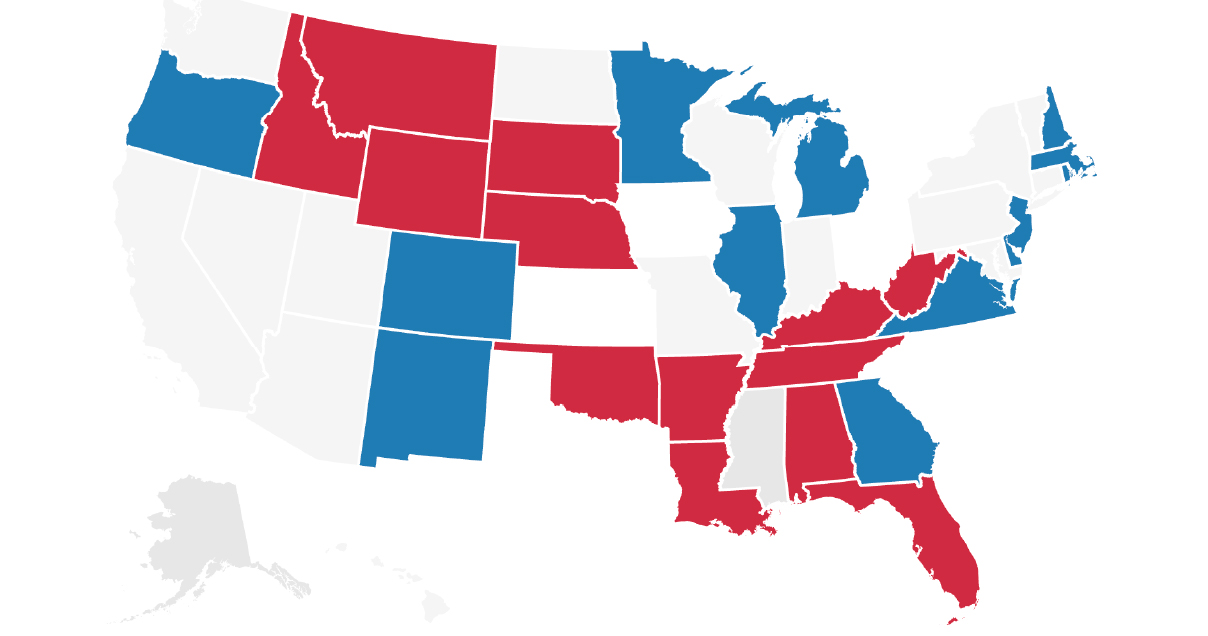
Democrats secured control of both the House of Representatives and the Senate in the Nov. 3 election, marking a significant shift in Washington.
However, in an interview with The Brock Press, Brock University political science professor Blayne Haggart says that Canadians should be cautious about interpreting the results as a turning point in the ongoing trade dispute.
The Democrats now have a majority, but they don’t have complete control. All legislation must pass through Donald Trump, who has the power to veto things. To override a veto in Congress, each chamber must pass the legislation with a two-thirds vote — a number Democrats don’t have.
“Overall, there’s some concerns of the Democrats in general; they’re more protectionist than they used to be,” said Haggart. However, he stated that the U.S. tariffs on Canada are quite unpopular across the board; as a result, the Senate may have ways to overcome a presidential veto.
Canadian Press explained that Democratic control could lead to new efforts to rein in tariffs on Canadian goods, although any legislation would still face the possibility of a presidential veto.
A Reuters report on the election noted that Democrats’ control of Congress will give the party greater opportunities to scrutinize Trump’s trade agenda. However, the president’s veto power remains a significant obstacle to reversing existing tariffs.
Moreover, the Democratic Party now has more power to run hearings, embarrass, and impeach the Trump administration for the crimes they are committing that are, according to Haggart, happening on “an almost minute-to-minute basis.”
However, Haggart questioned how much influence Congress could have over an administration that has repeatedly challenged legal limits. Based on the current lawsuits brought against the legality of the tariffs on Canada, it is clear that “Trump is not interested in law.”
“Trump has tended to not follow laws, so we don’t know what’s going to happen,” said Haggart.
Haggart also noted that Congress has constitutional authority over trade, although it has delegated some of that responsibility to the president over the years. With control of both chambers, Democrats could attempt to reclaim some of that authority and challenge how the administration uses tariffs.
For Haggart, the trade dispute between Canada and the United States extends beyond tariffs and economic policy.
“The thing to understand about Trump is that it’s not about economic policy. It’s about domination. And his goal is to dominate Canada,” he said.
Haggart warns that Canadians shouldn’t hold too much hope that the Democrats will actually be able to reduce tariffs, because Trump will find other avenues to continue his attempted domination.
“I would say not to expect too much from them. This is a long-term battle. The real game is going to be in 2028,” said Haggart.
Canada’s economic relationship with the United States makes the uncertainty particularly significant. According to the Congressional Research Service, the two countries maintain one of the world’s largest bilateral trading relationships, with highly integrated energy and automotive industries.
The ongoing trade dispute has created uncertainty for Canadian businesses that depend on access to the American market, making the future of the Canada-United States-Mexico Agreement (CUSMA) particularly important. The agreement is undergoing a joint review in 2026, creating another opportunity for the three countries to address trade concerns.
However, Haggart questioned whether reaching an agreement with the Trump administration would provide the long-term stability Canadian businesses need.
“Trump can’t be trusted,” said Haggart.
He explained that even if Canada negotiated an agreement that reduced tariffs to zero, there is a very real possibility that the Trump administration could introduce new tariffs shortly afterward.
“If the [Carney] government follows that path of negotiating an agreement with Trump, anything that they get is not going to be worth the paper it’s written on,” said Haggart.
Haggart said the uncertainty extends beyond Trump’s presidency. Even if an agreement signed after the midterms provides relief, future administrations could reverse policies, leaving Canadian businesses unable to depend on consistent trade conditions.
“The United States can’t be trusted,” said Haggart.
He argued that growing political polarization in the United States makes it difficult for Canada to plan around long-term commitments.
“That means that Canadian businesses can’t count on the US government to provide them with stability across administrations,” Haggart said. “The Carney government and its business allies refuse to acknowledge that certainty is off the table.”
Haggart said the political direction of the Republican Party presents a larger challenge for Canada than the outcome of one election.
“MAGA, which is basically the Republican Party, is an authoritarian party right now,” he said. “And authoritarian parties and countries don’t play well with democracies.”
This goes further than just the Trump administration; Haggart commented that the tendency of the Republicans to move towards authoritarianism has been going on since the 1990s. “Trump is not the cause; he’s the symptom,” said Haggart.
Until this MAGA mindset breaks, Canada is at risk.
In order for this threat to be resolved in totality, “they [Democrats] basically have to — to be blunt — put MAGA and the Republicans in the ground,” said Haggart.
Despite his concerns, Haggart described the midterm results as an encouraging sign that many Americans are dissatisfied with the current administration.
“It was the best possible outcome for people who like democracy, and quite honestly for Canada,” said Haggart. “The election results were beyond heartening because it showed that a lot of Americans, at the very least, do not like what Trump has been doing.”
However, he emphasized that the midterms are only one election. Democrats could use their new congressional majority to pursue investigations and impeachment proceedings, but Haggart said the party would need to focus on holding the administration accountable.
“[Democrats] have the votes to impeach, but they don’t have the votes — assuming everyone votes along party lines — to convict,” he said.
For Haggart, impeachment is not simply about removing Trump from office, but about upholding democratic accountability.
“It’s not just impeachment, it’s basically standing up for the rule of law.”
“If the Democrats are serious about reclaiming their democracy and reclaiming their country, you will see a lot of pushes to have impeachment hearings and to charge people with crimes. If you don’t, just say goodbye to U.S. democracy because if it’s not this election, it will be the next,” said Haggart.
It is important for Canadians to understand what an impeachment would mean.
“With Trump out of power, that would be a straight-up win, but the Republicans are still a challenge,” said Haggart.
The major threat with an increasingly impulsive Trump is an invasion of Canada, said Haggart. With his administration gone, Canadians can relax slightly; however, Republicans are still authoritarian and pose a threat.
Because of this election, the Canada-U.S. relationship is hopeful, but Haggart is still pessimistic. The path to a more stable relationship goes through MAGA. As Canadians, a sign this new congressional control will produce positive change will be its ability to rein in the corruption currently present in the Republican Party.
“What’s going to be hopeful is if they go hardcore on prosecutions and trying to hold people accountable,” said Haggart. “That is the baseline for the return to something that resembles a liberal democratic society.”
Haggart said one of the most important economic changes to watch will be whether the Carney government ultimately reaches an agreement with the United States and what concessions it makes to secure one.
“The onus should be on the Carney government to say why should we be signing an agreement with a country whose word can’t be trusted,” said Harrgart.
Haggart told TBP that when agreements are being debated, Canadians should ask themselves two questions: if we can’t trust Trump, why are we signing an agreement, and if what we are giving up worth it if Trump does reimpose the tariffs?
While the midterm results offer some hope that the Trump administration will face greater opposition in Washington, Haggart said a more stable relationship between Canada and the United States will require a much larger political shift.