

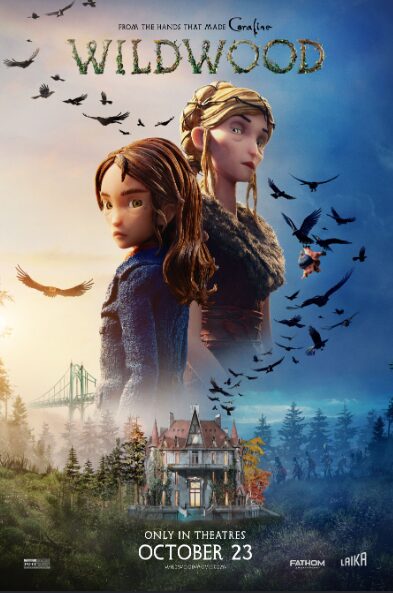
There’s a magical quality to the effort and care that must go into creating a stop-motion film. Few studios have consistently proved this as well as LAIKA, the animation company responsible for films like Coraline, ParaNorman and The Boxtrolls. After a seven-year absence from theatres, the studio returned on Oct. 23 with its latest film, Wildwood, an ambitious fantasy adventure approached with the kind of gentleness and care we don’t often get to see in new media.
Directed by Travis Knight, the CEO of LAIKA, Wildwood follows a young girl named Prue McKeel, whose baby brother is abducted by a murder of crows and taken into a mysterious forest outside Portland, Oregon. Alongside her classmate Curtis, Prue ventures into the forbidden wilderness, where she’s greeted by a world of talking animals, strange creatures and a world more complicated than the one she has always known.
The film is adapted from the 2011 novel of the same name, written by Colin Meloy, frontman of indie rock band The Decemberists. The Decemberists have written an original song for the film titled “I Want to be Lost.” The band’s involvement is just one small piece of the mystique that comes with Wildwood, as LAIKA has never been particularly interested in making ordinary children’s films.
Since the release of Coraline in 2009, the studio has developed a reputation for stories that embrace the strange and unsettling. Its films often place young protagonists in unfamiliar worlds where curiosity and fear exist alongside one another.
When Coraline and ParaNorman were first released, I remember the fear and curiosity they inspired amongst my peers and I. I don’t know if there’s a film quite as evocative for 20-something-year-olds now as Coraline was because, love it or hate it, the film made an impact.
While Wildwood may not have the same eerie nature as Coraline, it still attempts to challenge what we consider appropriate for young audiences.
While contemporary family films are frequently associated with colourful characters, light-hearted humour and easily digestible moral lessons, LAIKA has never treated its audience as stupid, nor has it tried to pander or make media easy for children to digest.
Wildwood is rated PG-13, higher than any of LAIKA’s other movies that have a PG rating. In an interview with The New York Times about the film, Knight was asked about the mature themes within Wildwood and said the following:
“Modern cinema generally tends to talk down to young audiences. But young people experience loss. They know what it’s like to feel afraid.”
It feels shameful that most of the conversations around this film seem to be about the box office success, or lack thereof. While reports have accounted for upwards of $65 million in worldwide box office sales, this pales in comparison with the reported $100 million dollar budget of the film.
The immense effort it took to create the film is being washed out by the lack of profitability. The studio has been working on this story since it acquired the rights to it sixteen years ago, and this time and effort are made clear within the film and all of its details.
The characters on screen are comprised of puppets and practical miniature sets. The team behind the film even created mechanisms within the puppets to make them appear like they’re breathing, adding another layer of depth and humanity to the screen.
The presence of A.I. in new media seems to be an unavoidable conversation now, as its use is becoming more frequent and less controversial. On the subject, Knight said to Variety:
“…technology seems like it’s only pushing us in one direction, which is everything is going to be simpler. Everything is going to be automated; everything is going to be easier. What I would say to that is that there is something special about the human touch. There is something beautiful about humanity. And that’s one thing that stop motion represents. Stop-motion represents humanity at its finest creativity, emotion, care, devotion, time… That’s something that AI could never do because a computer has never felt anything. It’s never felt loss or love or pain, and that’s something that people can feel and that’s something you feel in something that was made by people.”
In a world where automation, speed, and instant gratification have increasingly encroached on the art world, Wildwood is a testament to the value of human creation and its necessity in understanding each other and the world around us.