

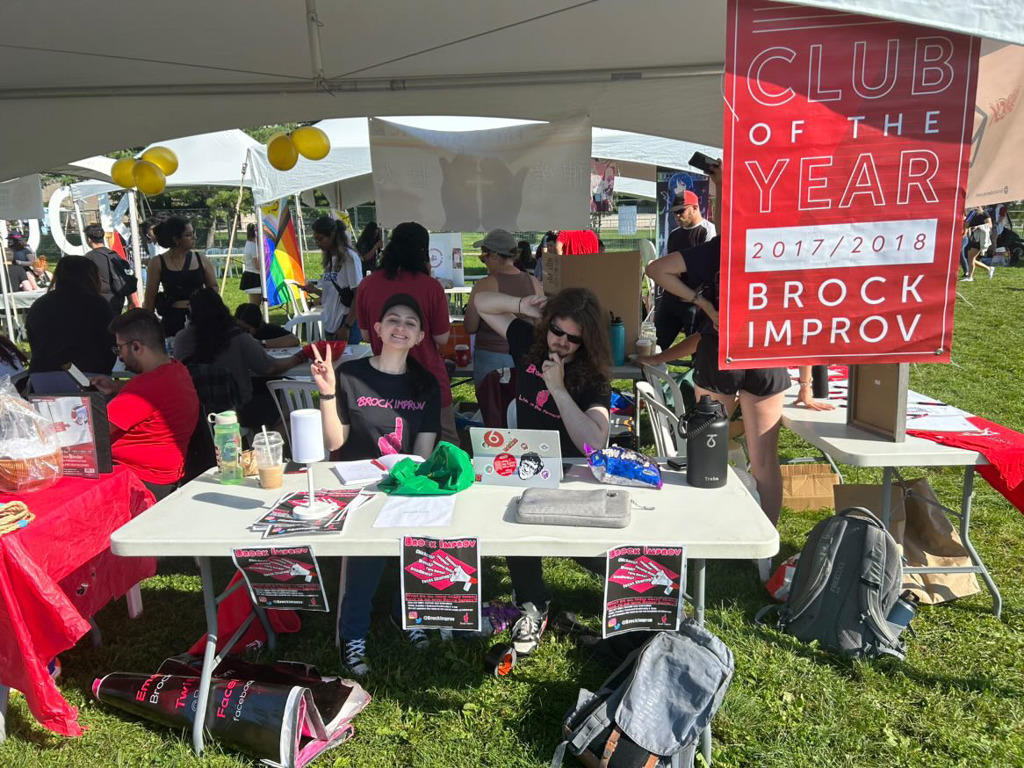
Brock Improv just held their final jam of the summer, but they’ve got their visions set on the upcoming school year.
Brock Improv held their final summer jam of the season on Aug. 30th, one of a series of events held in August. The jam consisted of several improv games, each one allowing participants to practice different elements of improv in a safe and fun environment.
Club executives Paul Drotos and Scott Yoo were incredibly warm and inviting towards each attendee, regardless of their improv experience.
Over the jam’s two-hour runtime, the club played a variety of games, which began simple before easing the group into more involved games. After introductions, they did a word-association exercise, going in a circle, hearing words and saying the first word that popped into their minds.
The group practiced body language in scenes with games such as Sit, Stand, Lie, where the motions were drastic and dramatic; and the Waiting Game, where movements needed to be subtle in order to portray specific emotions. Some games were all-out chaos like Survivor, where five actors performed a scene and repeated it as members were voted out one-by-one, with the remaining members stepping in and out of their roles to achieve the same scene.
Finally, groups performed fifteen-minute segments called Montages, where six actors performed various short scenes all in a row until the time ran out.
According to Drotos, the summer jams were a “roaring success.” Despite initial fears that they wouldn’t get many returning participants, let alone new ones, he was pleasantly surprised. Once the school year begins, Brock Improv plans on having a variety of meetings and events for all improv enthusiasts. They are hoping to have monthly shows, a yearly improv summit — hosting improv groups from other schools, which in the past has included University of Ottawa and Laurentian University — as well as even more jam sessions.
This is a vast departure from the club’s state a few years ago, when they weren’t sure they could continue running at all.
After COVID-19 left a lot of school clubs floundering, Brock Improv had an especially difficult time. In 2021, room bookings for clubs were tenuous, and the club attempted to run online improv sessions, a task that came with great difficulty. According to Drotos, people spoke over each other due to connection issues or were difficult to understand through grainy picture quality and warbled audio. Part of what makes the experience so memorable is how actors can feel each other’s energy mid-scene, and riff on that in the moment – acting in front of a screen takes most of that away.
Drotos gives Yoo the credit for the club’s perseverance and eventual resurgence.
Yoo is currently the Media Executive for the club, but last year he was the president, the very same year that the club held their first yearly summit since the pandemic, aptly named “Brock From The Dead.”
Brock Improv is a relaxed club as far as attendance goes; one can choose to come to jams or not depending on their schedule, and they can come late or leave early if need be. Everyone is most welcome to participate in a show if desired – they only ask that you attend several of the jam sessions before a show to prepare.
If you’re interested in joining the club or participating in its events, keep an eye on the Brock Improv ExperienceBU page or their Instagram.