

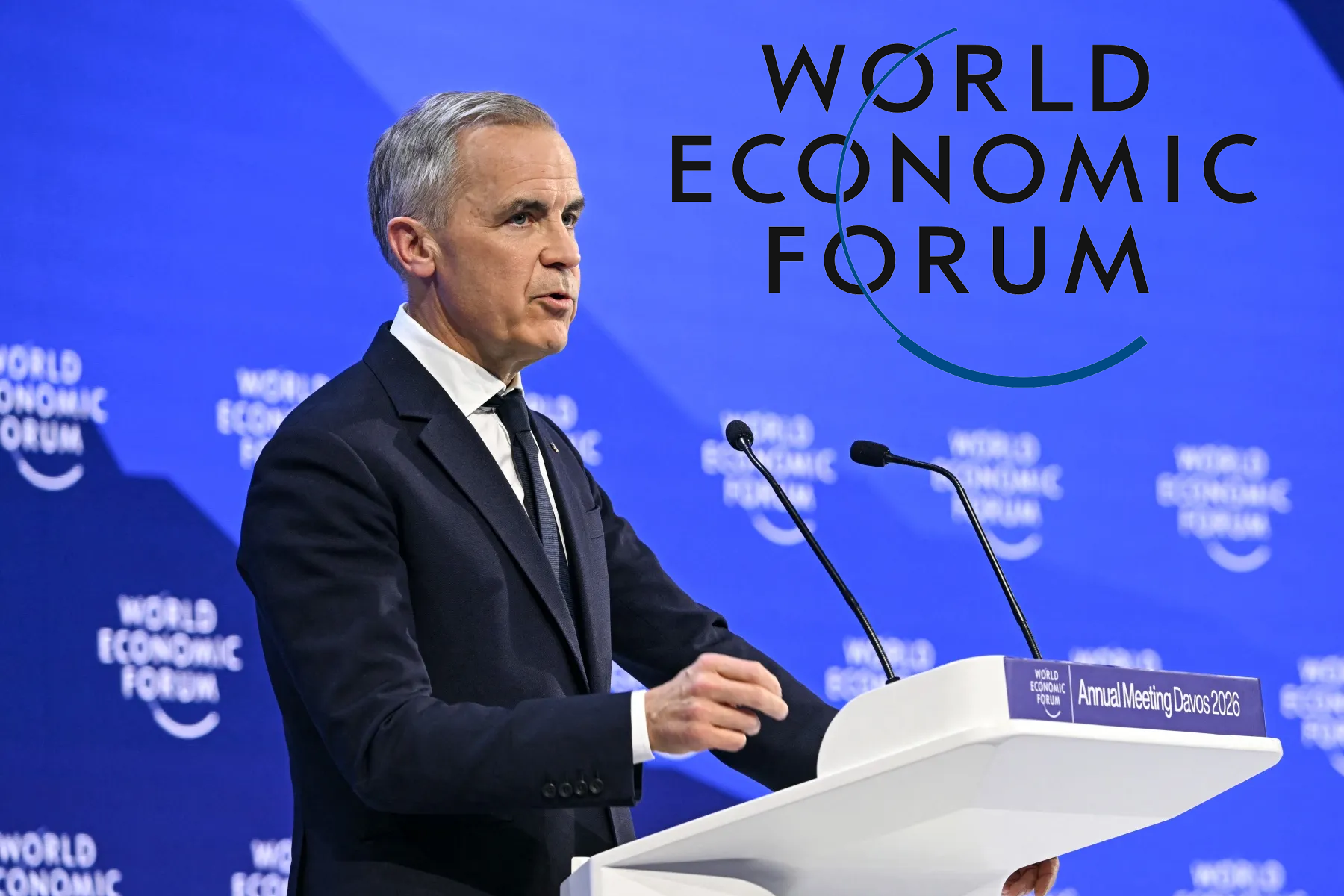
Speaking at the World Economic Forum in Davos, Switzerland on Jan. 20, Prime Minister Mark Carney said that the global “rules based international order” was undergoing a rupture, not a transition.
Carney warned that the long-standing promise of economic integration between middle and great powers has increasingly been distorted, becoming a tool of leverage and subjugation rather than cooperation.
The speech — written entirely by Carney — came alongside a series of strategic trade and security agreements announced in the days leading up to Davos. Together, these developments indicate a shift in how Canada is positioning itself amid growing rivalry between the world’s great powers and mounting strain on — as Carney stated in Davos — “the rules based international order.”
To illustrate his argument, Carney referenced an essay by Czech dissident and former president Václav Havel, The Power of the Powerless. In it, Havel describes how political systems persist not solely through force, but through the quiet participation of individuals who comply with narratives they privately know to be false. Carney applied this metaphor to the rules based international order, arguing that countries like Canada benefited from the rules-based order while avoiding confronting its contradictions.
“We participated in the rituals, and we largely avoided calling out the gaps between rhetoric and reality. This bargain no longer works. Let me be direct. We are in the midst of a rupture, not a transition,” said Carney.
As countries respond to this breakdown by seeking greater strategic autonomy, Carney cautioned against a retreat into isolation, saying that “a world of fortresses will be poorer, more fragile and less sustainable.” While middle powers lack the economic and military leverage of greater powers, he argued they are not powerless.
Acting collectively rather than individually offers a path forward, said Carney. Continuing on, he noted that the greatest risk facing middle powers today is accepting unfavourable terms in exchange for short-term stability that is neither durable nor guaranteed.
According to some observers, the Davos speech is not merely a reaction to recent U.S. unpredictability. As At Issue panelist Althia Raj noted, the remarks were internationally interpreted as a warning, particularly in the U.S., about the potential international consequences of the current administration’s policy decisions.
In a conversation on CBC: The National, Rosemary Barton referred to Carney’s remarks in Davos as “a clear-eyed assessment of the world as it stands now and what his government is trying to do to navigate that.”
Carney says that the problem of the rules based international order is structural rather than administrative, meaning the problem demands a fundamental shift of how middle powers cooperate with one another.
Central to this shift is Canada’s growing strategic autonomy in energy, critical minerals and human capital. Carney also noted deepening trade diversification pointing to recent partnerships with China and upcoming free trade packs with South and East Asia.
Rather than relying on “naive multilateralism,” Carney argued for building smaller issue-specific coalitions, “creating a dense web of connections across trade, investment, culture, on which we can draw for future challenges and opportunities”. As he put it, “if we’re not at the table, we’re on the menu.”
Carneys remarks concluded a week of diplomatic and economic engagements in Davos. As noted by The Globe and Mail, Carney’s speech marked a rare shift positioning Canada as an influential voice in shaping world order, rather than a country which responds to it.