
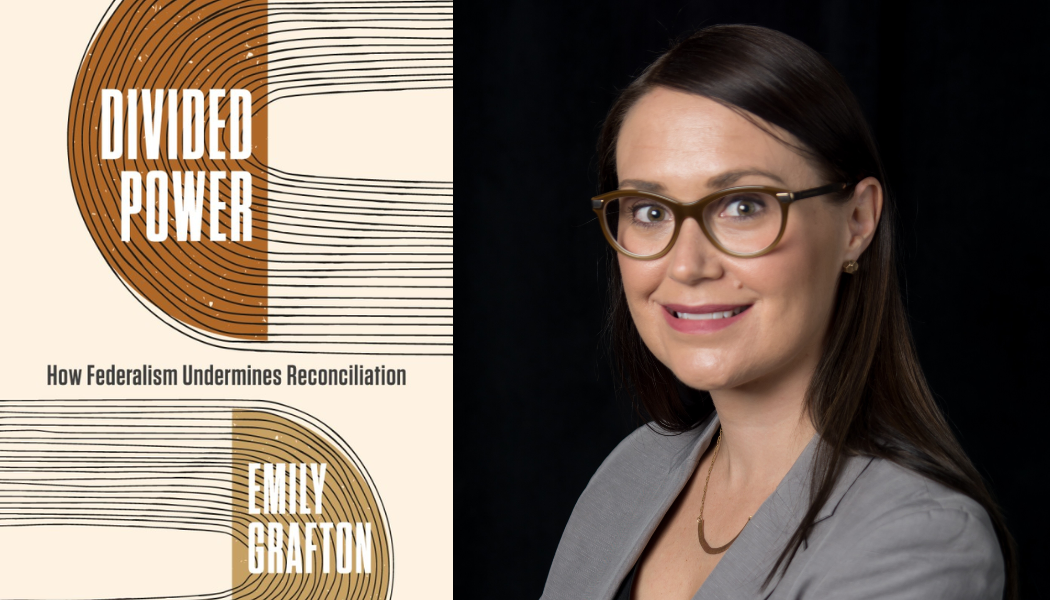
Dr. Emily Grafton — professor at the University of Regina and author of the newly released book Divided Power: How Federalism Undermines Reconciliation — delivered a lecture at Brock University on Nov. 11, encouraging Canadians to rethink the constitutional foundations that shape Indigenous and state relations.
Speaking to an audience of students, faculty and community members, Dr. Grafton opened with a non-traditional land acknowledgement that emphasized the historic and ongoing presence of Métis families in the region. Rather than repeating a standardized statement, she noted the material contributions of Métis ancestors who “built the spaces we occupy,” setting the tone for a presentation centred on accountability, history and structural change.
At the heart of Dr. Grafton’s talk was a stark critique of federalism as a system that continues to limit Indigenous sovereignty. Drawing from her book, she argued that the Canadian constitutional order positions Indigenous nations as subordinate political entities: “possessions” within a framework designed to maintain settler authority. While reconciliation efforts often focus on symbolic gestures or rights language, she contended, the underlying power structures remain largely intact.
“Recognition and erasure often work together,” she said, noting that rights frameworks, negotiations and institutional reforms frequently acknowledge Indigenous presence while simultaneously containing or narrowing Indigenous authority. This duality, she argued, allows governments to promote reconciliation while avoiding the substantive power-sharing that true nation-to-nation relationships require.
Dr. Grafton called for a post-colonial approach to federalism grounded in treaties, shared governance and what she described as “multiple sovereignties,” a concept drawn from international relations theory that acknowledges the coexistence of distinct political orders. Under current institutions, she argued, federalism operates as a tool of ongoing occupation, rather than a platform for meaningful self-determination.
Her critique extended to contemporary political decisions. Using examples from Saskatchewan, she highlighted how provincial priorities such as resource extraction, mineral development and roadbuilding regularly override Indigenous rights and concerns. These pressures, she noted, contribute to the marginalization of communities both on-reserve and off-reserve, while language loss — such as the decline of Cree — further impacts identity, culture and governance.
Despite the challenges, Dr. Grafton emphasized that Indigenous resurgence movements remain a powerful force for change. She pointed to language revitalization, community-led governance initiatives and grassroots mobilization as key pathways to rebuilding Indigenous political orders outside the constraints of state-defined reconciliation.
She also affirmed the value of the Truth and Reconciliation Commission’s 94 Calls to Action, but argued that they represent a starting point rather than a comprehensive solution, noting it is evident that the federal government has neglected the initiative.
The presentation sparked inciting discussion during the Q&A session, with audience members raising questions about policy, institutional responsibility and the future of Indigenous-state relations. Dr. Liam Midzain-Gobin, a faculty organizer and associate professor at Brock University’s department of political science with specialization in Indigenous politics and decolonial theory, noted that Grafton’s visit aligns with Brock University’s growing efforts to support Indigenous scholarship and integrate Indigenous perspectives into campus programming.
Dr. Grafton’s lecture concluded with the consensus that reconciliation that does not confront federalism’s structural limitations and therefore cannot deliver justice.
For Dr. Grafton, reckoning with political power rather than simply acknowledging historical harm is the foundation upon which domestic and international relationships must be built.
Dr. Grafton’s book, Divided Power: How Federalism Undermines Reconciliation, is now available through academic and commercial publishers, offering a deeper exploration of the themes she shared at Brock.