
Score: 1.5/5
This article contains heavy spoilers for the Five Nights at Freddy’s 2 movie.
It’s my fault that I hated Five Nights at Freddy’s 2 so strongly.
All the signs were there. Critics were brutally honest about their distaste of the film, with the horror sequel amassing an abysmal 14 per cent score on Rotten Tomatoes. Fan reception wasn’t much better, with even the most diehard fans calling the movie “insulting.”
Yet, after my surprisingly positive experience finally watching the first Five Nights at Freddy’s movie earlier this year, I foolishly held onto hope that all of these critics would simply somehow be… wrong. After all, the first movie garnered a fairly poor critical reception of its own — albeit not quite as bad as its sequel — yet I found it to be a strangely competent and fun horror story with a far better narrative structure than anything I could have expected.
What I’ve come to understand is that my enjoyment of any Five Nights at Freddy’s movie is predicated on my expectations going into it. When I watched the first Freddy’s earlier this year, I expected it to be terrible, leaving me pleasantly surprised when the film delivered in ways I hadn’t given the franchise credit for. Subsequently, my expectations going into Five Nights at Freddy’s 2 were inflated by my surprisingly positive experience with its predecessor, leaving me greatly disappointed when it ended up being terrible after all.
Five Nights at Freddy’s 2 is written by Scott Cawthon, a name anyone remotely interested in the long-running game franchise will instantly recognize as the developer and public face of the series. Cawthon took on sole writing duties for the sequel after co-writing its predecessor’s script with Seth Cuddeback and director Emma Tammi. Let’s just say that the lack of professional screenwriting experience on Five Nights at Freddy’s 2 shows, especially when compared to the first film.
I’d love to say that an indie franchise’s creator taking charge of a major project involving their work would naturally mean it was left in the best hands possible. Unfortunately, Freddy’s 2 is more of a case study on what happens when you take a skilled app developer, plop them in front of a keyboard and ask them to single-handedly write a script for a major theatrical release. Needless to say, Cawthon’s game development skills don’t seamlessly translate into effective screenwriting abilities.
Cawthon struggles to tell a coherent story throughout the movie, with the final script riddled with plot holes and baffling writing decisions that will often leave you laughing at the movie rather than with it (that is, except for the long stretches of boring, contrived storytelling where the theatre will be devoid of any audience engagement at all).
Speaking of contrived sequences, this movie is jam-packed with them, which quickly becomes one of the script’s greatest shortcomings. Several moments are so clearly forced that future scenes become incredibly easy to predict, almost like the setups were shoved in at the last moment to ensure later sequences in the film’s story can go off without a hitch.
One such moment is when Henry Emily (Skeet Ulrich), the father of Charlotte (Audrey Lynn-Marie) — the girl who perished in the original Freddy Fazbear’s location two decades before the film’s story takes place — gives our daring protagonist Mike Schmidt (Josh Hutcherson) a music box to leave at the now-abandoned restaurant for no discernible reason other than that it’s where his daughter died 20 years earlier. As if the script is aware of its own defects, Emily even acknowledges that the request to deliver the music box sounds silly.
Of course, this incredibly convenient moment is just a forced setup for Schmidt to be able to eventually use the music box to pacify Charlotte’s enraged ghost — and don’t worry, the film also clarifies earlier that music boxes are able to calm Charlotte’s spirit, so there’s absolutely no guesswork to be done on the audience’s part.
This is just one of several contrived moments that end up defining the experience of watching this film. At best, this style of script writing creates some easily predictable moments later in the story; at worst, it’s bafflingly lazy writing that demonstrates Cawthon’s inability to weave together plot points in a way that feels interesting or natural.
Contrivance isn’t my only grievance with the film’s script, however. There were several moments that initially caused me to question the acting abilities of several of the film’s leads before realizing that their awkward delivery could likely be attributed to the movie’s amateur script. One such moment is when Toy Chica (Megan Fox) makes a quip about wanting to see “what’s going on inside the head” of the person she’s about to murder, a line that is substantially less funny when she inexplicably repeats the exact same joke in the next scene.
An overview of the story’s flaws wouldn’t be complete without mentioning the absolutely awful ending. The final minute of the film attempts to set the franchise up for a third movie with a cliff-hanger, but the moment ultimately destroys Schmidt’s character when he turns his back on one of his closest allies with absolutely no forewarning. This ending moment was more than a disappointment — it felt like a complete betrayal toward the audience, who up until that point had been led to believe that Schmidt was an upstanding individual, giving viewers narrative whiplash when he abandons his longstanding ideals within the last 60 seconds of the movie. I know for a fact that I wasn’t the only one who felt betrayed by this ending, with several (very vocal) audience members around me loudly expressing their disdain as well.
I’m all for independent creators maintaining control over their franchises, and the franchise is usually better off for it. But that’s not the case here. With all respect to Cawthon, who is no doubt a very talented game developer, this is the first time in filmmaking history that I wish executives would have stripped creative control in storytelling from a franchise’s original creator and instead given it to someone with established screenwriting experience. Yes, the script is that bad.
With that said, the actors aren’t completely off the hook either. Most of the film’s lead actors struggle to carry the show, including Hutcherson, whose performance gave me the impression that he would rather not have shown up on set that day. The opposite critique can be given to Elizabeth Lail, whose slight over-acting compromised the believability of her character.
I’ll refrain from commenting too harshly on the acting of 12-year-old Piper Rubio, who indeed has some bright moments throughout the movie. However, as a lead actress in this 104-minute film, it needs to be mentioned that her performance in many of the film’s deepest moments left something to be desired.
As someone who loved acting during my childhood years, I have first-hand experience in the difficulty that critical feedback can have on a child actor who is developing in their craft. Rubio does have many moments where she shines, and I can honestly say that her acting in those scenes were some of the film’s most authentic performances. However, in order for this to be an honest review, I need to be able to point out that she struggled to effectively drive the plot forward in critical moments where the story rested on her shoulders.
There were only two actors whose performances actually resonated with me, and interestingly enough, they were the story’s two primary antagonists. Matthew Lillard returns as William Afton, the notorious serial killer who founded Freddy Fazbear’s Pizzeria, built the animatronics, and set the entire franchise’s story into effect. Unfortunately — and it pains me to say this about one of the only positive elements of this entire movie — Lillard is vastly underutilized in the film, only appearing in flashbacks and a couple of Vanessa Shelly (Elizabeth Lail)’s dream sequences.
Afton’s legacy is carried on by his son, Michael Afton, who is wonderfully portrayed by Freddy Carter. Carter brings a creepiness to his role that makes his character’s intentions clear from the start, even if his actual lines are deceivingly friendly. He is also responsible for one of the film’s most effective jump scares, which genuinely caught me off guard (and given the vocal response from the other theatregoers, I wasn’t the only one who jumped).
Moving onto the characters themselves, Five Nights at Freddy’s 2 falls victim to the classic horror trope where the characters are so bafflingly stupid that it’s impossible to empathize with them as they repeatedly put themselves in harm’s way.
No one is more guilty of this than the various children who inhabit the unnamed town in which Freddy’s takes place. Every child in town seems to have an unhealthy obsession with the obviously terrifying animatronics that reside within Freddy Fazbear’s Pizzeria, with one child even welcoming a spooky-looking animatronic into her home when she spots its illuminated eyes beaming through her bedroom window.
I’m not sure what’s in the water that these kids are drinking, but there seems to be a pandemic of pure idiocy affecting the children living around the abandoned pizzeria. Abby Schmidt (Piper Rubio), the younger sister of Hutcherson’s Mike Schmidt, is the main culprit in this regard, constantly running back to the decrepit building to spend time with the obviously scary animatronics, forcing her older brother to put himself in danger every time he needs to go to the pizzeria to conduct a rescue mission.
It’s worth mentioning that the animatronics inhabiting the pizzeria are the same ones that provided nightmare fuel to an entire generation of real-life children when the Five Nights at Freddy’s games got popular over a decade ago. I can’t quite understand what compels the children in the movie universe to love the animatronics so much, when real life has shown us practical evidence that kids are rightfully terrified of these mechanical monsters.
Regardless, it just makes the threats facing the protagonists feel even more avoidable. Like, just… don’t go to the spooky abandoned pizzeria with documented child murders where the terrifying animatronics roam about. Almost all the movie’s problems would have been solved if the protagonists would just follow this dumbfoundingly obvious rule.
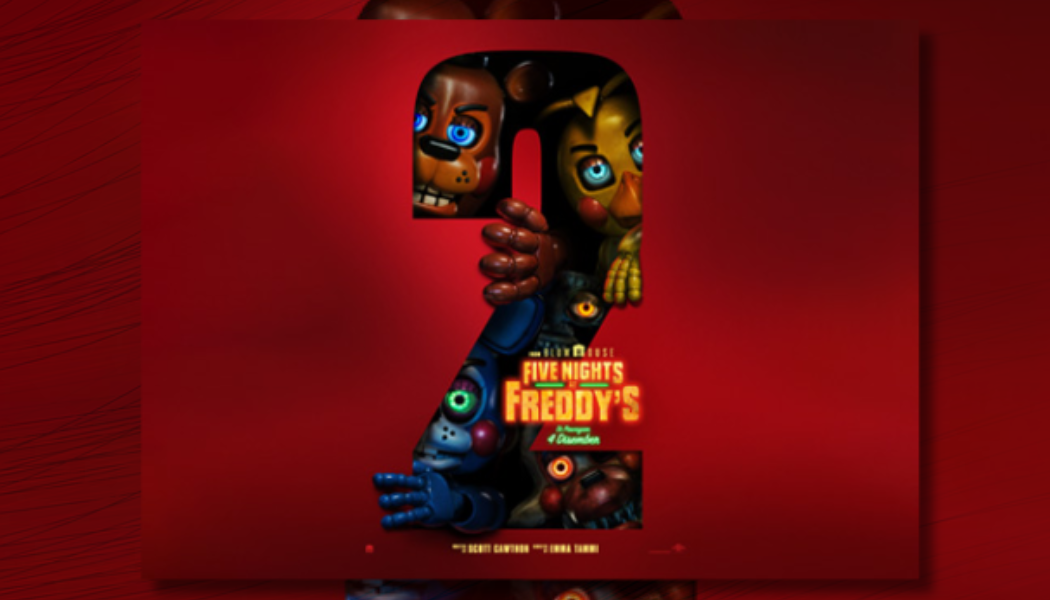
It’s worth mentioning that the animatronics themselves have a wonderful visual design, perfectly encapsulating the horror vibes that the entire franchise thrives on — though, seeing as they were put together by the legendary Jim Henson’s Creature Shop, this shouldn’t come as a surprise.
Speaking of horror elements, the one area where Five Nights at Freddy’s 2 improves on its predecessor is in its inclusion of jump scares, something that was sorely missing from the first film. While I’ll be the first to admit that I personally hate being jump-scared, I acknowledge that jump scares are a quintessential element of the Five Nights at Freddy’s franchise and a major reason why the original games gained popularity in the first place. The absence of major jump scares in the first film was one of its most glaring omissions, so it’s nice to see that the sequel remedies this by finally paying tribute to this classic element of the horror franchise.
A few jump scares, though, ultimately can’t save this movie from the real horror that haunts it to its core: an underdeveloped and frustrating script riddled with plot holes and contrived sequences, coupled with largely mediocre performances from its leading actors.
It’s a reminder to me that the enjoyment of movie-watching is largely a matter of managing expectations. If I had entered the theatre with the same rock-bottom expectations that I started watching its predecessor with, I might have been left enjoying the cheesy writing and unintentionally dumb moments that define the experience of watching Five Nights at Freddy’s 2 — much like I managed to enjoy A Minecraft Movie despite its similar flaws earlier this year.
Instead, my expectations were elevated by my surprising enjoyment of the first Five Nights at Freddy’s film, which in hindsight was probably only a result of the low expectations I entered that movie with.
So, much like Mike Schmidt’s character was betrayed at the tail-end of Five Nights at Freddy’s 2, I’m going to go against everything I’ve written here and recommend that you watch this film — but only if you adjust your mindset going in. If you’re ready to laugh at stupid lines, poke fun at baffling plot contrivances with other theatregoers, and make some jokes out of a truly awful script that doesn’t deserve to be taken seriously: I think you might just have an excellent time.