

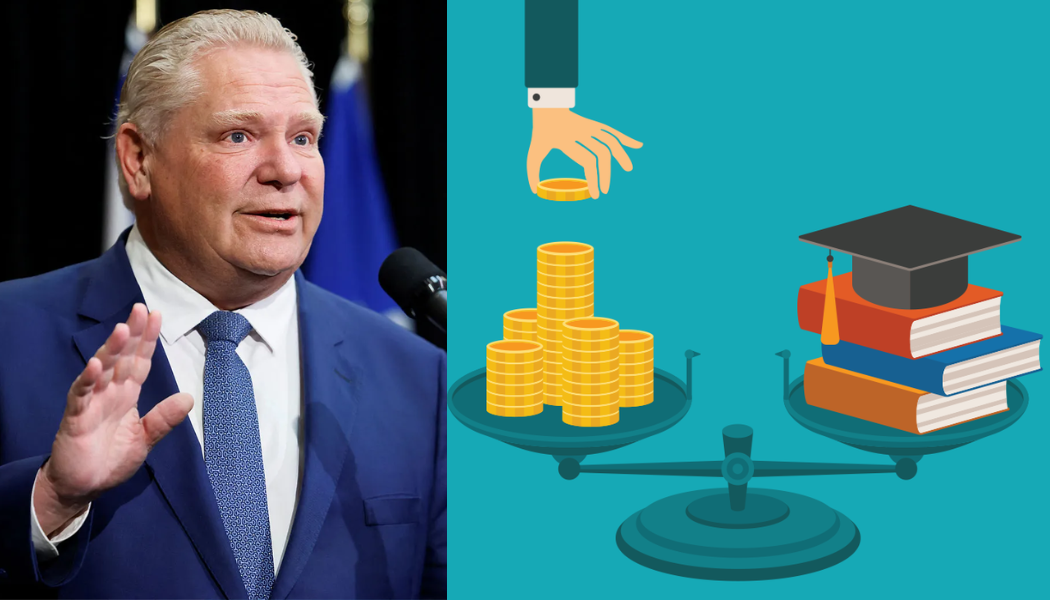
In a news release on Feb. 12, the Ontario’s Progressive Conservative government announced that through a new long-term funding model, they will permit domestic tuition increases and restructure Ontario Student Assistance Program (OSAP) beginning with the Fall 2026 academic term, then in turn the government will invest $6.4 billion over four years into the postsecondary sector.
The province says that the package is designed to support the sector’s “long-term success and sustainability” and that the OSAP redesign will increase “reliance on repayable borrowing.”
Under the updated tuition framework, Ontario says that publicly assisted colleges and universities will be allowed to “raise tuition by up to 2 per cent per year for three years, then up to 2 per cent or the three-year average rate of inflation.” The government describes the approach as maintaining “one of the lowest rates of tuition increase in Canada,” while allowing institutions to adjust tuition after a multi-year freeze.
The funding model includes an overhaul to the OSAP. The provincial government’s news release says that, starting in fall of 2026, students will be eligible for “a maximum of 25 per cent of their OSAP funding as grants and a minimum of 75 per cent.” This marks a significant shift from the prior model, which allowed students to receive up to 85 per cent of their OSAP funding as grants.
The province also says that OSAP will “no longer offer grants to students at private career colleges.” The report explains the choice to shift toward loans by describing OSAP as “dramatically out of line with other jurisdictions.”
Ontario’s announcement pairs tuition and OSAP changes with system funding measures and enrolment targets. The province says that the model will bring “$6.4 billion into the sector over four years and raise annual operating funding to $7 billion, a 30 per cent increase.”
After the announcement, Global News reported that Premier Doug Ford said the government faced “massive pressure” from colleges and universities and suggested that the government could not “fight against” postsecondary leaders on the issue any longer, while defending the decision to allow tuition increases and reduce grant funding.
The Global News report also stated that “after fees were frozen by Ford in 2019, colleges and universities increasingly turned to international students […] with roughly one-third of total college revenue coming from international students.” Then, as The Brock Press has previously reported, “the federal government’s decision to reduce the number of international students accepted into Canadian universities has upended 2025 budgets across the nation.” Thus, the Ontario government links the tuition changes to adapting to reduced international student revenue.
The province permits tuition increases beginning in September under the new framework, ending a seven-year tuition fee freeze. The tuition framework sets an allowable ceiling rather than a single mandatory increase, the immediate effect on tuition bills depends on institutional decisions within the provincial cap.
Advocacy groups and campus stakeholders, like the Ontario Confederation of University Faculty Associations (OCUFA), have said that the province is shifting student aid from “up to 85 per cent grants and 15 per cent loans” to “25 per cent grants and 75 per cent loans.”
Brock University’s Student Accounts and Financial Aid pages state that tuition and fees are assessed per term, and the assessment system calculates fees based on factors such as credit weight and whether a student is in a flat-fee structure. Brock’s student tuition fees are also approved by the Brock University Board of Trustees in accordance with the provincial tuition policy.
Under Ontario’s updated tuition framework, any changes to Brock’s domestic tuition for eligible programs would occur within the province’s permitted policy limits and through Brock’s institutional approval and fee-publication process.
Opposition parties have criticized the OSAP redesign and the return of tuition increases, saying that the changes will increase student debt burdens.
The Ontario NDP launched a “Save OSAP” campaign, calling on the government to stop the plan, describing it as one that leaves students with greater debt. The Ontario Liberal Party said that the 25 per cent grant cap shifts support “away from grants and back toward loans,” claiming that students will now graduate with more debt. The Green Party of Ontario also called on the Ford government to reverse OSAP model changes and increase grants, arguing that the package shifts will cost students.
CHCH News reported that students and critics gathered at Queen’s Park on Feb. 20 to protest the OSAP and tuition changes. The report also stated that the Canadian Federation of Students campaign page lists an upcoming “Hands Off Our Education Rally” on March 4 at 12:30 p.m. at Queen’s Park. The event is part of a campaign opposing OSAP changes and tuition increases.
Ford responded to the backlash from students by defending his government’s decision, saying that he had “fought for […] seven and a half years, not letting universities and colleges raise tuition,” but ultimately faced “massive pressure from the [education] sector” to lift the tuition freeze. Ford noted in his response that OSAP grants “created a problem when the federal government cut off foreign students coming in,” while also saying that students “have to invest in [their] future, into in-demand jobs,” like healthcare or trades. He urged students to avoid “basket-weaving courses” because “there aren’t a lot of baskets being sold.”
Ontario’s policy framework sets the parameters for tuition and OSAP beginning in Fall 2026, while the specific tuition schedules students will pay are ultimately set by institutions within the provincial rules and published through each school’s fee schedules. Student organizations and opposition parties have indicated that they will continue public campaigning and advocacy against the OSAP redesign and tuition framework, including planned events such as the March 4 rally at Queen’s Park.