
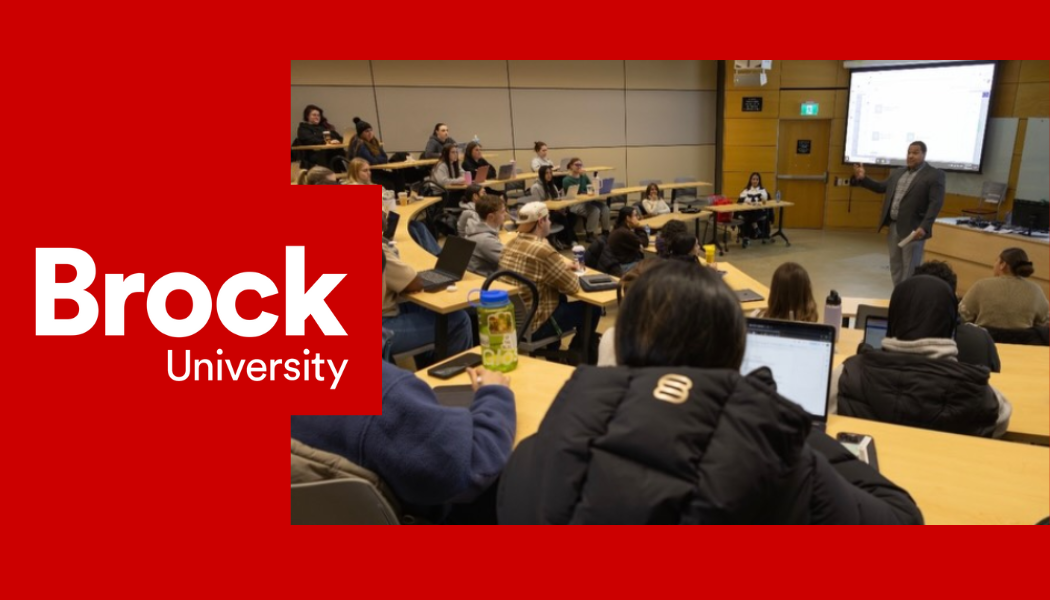
On Jan. 29, a speaker series event at Brock University examined current issues and recent developments in youth justice in Canada, with presentations focused on youth justice programming and the role of pre-trial detention.
The event, titled “Youth Justice in Canada: Issues and Developments,” was hosted by Brock’s Forensic Psychology and Criminal Justice program. The speakers were Che Latchford, Management Consultant for Florida Network of Youth and Family Services, and Nicole M. Myers, associate professor in Sociology Department at Queen’s University.
Latchford’s presentation addressed how youth justice and community programs are developed, implemented and evaluated across different settings. He emphasized transparency, reciprocity and intentionality as principles guiding this work, framing program development as a process that should be revisited, rather than treated as a one-time rollout. He described an approach organized around understanding the current context, clarifying problems with input from relevant stakeholders and developing solutions that are tested and adjusted based on evidence.
In describing why evaluation and iteration matter, Latchford discussed how the same program can look different when delivered across multiple sites. Even when a service is intended to be standardized, delivery conditions, staffing, community context and participant needs can shape how it works in practice. He presented these differences as a reason to build feedback mechanisms into programs, so that implementation can be assessed and modified over time.
A significant part of his talk focused on youth participation. He described participation as more than consultation and discussed the importance of clear expectations and the conditions required for youth to contribute meaningfully. He also raised cautions about how participation processes can reproduce power imbalances if adult professionals retain full control over decisions while presenting youth involvement as substantive.
Latchford also addressed the role of data in youth justice programming. He discussed concerns about how information can be used in ways that may harm participants, emphasizing responsible stewardship in how data is collected, interpreted and applied. He connected this to a broader point that system design and program success depend not only on what is measured, but on how measurement practices relate to the lives of young people and the services meant to support them.
As a program example, the event included discussion of SNAP (Stop Now and Plan), described in the session as a Canadian-developed program implemented in custody or detention settings and later expanded. The presentation described structured sessions in which youth responses and reflection shape the discussion, with facilitators supporting the process rather than directing it. The description emphasized program development that incorporates feedback and focuses on how youth make decisions in real-time situations.
The second presentation shifted from program design to legal process, focusing on youth legal rights and pre-trial detention. Myers framed release on bail as a constitutional right connected to the presumption of innocence, rather than a matter of leniency, and reviewed legal grounds for detention that can be used to keep a person in custody. These grounds included risk of not appearing in court, public safety concerns and maintaining confidence in the administration of justice. She also discussed how release conditions can restrict liberty even when a person is not detained, highlighting that legal “release” can still involve extensive controls.
Myers also discussed trends in custody and pre-trial detention, distinguishing between sentenced custody and remand, which refers to detention while a case is awaiting resolution. In describing adult trends, she presented figures indicating that remand has grown as a share of provincial custody in Canada and in Ontario. In relation to youth, she described how youth court caseloads and youth custody have declined since reforms associated with the Youth Criminal Justice Act, while also noting that remand remains a significant portion of the youth custodial population.
A central point in the presentation was the relationship between bail practices and detention outcomes. Myers presented figures on bail outcomes for youth, including counts of release orders and detention orders, as well as cases categorized as having no bail outcome. The figures presented included 1,019 release orders, 34 detention orders and 1,192 cases categorized as no bail outcome. She linked bail outcomes and release conditions to the practical realities young people can face while awaiting resolution, including time spent either detained or under restrictive conditions prior to any finding of guilt.
The presentation also reviewed consequences associated with detention, including disruptions to education and employment, impacts on family and social ties and effects on trial preparation. She discussed how release conditions can create additional pressures, noting that individuals may accept restrictive conditions to leave custody and that meeting conditions can be difficult for those without stable housing or reliable support networks. The event also addressed how breaches of release conditions can lead to additional charges or a return to custody.
Court timelines were also addressed. Myers presented a figure indicating youth cases averaged 211 days from arrest to disposition or resolution, connecting the length of proceedings to the duration of time youth may spend in detention or under restrictive conditions. The presentation also referenced the over-representation of Indigenous and Black youth within the system and noted long processing times as an ongoing issue.
Taken together, the event presented two lenses on youth justice: how programs are designed and evaluated across institutions and community sites, and how pre-trial procedures, detention decisions and release conditions shape youth experiences in the legal system. The discussion connected questions of participation and program implementation with questions of legal rights, case processing and the practical effects of remand and bail conditions.