

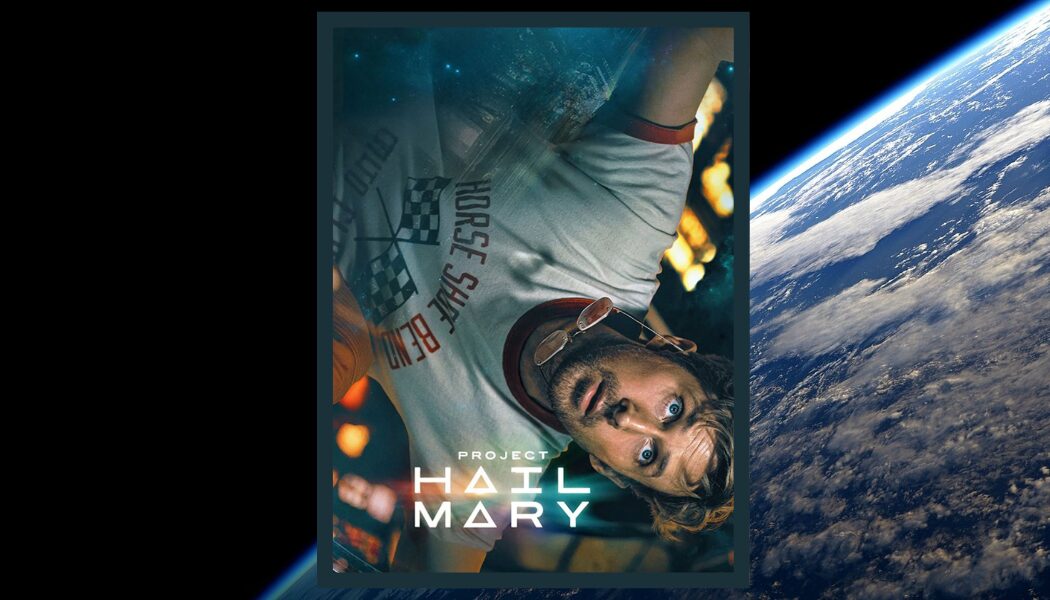
Score: 4/5
With visuals that demand theatrical scale, Project Hail Mary has quickly positioned itself as one of the clearest examples of a film that justifies the cinema experience.
The use of practical effects doesn’t just add immersion; they reinforce a sense of spectacle while serving as a nod to past space epics that expanded our view of ourselves while inviting introspection in the process. The film’s vision of space feels tactile and immediate, a quality made possible by director Christopher Miller’s decision to shoot without traditional green or blue screens and to rely on minimal CGI. The result is a version of space that feels tangible rather than manufactured, allowing the spectacle to draw the viewer deeper into the story rather than overwhelm it.
Going into Project Hail Mary, I wasn’t sure what to expect. The film adapts Andy Weir’s 2021 novel, and my expectations were shaped almost entirely by the 2015 adaptation of his breakout success The Martian — which has since become my go-to comfort watch for a sick day in bed.
I’ll admit my expectations for a “fictional science” epic with the pacing of a Ridley Scott film did slightly ruin the initial 30 minutes of my experience in theaters. Although written by the same author, it became clear very quickly that Project Hail Mary was not a sequel, an homage nor Weir’s attempt at recapturing the lightning-in-a-bottle success of his first novel.
That’s because Project Hail Mary isn’t really a sci-fi movie, and yet it satisfies all the necessary precursors of a space epic. The little science fiction that the film introduces exists primarily to set the plot in motion rather than to be the plot itself, used sparingly as a “MacGuffin” of sorts. This approach is reinforced by the fact that nearly all of the science presented to the viewer is filtered through the imperfect narrator, Dr. Ryland Grace, played by Ryan Gosling.
Waking up on a ship, unaware of how he got there, the film utilizes momentary flashbacks to partially explain his circumstances. For the sake of its runtime and family-friendly PG rating, Project Hail Mary avoids cluttering the viewer with an excess of knowledge.
This lack of overcomplication means the film is extremely approachable to nearly any age demographic. A drawback, however, is that for a majority of the first act, Ryland’s cluelessness in both the present and past leads to the film feeling as though it drags until enough exposition is provided for the plot to progress.
What’s most striking is that the film rarely uses science as a propulsion tool in this way, so its reliance on science to get the ball rolling creates this felling of confusion. Though slower than it perhaps should be, this pacing ultimately mirrors the experience Ryland is living through at every moment: as he learns and begins to understand his circumstances, the audience learns alongside him.
Once the story comes more clearly into focus and the true intentions of “Project Hail Mary” are revealed, the tone of the film begins to make sense.
The choice to cast Gosling as Ryland Grace delivers what is, in my mind, his greatest performance yet. His comedic abilities are on full display, but it isn’t the character’s intelligence that allows the audience to connect with his circumstances. Instead, the script relies on a charismatic, lighthearted lead — something Gosling succeeds in bringing to every scene, regardless of a large portion of the film spent acting alone or opposite a puppet portraying the arachnid-like alien, Rocky.
On Earth, Gosling is supported by a strong cast of actors, including Sandra Hüller, who previously received North American acclaim for her Academy Award-nominated role in Anatomy of a Fall (2023).
Hüller’s character serves as a representation of the sobering extinction threat facing Earth and humanity. Though her later actions in the film could make her appear villainous, she grounds her character in reality, allowing such scenes to require deeper introspection from the audience.
Hüller also demonstrates strong comedic timing when acting opposite to Gosling. Their joint chemistry, although tragic, produces touching scenes, including one that allowed me to experience “Sign of the Times” — the 2017 Harry Styles record that anchors the film and its big-budget advertising campaign — in a new light.
Truthfully, I didn’t expect a space epic like Project Hail Mary to provoke such a strong emotional response. More than once, I found my eyes welling up with tears, a reaction made even more surprising by the film’s balance of chest-pumping action and genuine, feel-good humor. That tonal balancing act ultimately becomes the film’s greatest strength, allowing Project Hail Mary to resist neatly fitting into any single genre and instead exist as something far more universal: a true crowd-pleaser that invites viewers to take from it whatever they need.
Project Hail Mary doesn’t set out to prove what a modern sci-fi film can be. Instead, it uses sci-fi as a vehicle to tell a deeply personal, thoughtful and emotional story about perseverance, belief, and hope in the face of impossible odds.