
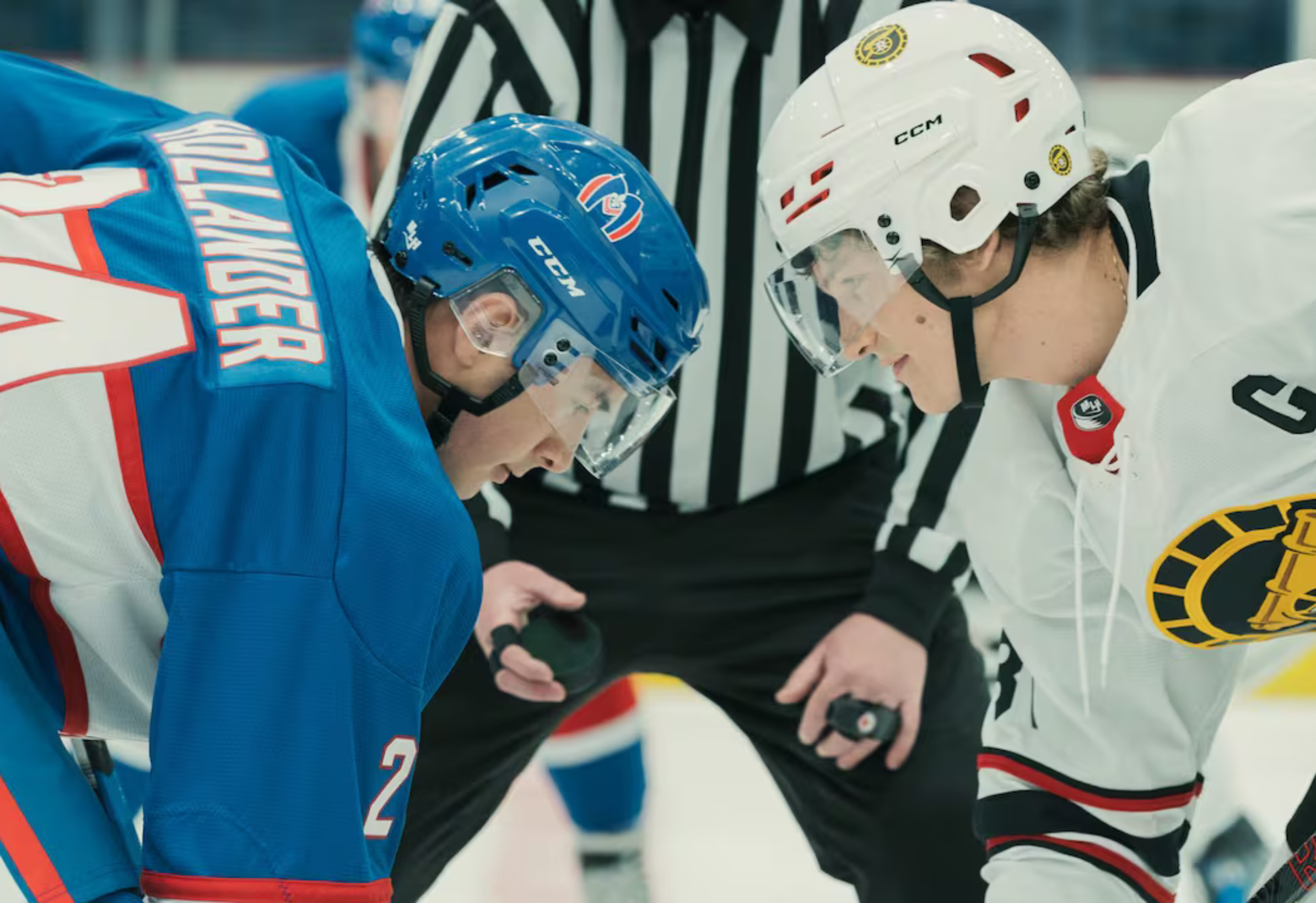
For those of us who choose to spend the winter break catching up on the semester’s TV backlog, it’s nearly impossible not to have heard about Heated Rivalry.
The steamy queer hockey romance has sent the internet into a frenzy, not only skyrocketing two unknown actors to the top of the A-list but pushing the series far beyond anything the creators or studio had originally expected.
Heated Rivalry is a rare show: one that feels organic rather than engineered. Produced by Canadian streaming service Crave in conjunction with Bell Media, the series has exploded in popularity at a scale that few Canadian shows ever reach.
The show began as a spinoff from the “BookTok” famous Game Changers series by Nova Scotia-based author Rachel Reid. When production for the show began in early 2025, it was led by creator, director, writer and producer Jacob Tierney, the creative force behind the hit shows Letterkenny and Shoresy.
Across online discourse, one thing has become clear: Heated Rivalry would not have been the show that it is without Tierney at the helm. While Reid remained involved in shaping the adaptation, Tierney took the lead creating a six-episode saga that spans nearly a decade — a story driven by yearning, love, pain and emotional restraint.
What makes this achievement even more impressive is how little producers had to work with. Shot primarily in Hamilton, Ontario, the series convincingly moves through New York, Montreal, Russia and beyond — all on a shoestring budget and an unforgiving production schedule. In doing so, Heated Rivalry places Canada’s creative talent on the global stage, proving that exceptional television doesn’t require impossible resources; only vision and precision.
I’ll admit that when I first heard about Heated Rivalry, I dismissed it as another hollow queer romance — unrealistic, glossy, thin and inaccurate. Too often stories like this don’t measure up to the hype grown around them.
Like much of the internet, I was wrong.
In just six hours, Heated Rivalry rewrites the script for queer romance on screen, proving that passion and intensity can coexist with depth. The enemies-to-lovers framework never overwhelms the story; instead, it grounds it. The writing is sharp and disciplined, the direction is intentional, and most importantly, the romance is tangible — in every glance, text message and moment of restraint.
Tierney and Reid have created a queer love story that asks for, and earns, the audience’s trust. That trust matters, particularly in a moment where younger audiences increasingly view coming out as unnecessary or even outdated because queerness feels normalized in much of popular culture. Against that backdrop, a story where coming out could realistically end a career might feel difficult to accept.
Heated Rivalry insists on that reality anyway. The series is structured carefully, asking viewers to believe that queer visibility still comes with consequences. For these characters, coming out could be professionally devastating. This isn’t a historical drama or a story set in a less tolerant past; it’s set in the present day. That’s what makes it uncomfortable, but necessary.
That trust becomes even more crucial, given the setting. The professional hockey world at the beginning of Heated Rivalry mirrors the NHL itself in never having an openly gay player. That silence speaks volumes about the culture surrounding the sport. Heated Rivalry doesn’t ignore this reality. It confronts it head on, exploring the struggle of self-acceptance in a world that is increasingly open to queer identities while remaining trapped in a sport that continues to discourage any deviation from heteronormativity.
The absence of openly gay players in the NHL underscores the importance of a show like Heated Rivalry. Having no openly gay players doesn’t mean they don’t exist, it means their stories remain buried. Tierney and Reid use the series to unearth those stories, challenging audiences to reconsider where queer love is allowed to exist, and where it has always existed quietly.
Perhaps most refreshing of all is what the show refuses to do. In a landscape where some of the most celebrated queer films end in devastation — like Call Me by Your Name and Portrait of a Lady on Fire — Heated Rivalry chooses a road often reserved for happier straight love stories. It’s not a tragedy; it’s a long, complicated love story — a situationship that matures into commitment. Although the story hasn’t concluded, it is hopeful, and that alone feels like a paradigm shift in popular media.
Heated Rivalry is currently enjoying an international moment larger than anything Canada has produced in recent years. Despite being ineligible for the Primetime Emmys due to its Canadian production, the show has found massive audiences through HBO Max in the U.S. and Crave at home, where it has climbed the ranks to number one on both platforms. As it continues rolling out across Europe in early 2026, the show’s momentum shows no signs of slowing.
This is Canadian television at its most confident and ambitious, unafraid to take up space, ask uncomfortable questions and show intimacy without apology. There’s no doubt Heated Rivalry lives up to the hype, but the real question is why it took so long for a show like this to exist in the mainstream.