
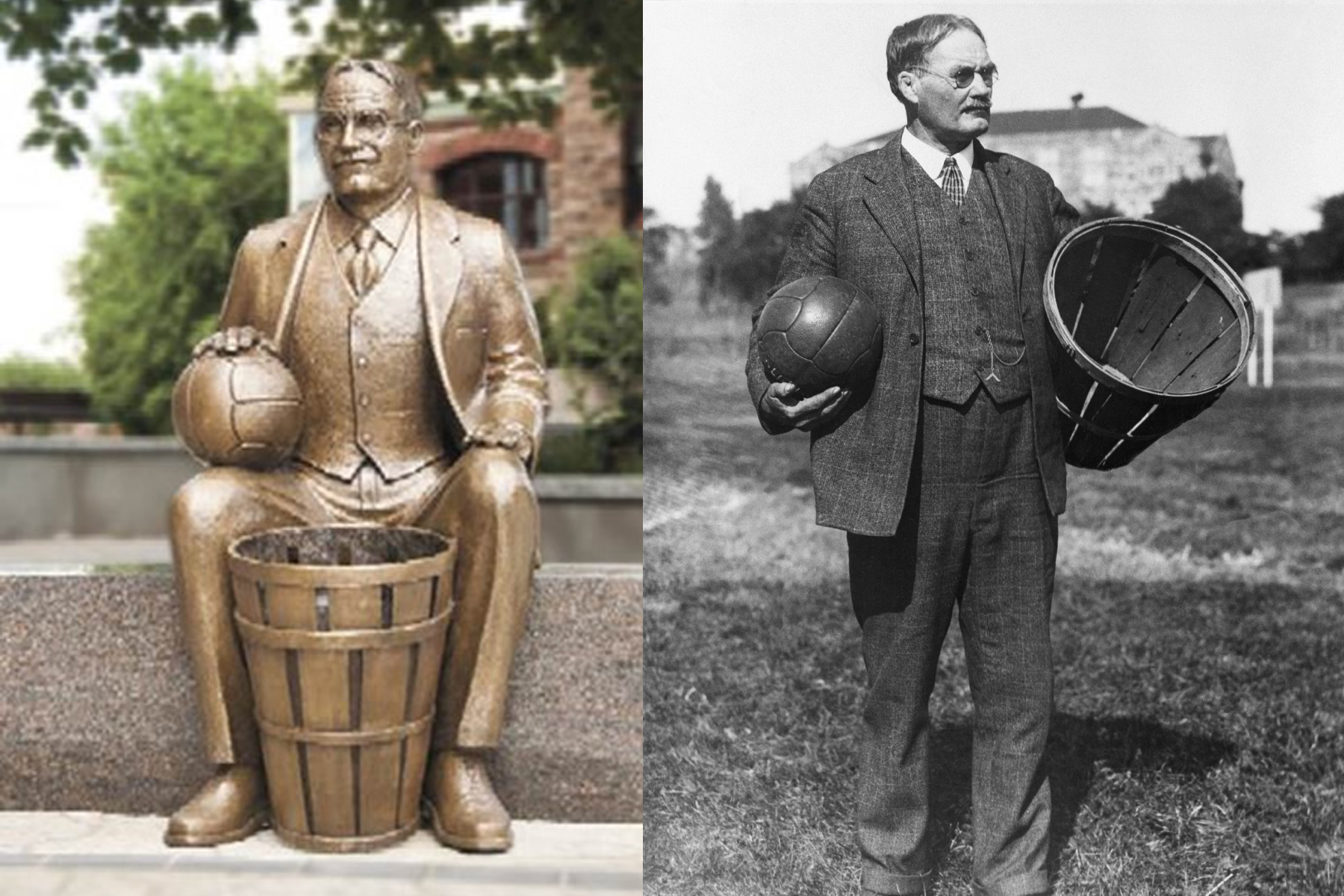
Basketball is one of the most popular sports worldwide, so its Canadian roots often come as a surprise for fans of the game.
Origins of the infamous sport trace back to 1891, when Canadian Dr. James Naismith invented the game at the International YMCA Training School in Springfield, Massachusetts.
Naismith, an educator and physician, was given a challenging task by his superior, Dr. Luther Gulick, who wanted a fresh, engaging sport to be played indoors during the harsh New England winters. The existing sports at the time, such as football and rugby, were too rough for indoor play, while others like soccer and lacrosse lacked the structure needed to be effectively played in a gymnasium. Drawing inspiration from childhood games he played growing up in Canada, including “Duck on a Rock,” which was played by throwing a small object to knock another off a larger base, Naismith set out to develop a game that would prioritize skill over brute force while still promoting physical activity and teamwork.
To create a set of rules, Naismith focused on a few principles that would make the game unique. He determined that running with the ball should not be allowed to reduce the roughness of play, and that players would pass the ball instead, emphasizing cooperation. He also wanted to eliminate aggressive physical contact, which led to the idea of placing the goal above the player’s heads to discourage direct attacks on defenders. Rather than using goals like those in soccer or hockey, he decided that the ball should be thrown into a horizontal goal, originally a peach basket. This setup required players to develop precise shooting skills instead of relying on sheer force to score.
On December 21, 1891, the first-ever basketball game was played in Springfield’s YMCA gymnasium. Naismith assembled a group of 18 students and divided them into two teams of nine. The game started with a soccer ball, which was the closest available option, and the two peach baskets were nailed to the balcony railing at each end of the gym. Without a hole in the bottom, the ball had to be manually retrieved from the baskets each time a point was scored, a process that was later changed by cutting out the bottom of the baskets to allow the ball to drop through.
The game immediately captured the attention of students, who enjoyed the combination of strategy, movement and shooting. Although the first match ended with a final score of 1-0, the potential of the sport was undeniable. Word of the new game spread quickly through the YMCA network, leading to its adoption at various locations across North America. Within a few years, modifications were introduced to improve gameplay, including the introduction of a backboard to prevent spectators from interfering with shots and the eventual switch from a soccer ball to a specifically designed basketball.
As basketball continued to evolve, it rapidly gained popularity beyond YMCA gyms. In 1893, women began playing the sport after it was introduced at Smith College, with modified rules to accommodate differences in physical endurance and playing style. By 1898, the first professional basketball league, the National Basketball League (NBL), was formed. While it lasted only a few years, the league set the foundation for what would later become major basketball organizations like the National Basketball Association (NBA) and the International Basketball Federation (FIBA).
Basketball’s expansion was aided by its relatively simple equipment requirements and adaptability to different playing environments. Unlike sports that required large outdoor fields or specialized gear, basketball could be played in a variety of settings, from gyms to driveways, with minimal modifications. The sport’s emphasis on skill, agility and teamwork made it appealing across different cultures and skill levels, leading to its eventual inclusion in the Olympic Games in 1936.
Dr. James Naismith never sought personal recognition for his invention, viewing basketball as a means of promoting physical activity and moral character among students. Despite its rapid professionalization and commercialization, his original vision remains at the heart of the game.
Today, basketball is played by millions worldwide, yet its origins remain rooted in the simple idea of creating an engaging and accessible sport. The evolution of the game from peach baskets in a YMCA gym to a global sporting spectacle is a testament to the ingenuity of its creator and basketball’s enduring appeal.