
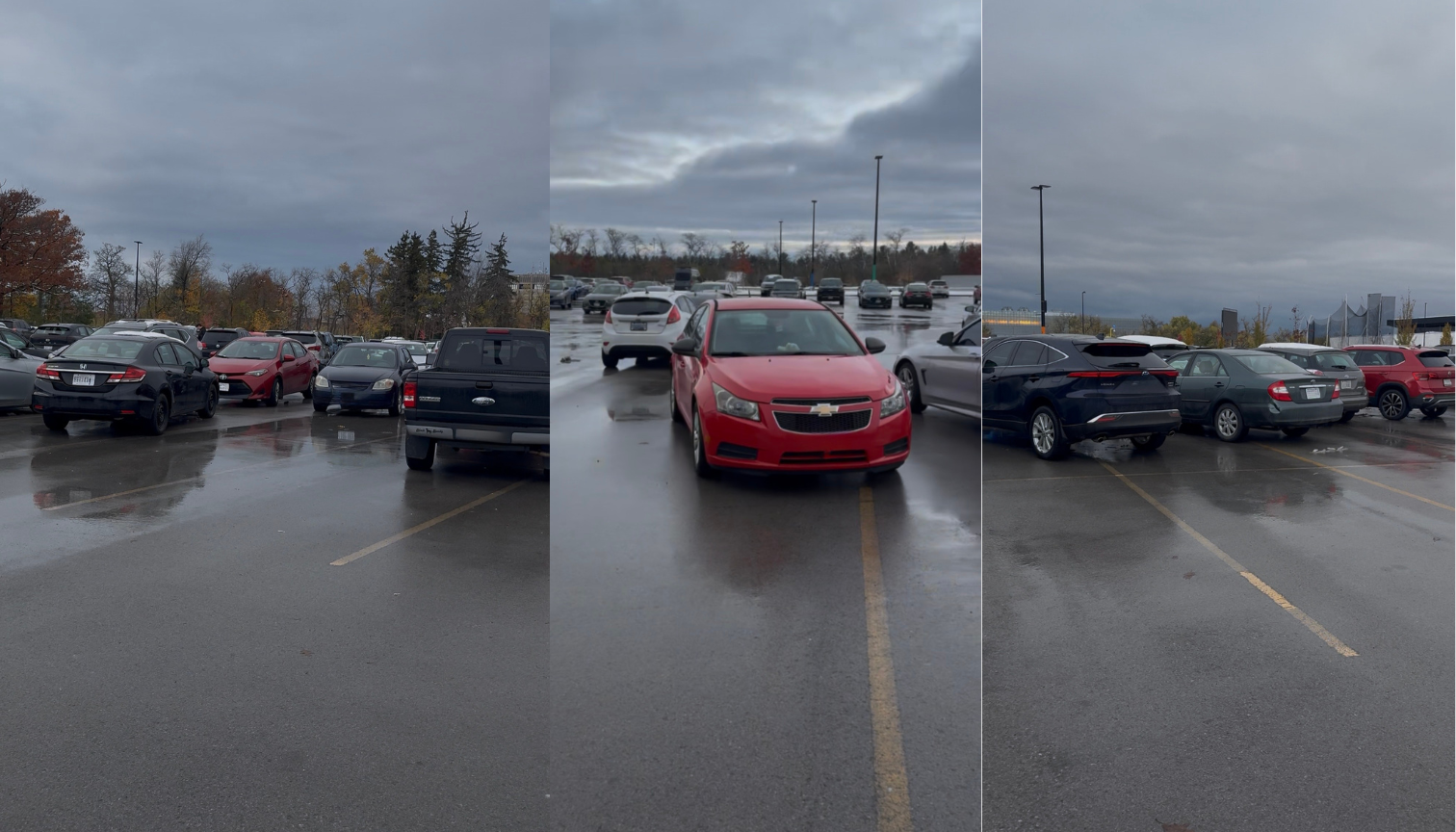
I’m hardly the first to say it, but Lot 2 sucks.
The dreaded walk, the bone-chilling wind, the speeding cars — students know the routine. Aside from the lower upfront cost of the parking pass, there aren’t many upsides to parking there. Lot 2 is consistently frustrating, and in the winter, those frustrations turn into hazards.
As the biggest parking lot on campus, Lot 2 is the catch-all for every car, but there’s a reason it stands apart from the rest: it’s more than just inconvenient. Lot 2 reflects bigger issues with campus planning and the university’s growing car dependency.
With our first snowfall arriving uncharacteristically early, many students were caught off guard. It seems like with every fresh snowfall, drivers forget the rules of the road. The morning of Nov. 10 made this painfully clear. Despite the hard work of maintenance crews, the lot remained unploughed well into the morning, leaving most of the parking lines buried under heavy snow. Without those lines, the entire lot turned into a free-for-all — an unregulated space where drivers were forced to improvise their own parking patterns.
Cars parked in precarious spots don’t just make the lot inefficient — they create hazards for anyone walking or driving through. When the layout of a parking lot disappears under snow, the sense of controlled traffic and predictability goes with it. The failure to maintain Lot 2 properly, especially given its size, creates a domino effect of new problems. In a lot this large, that means hundreds of people were navigating a space without clear order or safety.
This isn’t just a one-time problem; it’s a yearly pattern. When the lot is unploughed or ploughed late, the consequences escalate quickly. An icy, uneven parking surface forces students to park farther away than necessary and walk long distances in conditions that slow them down.
Some unlucky drivers found themselves blocked entirely, boxed in by cars trying to squeeze into whatever space seemed available. When I spoke with Brock’s Parking Services, they told me that on days with persistent snowfall, tickets normally given for taking up more than one spot or parking incorrectly aren’t issued. In other words, the chaos is expected — and tolerated — because the lot and maintenance teams aren’t equipped to handle winter conditions effectively.
But winter doesn’t only magnify the physical challenges of Lot 2; it amplifies the emotional and practical frustrations students already feel. Even on a good day, finding a spot requires time management. You’re not just driving to school — you’re budgeting minutes for looping the lot, hoping something opens up, then calculating how far your eventual spot will add to your walk. In my experience, that walk can range anywhere from five to 15 minutes. In cold weather or rain, that distance feels even longer. Ice and slush slow down foot traffic and the pathways themselves become harder to maintain, creating bottlenecks and slip hazards that the university struggles to stay ahead of.
And it’s not as if students have many walking routes to choose from. There are only two main pathways out of Lot 2 — one toward the Campus Store, and the other looping around the roundabout. Both are inefficient and funnel hundreds of students through narrow pinch points. Worse yet is the formation of desire paths, like the one that cuts across Weather Station Field, a faster route students take out of necessity and one that reveals where the true path should be.
This year, common grievances have gotten noticeably worse. Lot 2 has been uncharacteristically full for most of the semester. More cars mean more congestion, more looping for spots and much longer walking times. The 2021 expansion of Lot 2 added around 700 new spaces, but that expansion pushed parking even farther from the campus core. So, while the lot technically holds more cars, the actual student experience has declined. The distance grows, the pathways remain the same and the winter conditions make everything harder.
This all points to a broader, systemic issue on campus: Brock is becoming increasingly car centric. As the student population grows and schedules become more demanding, more people rely on cars to save time. But not all infrastructure has evolved alongside that shift. Instead, we’ve seen expansions of lots and roadways without parallel improvements in walkability, building placement or public transit support. The campus becomes less of a community space, and more of a place that students simply move through as efficiently as possible.
Students paying for Lot 2 passes deserve better. If the university intends to keep relying on Lot 2 as a primary parking hub and overflow lot, it needs to start investing in making it more usable. That means more frequent snow removal; earlier ploughing on storm days; and clear, maintained pathways that support students walking to and from the lot. It means rethinking the layout to reduce congestion and improve traffic flow. It means acknowledging that a 15-minute walk in winter conditions is more than an inconvenience — it’s a preventable barrier to accessibility and safety.
Until those changes are made, those of us parking in Lot 2 — whether by necessity or because permits sold out early — are left with diminishing returns.
Lot 2 is the university’s largest parking lot and by extension its most profitable, but the students who rely on it daily often feel overlooked. Recognizing their experience and investing in meaningful improvements would go a long way toward making Lot 2 functional rather than frustrating. For now, it remains a daily reminder that car dependency without thoughtful planning leads to inefficiency, discomfort and the erosion of student life on campus.