

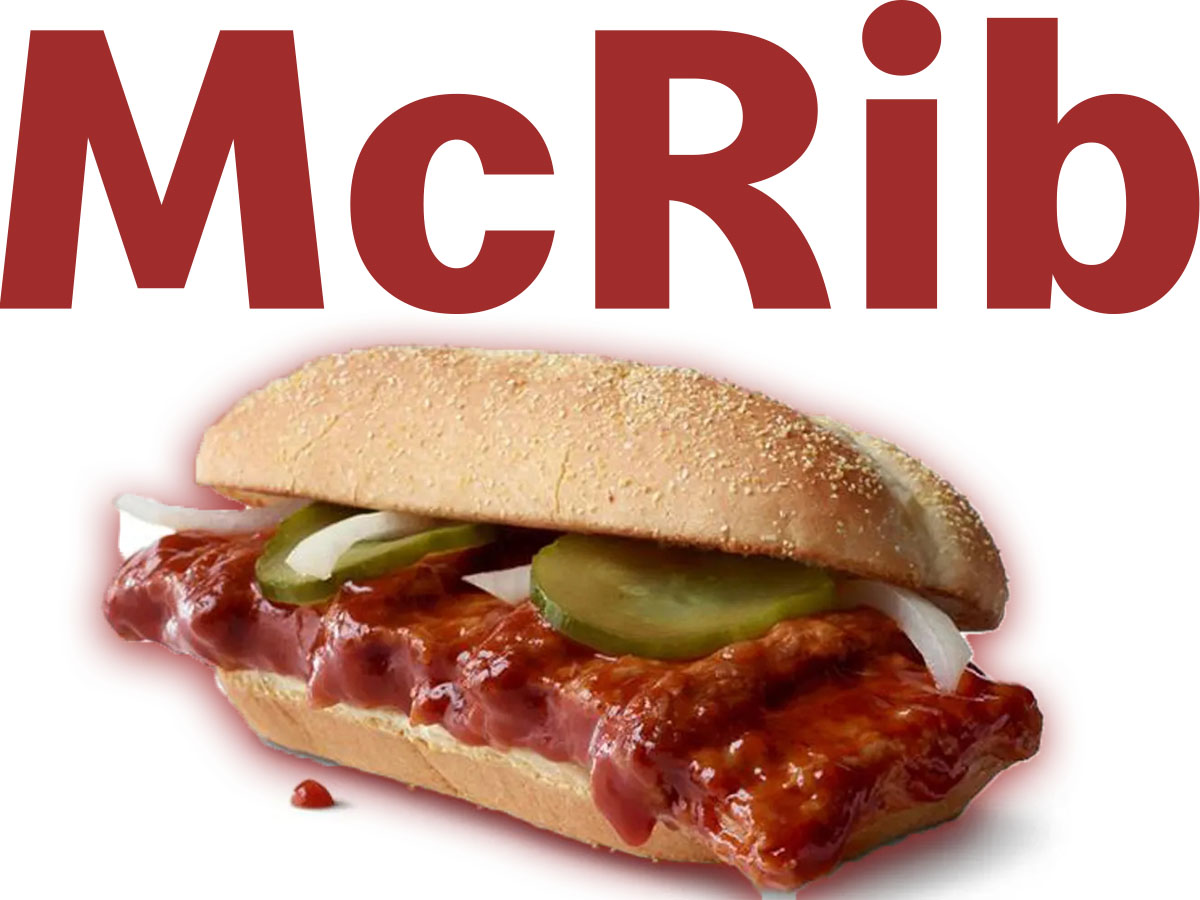
McDonald’s has removed the McRib yet again, and this is nothing less than a modern-day tragedy.
On Jan. 30, after 10 long years of silence, McDonald’s finally gave fast food connoisseurs what they’d only ever dreamt was possible: the return of the legendary McRib.
The McRib is far more than your average fast-food junk. The sandwich has attained legendary status as a cult classic edible icon, unrivalled in its ability to strike joy into the hearts of fast-food fans every time it makes a return.
The return of the McRib was, of course, noted by the dedicated fan-run McRib Locator website, through which users can report local “sightings” of the McRib for fellow fans to keep track of its availability.
This was big news for McDonald’s Canada, something the brand obviously recognized through its intense Instagram “McRib Mania” promotion. The caption of the post announcing the McRib’s return notes that the company is “[preparing] for chaos” with the announcement and acknowledges the decade-long wait for the sandwich.
So then, if the company is aware of the McRib’s acclaim, the question remains: why are they taking the McRib away from us yet again?
Having only ever heard the legend of the McRib, I had never actually tried one until this promotion, and I can finally see what I’ve been missing out on. The McRib is truly something special; it is a phenomenon that should be experienced by everyone who enjoys fast food, McDonald’s and pork ribs.
Well, okay, maybe that’s not entirely true. The meat in McRibs isn’t actually sourced from the bony parts of a pig; according to McDonald’s, they’re pork shoulder patties with a mixture of spices moulded to look like a boneless rib. I suppose that sounds a bit less appetizing.
Regardless of the McRib’s not-actually-rib nature, its cultural impact speaks for itself. Fans have been yearning for the meal’s comeback for a decade, and to strip that away after a mere month on the market is unfair and cruel.
And even if the McRib isn’t actually made of pork rib, the flavour is practically indiscernible. If you turn off your Internet search browser, close your eyes and pretend you’re biting into an authentic pork rib, it feels as though you truly are.
But let’s not forget that there’s more to the McRib than this mysterious slab of meat.
Each McRib comes slathered with a tangy barbeque sauce that perfectly complements the “rib.” While McDonald’s can be somewhat stingy with the amount of sauce they put on each McRib, the actual sauce itself is still incredible.
Plus, I discovered that ordering a McRib with an extra meat patty tends to yield substantially more sauce than its single-patty counterpart – so keep that in mind when the sandwich inevitably returns in another 10 years.
The onions on the McRib add a nice crunch to the otherwise soft sandwich, giving it some much-needed texture. As for the pickles, I usually take those off since I can’t stand them – but if you’re into that sort of thing, the McRib’s got you covered.
Combine all these elements and slap them together in a soft, flaky bun, and you’ve got a sandwich fit for a king. As if that wasn’t good enough, the easy availability and cost-effective pricing makes the McRib’s status as a cultural phenomenon easy to understand.
At this point in time, it’s unclear why McDonald’s has decided to kill the McRib yet again. It seems like the company wants the McRib to remain an elusive legend that only reappears every few years, but the sandwich’s never-ending fanfare should be more than enough reason to make it a permanent addition to their menu.
It could be argued that the McRib wouldn’t be quite as popular if it were a permanent menu item. Maybe McDonald’s wants the sandwich to be a mainstream event every time it comes around, which is understandable albeit still painful. Even still, forcing fans to wait a decade to enjoy their beloved sandwich just seems cruel. If they’re able to order the products necessary to create a McRib anytime they please, there shouldn’t be much of a problem from a manufacturing standpoint – so what’s the deal?
Alas, McDonald’s seems insistent on stripping the McRib out of the public’s grasp. Whatever the reason may be, and no matter how cruel McDonald’s corporate overlords are for doing so, it seems that there is not much for fans to do but mourn the loss of the McRib yet again.
Losing the McRib is a modern-day tragedy and no amount of Big Macs will ever fill the void it is leaving behind.