

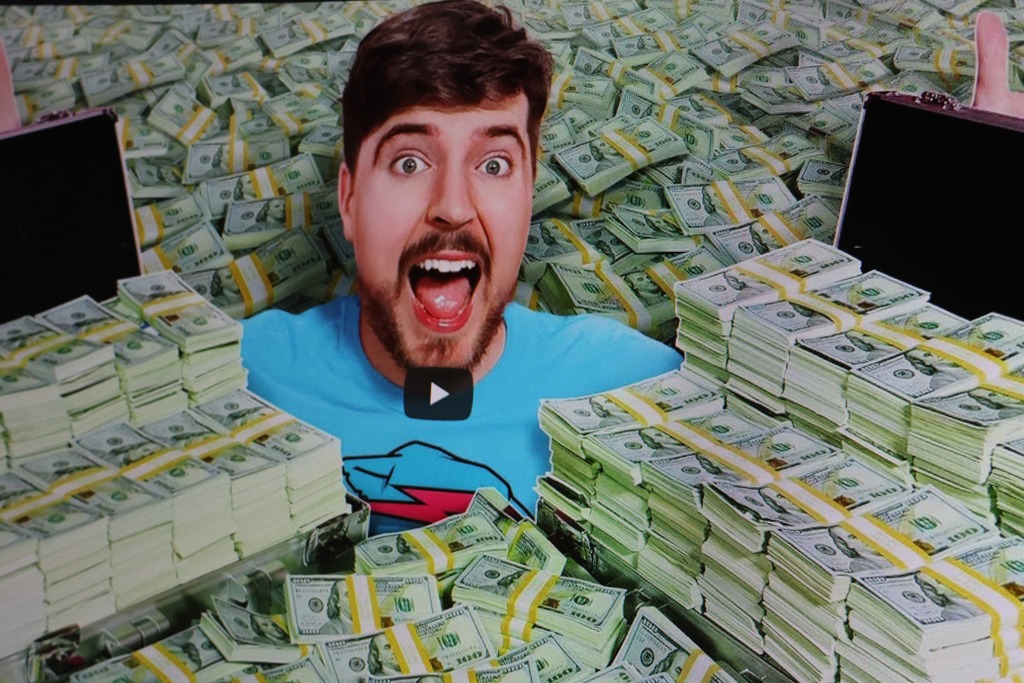
Online superstar MrBeast isn’t directly to blame for YouTube’s downfall, but his impact has been detrimental to the platform’s culture.
To say that MrBeast is influential to today’s youth would be an understatement.
MrBeast, whose real name is Jimmy Donaldson, has amassed a jaw-dropping 182 million subscribers on his primary YouTube channel as of writing. This makes him the most-subscribed individual on the platform, only beaten by the likes of a major music corporation, which Donaldson is eager to overtake.
Donaldson’s immense fame can be credited to the outrageous stunts, challenges and giveaways that he performs in his videos. Last year, Donaldson stated that he spent at least $3,000,000 each month on his main channel, not to mention his various side channels and projects.
Last week, longtime YouTuber Seán McLoughlin, better known as Jacksepticeye, revealed his belief that MrBeast has ruined the video platform. In a now-deleted post on X, formerly Twitter, Donaldson expressed his frustration with McLoughlin’s comments, calling the clip “insanely disrespectful”. While the two have since made amends, McLoughlin has still raised an interesting topic of conversation.
While Donaldson’s willingness to financially help others is commendable, his video style and its growing popularity have ultimately negatively impacted the site’s culture – yet he is not directly at fault.
With Donaldson’s ascent to the top, a swarm of MrBeast wannabes hoping to replicate his success have been on the rise. Many of these creators copy Donaldson’s style of focusing on expensive or large quantities of items, and like Donaldson, try to create video titles that are so outrageously impressive – “$1 vs $1,000,000,000 Yacht,’ ‘Last To Take Hand Off Jet Keeps It,” “I Gave My 100,000,000th Subscriber An Island” – that a viewer simply has to click.
Unfortunately, not every one of these creators has mastered the art of combining an exciting video concept with compassion in the way Donaldson has.
Take the channel Fidias’ video, with one video’s title proudly proclaiming “I Spent 100 Hours In The World’s Poorest Country”. In the video, Fidias attempts to experience life in the poverty-stricken country of Burundi. While the creator expresses some semblance of goodwill near the video’s end through a fundraiser, he has undeniably missed the point of MrBeast’s content through his attempt to make a game out of living life in poverty.
Donaldson’s approach to challenge videos is different: his renditions force him to spend time in Antarctica, stranded on a raft at sea or even buried alive. The idea to use people living in poverty for a clickbait title is no less than dehumanizing, making visiting the country of Burundi seem like an entertaining challenge in order to accumulate views.
While Fidias’ video idea was certainly degrading, it was at least original. The same cannot be said for those who create counterfeit versions of already-released MrBeast content. Take the Stokes Twins, who uploaded a video in which they attempt to win every prize in a theme park. This would certainly have been an interesting concept if MrBeast hadn’t done the same thing two years earlier. Perhaps you’re interested in watching Ian Boggs’ experience in Slab City, which is supposedly lawless – but you might as well watch MrBeast’s original version first.
The list goes on and on, and each one of these copycat videos reeks of unimaginative greed. After all, if copying MrBeast’s ideas clearly brings in plenty of views, why bother creating any original concepts yourself? This removes any need for imagination and creativity, and instead relies on the hope that younger viewers who haven’t seen Donaldson’s original content (or simply don’t care about the nature of copycat content) will still drive up the video’s view count.
These copycats extend around the world and cover many different languages, meaning those who don’t speak English might come across a copycat’s video without even realizing MrBeast exists. Just look at the Russian channel A4, who has amassed upwards of 47,000,000 subscribers despite being known in North America as a notorious MrBeast plagiarizer.
Donaldson himself has complained about his legion of copycats, saying he regrets sharing “everything [he knows] about YouTube” and expressing disappointment that his content-creation tips haven’t been used for the positive inspiration within the space he’d hoped for.
This issue extends beyond only this video genre and has led to an effect online users have dubbed the “MrBeast-ification” of YouTube. In short, many modern YouTubers have seemingly adopted the mentality that large production budgets are required to appeal to the site’s algorithm.
Additionally, creators prioritize Donaldson’s filming and editing style, which involves a lot of shouting at the camera, consistent text on screen and rapid-fire jump cuts. Before long, each of these creators’ videos begin to blend into each other, and they feel like soulless attempts to exploit the algorithm through eye-catching titles and thumbnails rather than inspired and original works of digital art.
Compare this with the period of YouTube that allowed McLoughlin to rise to fame. While there have always been problematic creators on the platform, it felt as though many popular YouTubers were making content for a different reason – to engage with fans, explore their topics of interest, collaborate with others and have fun. I believe that McLoughlin’s era was one of creativity and inspiration, and while there are certainly still many YouTubers who keep hold of this ethos today, the content market has become oversaturated with those who simply hope to become the “next MrBeast.”
Despite this, I would disagree with any claim that Donaldson is directly responsible for YouTube’s current state. Donaldson is clearly passionate about YouTube and continues to grow through his incredibly creative ideas. Donaldson seems to have a creative mind unlike any other on the platform, displayed through his consistent creation of original yet entertaining video concepts. Despite his video style becoming plastered all over the platform in an attempt to appeal to the algorithm, Donaldson is arguably more emblematic of old YouTubers in the sense that he is passionate about making original content.
The issues plaguing YouTube today are not the fault of Donaldson; rather, those who are uninspired and hope to rise to fame through someone else’s creativity are to blame. It is unfair to blame MrBeast for his constant innovation – those who actively make the content that is hurting YouTube’s culture are the ones who should be held accountable.