

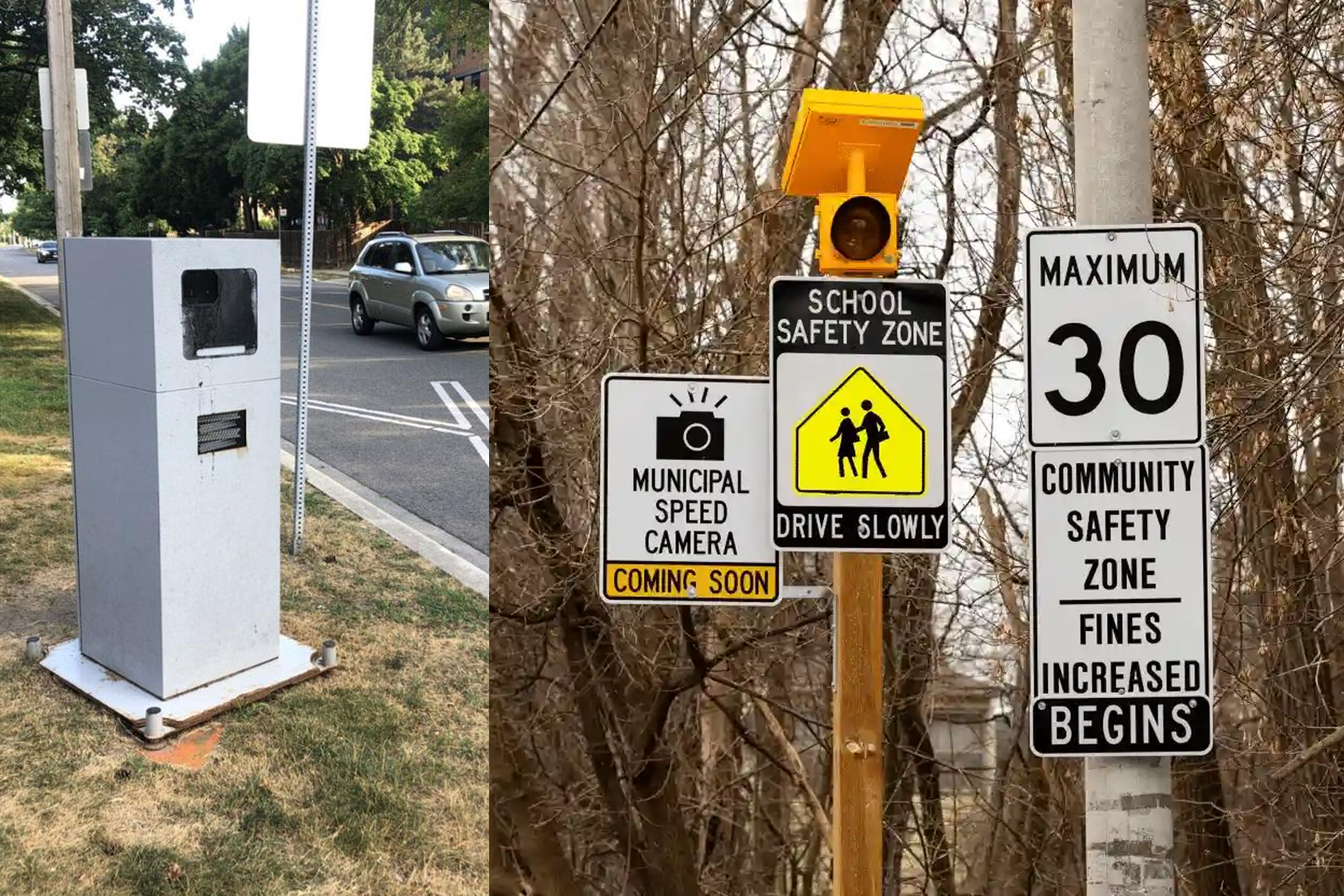
On the morning of Oct. 20, parents gathered at schools across the province to protest the Ford government’s plans to terminate the speed safety camera program. This day of action centred on the important role speed cameras play for families and young children across Ontario.
Tomas DeVito, the organizer for the Toronto West protest at Perth Park, explained that “school zones are where we’re focused […] generally the technology is strong, and it works.”
A father who lives about two blocks away from the protest expressed concern about Premier Doug Ford’s plans to remove speed cameras from community safety zones.
“My daughter, she is three years old, she is very rambunctious; she and her friends are out […] traversing these streets every single day […] going to and from the school, going to this park, going to Carlton park, [and] going to a whole bunch of other kinds of neighbourhoods,” said the community member.
“Ask any parent, we’ve all had feelings where you are panicked,” he continued. “Nine times out of ten, in my experience, that feeling is coming from an interaction with an unsafe vehicle […] speeding is one of the leading causes of injuries and fatalities for children in Canada, so it is statistically very dangerous.”
The father expressed that regulatory speed mechanisms like cameras are “common-sense tool[s]” to protect children from car-related dangers and said that it should not be an issue that divides communities across political lines.
“[Speed regulation] protects people no matter what kind of ideology you have. It protects something that I think universally we all care about, which is our kids,” they added.
Others at the protest echoed similar sentiments. Michelle, a mother of two, said that her family often opts to walk or bike around their neighbourhood, sparking concern at Ford’s decision to remove automatic speed enforcement tools.“I know that the Parkside Drive street cameras were originally put there due to community advocacy because of the dangerous driving that included the death of a senior couple,” said Michelle.
Michelle described that, while measures proposed by the province like speed bumps might work in the suburbs, schools in Toronto tend to be located along emergency routes where speed bumps are not as feasible.
For Michelle, removing speed cameras will “definitely make [her] extremely nervous because [kids] are going to school across a crosswalk, and then as soon as [they] cross there is a speed camera that mitigates a blind turn.”
“[It will] really impact my ability or my confidence in [the kids] to walk to school when they’re old enough without me — and we want to raise independent children who can walk in the neighbourhood without having a parent with them,” said Michelle.
Michelle expressed that Ford’s decision does not reflect the needs of Toronto’s downtown neighbourhoods, saying that she would rather listen to Mayor Olivia Chow’s opinions on the topic. Provincial NDP MPP Alexa Gilmour echoed Michelle’s concern while attending the protest at Perth Park, going on to say that “traditionally, speed cameras are a municipal issue and really should be a right. The municipality is the closest on the ground; they’ve got the statistics on the safe streets [and] they are speaking to the community members.”
Gilmour said that many community members hold the belief that speed regulation plays an important role in communities and expressed that there are other pressing issues to focus on at the municipal level.“The only people who want to remove speed cameras are vandals, criminals, people who like to speed,” said Gilmour.
Gilmour noted that, though Ford has called speed cameras a “cash grab,” the money collected from them in Toronto goes back into making the city safer, saying that other safety measures Ford is proposing will cost taxpayers as well. When addressing the claim that speed cameras ticket at ambiguous thresholds, Gilmour mentioned that the Toronto Star had recently put out a report stating that no one gets a ticket unless they go 11 km/h over the posted speed limit.
“We’ve got much bigger issues at the provincial level to be managing […] we’ve got 800,000 people unemployed right now and the premier […] has us all talking about speed cameras,” said Gilmour.
Brock University Labour Studies Professor Jordan House — who happens to live in the neighbourhood where the protest was held — also weighed in while at an adjacent march to keep school trustees and increase funding for education.
“Speeding is a problem in this neighbourhood like it is all over the city, from my understanding. Speed cameras are an effective way to reduce speeds and save lives, and I support speed cameras,” said House.
“The Ontario government has been underfunding the public education system for many years and has recently attacked basic principle democracy by taking control of school boards,” he continued. “I think that this is a blatant attack on children’s education and their future.”
Another protestor by the name of David said he decided to protest due to the fact that he has “watched the Ford government just buffoon their way through so many of our rights that [he’s] been taking it to the streets.”
“I’ve had enough,” said David.
The Perth Park speed camera protest lasted a little over an hour as the province continues with plans to remove speed cameras.