
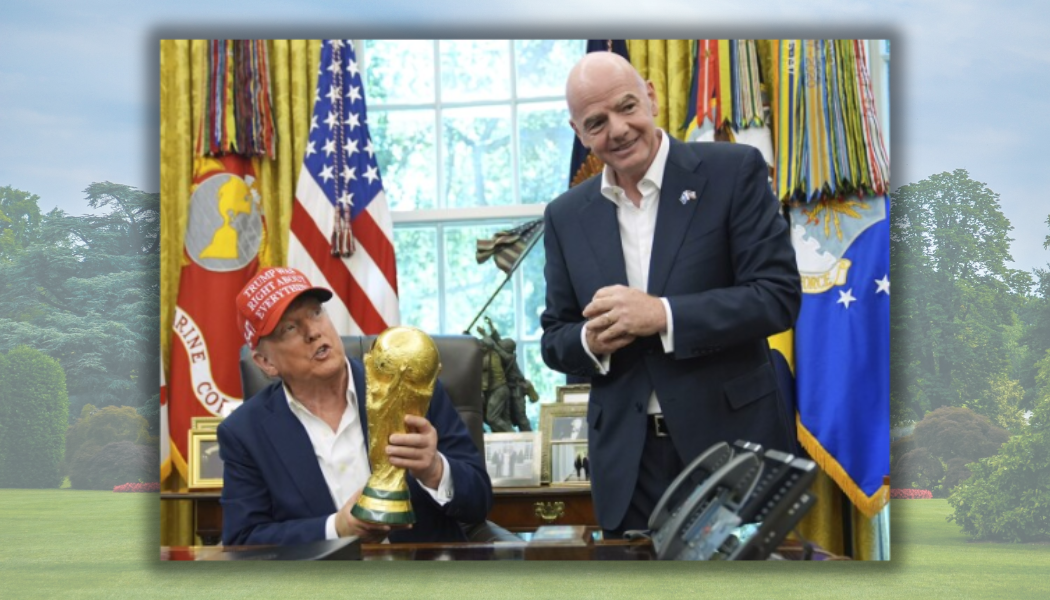
On Nov. 17, U.S. President Donald Trump met with FIFA President Gianni Infantino and other senior officials in the White House’s Oval Office to formalize elements of the federal government’s support for the upcoming 2026 FIFA World Cup, which the U.S. will be co-hosting with Canada and Mexico.
During the meeting, the administration unveiled the “FIFA Pass” visa-fast-track initiative: foreign nationals who have purchased World Cup tickets will be eligible for expedited visa appointment scheduling. Secretary of State Marco Rubio clarified that while ticket holders will receive priority interviews, they will still undergo full consular vetting.
However, what captured broad attention and controversy was President Trump’s remarks regarding the possibility of relocating matches from U.S. host cities that he deems unsafe or politically “troublesome.” In his remarks, Trump singled out Seattle, one of the 11 American cities slated to host matches, specifically referencing the city’s mayor-elect and suggesting that if there were “signs” of trouble, he would ask Infantino to move the games to another city.
Infantino did not commit to any relocation but emphasized that security and safety are FIFA’s top priorities. It is worth noting that host city assignments for the tournament were finalized by FIFA in 2022 and are supported by contracts and logistical arrangements.
Trump’s implication that U.S. host cities that challenge federal policy or are governed by political leadership that he views as adversarial could lose World Cup matches has raised questions about the independence of the tournament’s planning process and the role of politics in a global sporting event. While Trump did not explicitly reference “blue states” in his remarks, his mention of Seattle’s mayor elect as “very, very liberal slash-slash-communist” signals the overlap of political belief with venue security.
Local leaders from the targeted cities responded swiftly. Seattle officials emphasized that planning remains on track and that the city has a history of hosting major global events. In Massachusetts, where the city of Boston is set to host several matches at Gillette Stadium, Mayor Michelle Wu dismissed the notion that the president has the power to unilaterally strip the games away, invoking the contractual and procedural protections built into FIFA’s selection process.
From a broader perspective, the episode reflects the tension between sport governance norms — which emphasize autonomy of associations like FIFA and predetermined agreements — and national political priorities. The U.S. government has mobilized significant resources for the 2026 World Cup, including hundreds of millions in security funding for host city law enforcement and infrastructure needs, even in cities that have sanctuary city status and are governed by political leadership often at odds with the federal administration.
For the plain facts: yes, Trump and Infantino met and launched the visa initiative; yes, Trump threatened to move matches from cities he deems unsafe; no, there is no publicly available record that matches have been officially reassigned or contracts terminated as of now. The threat itself appears to be more rhetorical, though its implications are serious for host city relationships, planning certainty and international perceptions of U.S. sporting governance.
In effect, the coordination between the U.S. government and FIFA is proceeding in parallel with a potential wedge driven by domestic political considerations. For the cities scheduled to host, especially those governed by progressive leadership, the message is as preparation continues, they are now operating under a new risk factor, one fueled by the possibility of federal or political intervention rather than just logistical or security challenges.
As the tournament draws closer, the tension between global sporting norms and domestic political dynamics will remain a story to watch.