
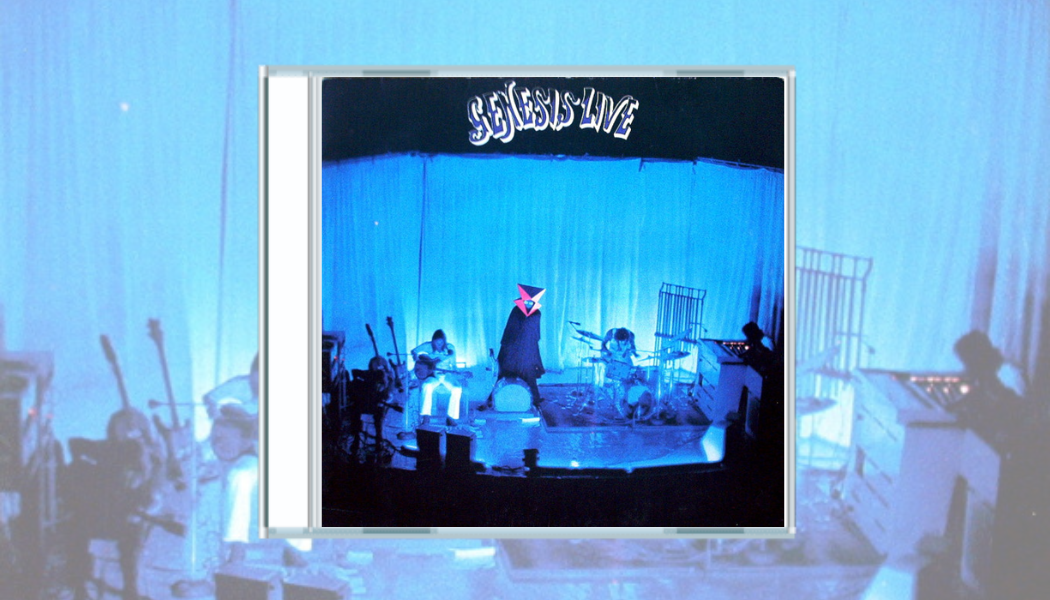
Before sold out stadiums, “In the Air Tonight” and slick 80s pop production, Genesis was an entirely different beast. They were the stranger, darker cousins of the British progressive rock explosion, weaving complex, Victorian-tinged fairy tales backed by virtuosic musicianship. In 1973, Genesis released what remains one of the most visceral documents of theatrical rock history: Genesis Live.
For today’s students who are exploring the roots of modern spectacle rock — from Muse to Florence + The Machine — this album is essential listening. It captures the definitive five-man lineup, Peter Gabriel (lead vocals and flutist), Tony Banks (keyboards), Mike Rutherford (bass and guitar), Steve Hackett (guitar) and Phil Collins (drums and backing vocals), right at the precipice of their greatest artistic peak, delivering a performance that is rawer, faster and far more aggressive than their studio counterparts.
Recorded during the tour supporting their masterpiece Foxtrot, Genesis Live 1973 was originally intended as a budget stopgap release to appease their label while working on their next album. Instead, it became a legendary snapshot of a band that had honed its live act into a tight, powerful weapon.
While Genesis’ studio albums of this era, Nursery Cryme and Foxtrot, are revered for their intricate, pastoral beauty, Genesis Live tears away the polish. The driving force here is the rhythm section. Collins’ drumming is nothing short of ferocious, providing a jazzy, muscular backbone that propels complex time signatures forward with alarming speed. Rutherford’s bass pedals shake the floorboards, grounding the ethereal textures of Tony Banks’ keyboards and Hackett’s distinctively eerie guitar work.
But what makes this era of Genesis truly mythical isn’t just their music: it’s the “rock theatre” concept spearheaded by their frontman Peter Gabriel. And this is where reviewing an audio-only live album gets tricky; how do you convey visual spectacle through sound?
The genius of Genesis Live is that you don’t need to see the footage to feel the theatrics. Gabriel’s vocal performance is deeply rooted in acting. He isn’t just singing songs; he is inhabiting characters, shifting his tone from a fragile old man to a mysterious narrator in a heartbeat.
Take the opener, “Watcher of the Skies.” On stage, this was Gabriel’s grand entrance. He would appear wearing bat-like wings on his head, glowing fluorescent makeup around his eyes, backlit by ultraviolet light to appear as an alien presence surveying a dead Earth. On the album, you hear this translated into the ominous, swelling groan of Banks’ mellotron intro, followed by the urgent, staccato rhythm that sounds like a ticking doomsday clock. Gabriel’s vocals are distant and imperious, perfectly matching the visual persona.
The centrepiece of the album, the 10-minute-plus “The Musical Box,” offers the best example of audio-visual synergy. The song is a macabre Edwardian ghost story. On stage, during the quiet instrumental middle section, Gabriel would slip offstage and return wearing an old man mask and a zippered chest piece. As the song built to its climax — a furious release of sexual tension from the perspective of a rapidly adding spirit — Gabriel would rip at the chest piece, miming the song’s violent conclusion.
On the record, you hear this climax delivered with frightening intensity. The band accelerates and Gabriel is practically screaming the final lines: “Touch me! Now, now, now!” The energy is palpable. You can hear the sweat and adrenaline that the studio version damped down.
The album closes with “The Knife,” a proto-punk track from their earlier days that the 1973 lineup transformed into a heavier beast. It was the moment in the show where Gabriel would stalk the stage with the microphone stand held like a bayonet, embodying a dangerous revolutionary leader. The recorded version bursts with a chaotic, militant energy that feels genuinely threatening.
It is worth noting one significant omission: my favourite, the side-long epic “Supper’s Ready” was performed on this tour but left off the original LP due to time constraints. While its absence is felt, the five tracks that remain form a tighter, punchier listening experience.
That absence, however, implies a missing piece of the visual puzzle, as “Supper’s Ready” served as the surrealist anchor of the show. It was during this performance that Gabriel’s costume changes shifted from merely strange to truly hallucinogenic. Audiences witnessed him transforming into a flower with a petal-wreathed mask for the “Willow Farm” section, later donning a geometric box over his head. For the spiritual finale, he would emerge in a shimmering silver suit as the “Man-Gog,” appearing to levitate above the stage while wielding a fluorescent tube like a sword of light. While the Genesis Live LP captures the band’s sonic grit, leaving this track on the cutting room floor meant omitting the very apex of their theatrical mythology.
Genesis Live is more than just a concert recording. It is an audio photograph of a moment when music ambition and theatrical absurdity collided perfectly. It is gritty, imperfect and undeniably thrilling — a testament to a time when rock music dared to take itself very seriously, and in doing so, created magic.