
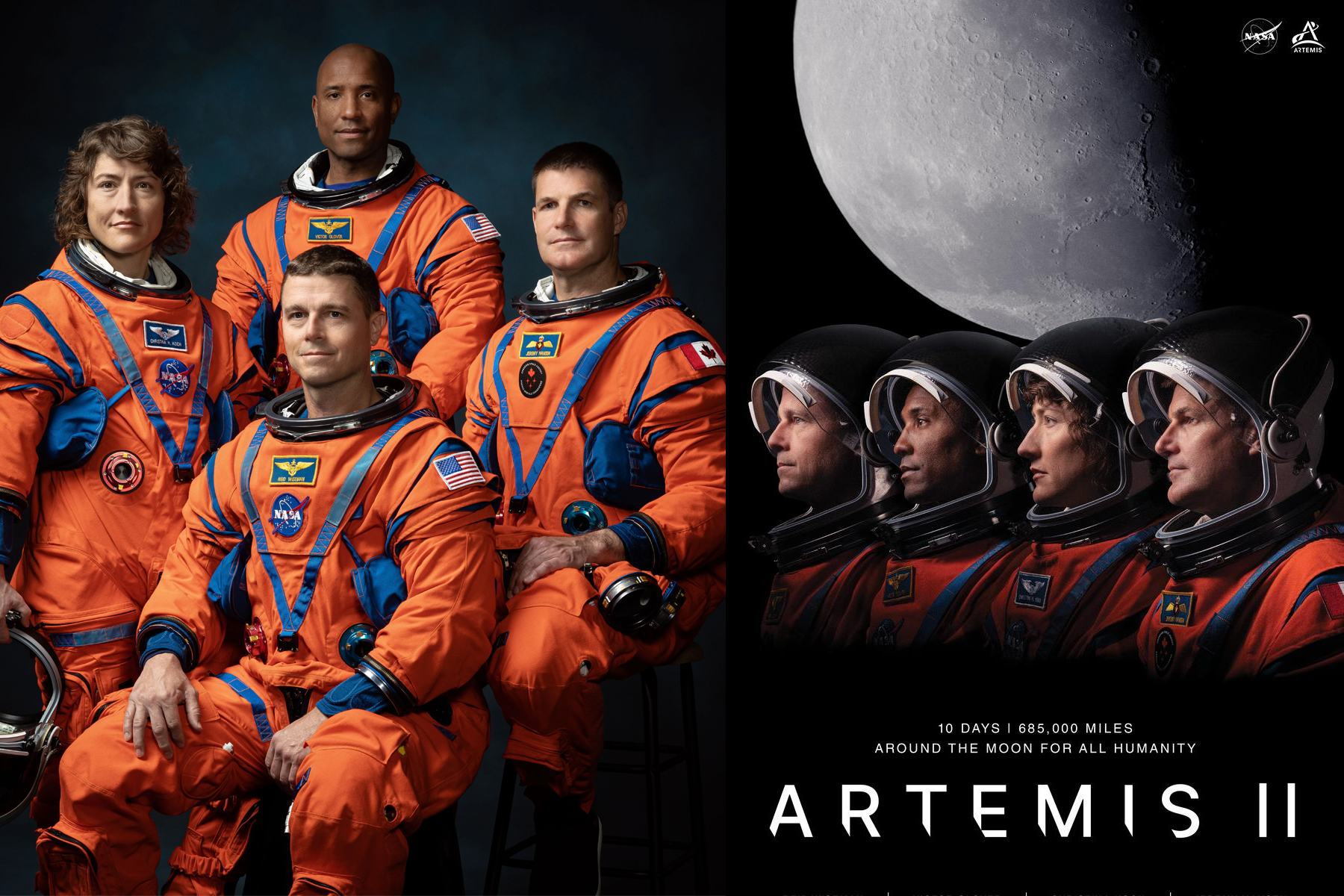
Now more than 53 years since humans last went to the moon, NASA will be going back with the Artemis missions.
Spending more than nine years in development and facing countless setbacks, the crew of Artemis II could return to the moon as early as early March. Though these astronauts will not be touching down on the moon yet, Artemis II symbolizes many milestones for space advancement and innovation.
Artemis II will mark the first crewed test flight of NASA’s human deep space capabilities, including the Space Launch System (SLS) rocket and Orion spacecraft, pushing humans further into space than ever before and paving the way for future lunar missions.
Onboard Orion, the Artemis II crew is made up of some of the world’s most highly qualified pilots and scientists, including the first Canadian selected to travel to the Moon.
Mission Commander Reid Wiseman, a former NASA astronaut and retired U.S. Navy captain, previously logged 165 days aboard the International Space Station (ISS) during Expedition 41 in 2014. Pilot Victor J. Glover Jr. most recently served as pilot for Crew-1 aboard SpaceX’s Dragon spacecraft, the company’s first crewed flight to the ISS. Mission specialist Christina Koch has logged the most cumulative time in space of the crew, completing a single spaceflight lasting 328 days and being a part of the first all-woman spacewalk.
While three members of the crew have prior spaceflight experience, Artemis II will mark Canadian recruit Jeremy Hansen’s first journey into space. Hansen is a former fighter pilot selected by the Canadian Space Agency. He completed astronaut candidate training, participated in the European Space Agency’s CAVES program, and was a crew member of NEEMO 19, where he lived and worked on the ocean floor in the Aquarius underwater habitat for seven days, becoming the mission’s only aquanaut.
Nearly 54 years since last visiting the Moon, the motivations for returning, as noted by astrophysicist Neil deGrasse Tyson in an online video, are eerily similar to the Cold War era thinking that drove the original Apollo missions. As China continues to make rapid advancements in space exploration, the United States has been pushed into what many see as a renewed space race.
Tyson noted that even in the 1960s, while the U.S. reached the Moon first, it did so by leapfrogging several major space achievements previously accomplished by the Soviet Union. He argues the United States is once again taking a reactive rather than proactive approach to space exploration.
The SLS rocket will serve as NASA’s flagship launch vehicle for the Artemis missions. It is set to surpass the Saturn V as the most powerful rocket ever built to carry humans.
Combining design and engineering elements from both the Apollo-era Saturn V rocket and the Space Shuttle program, SLS is flanked by two solid rocket boosters that together generate nearly seven million pounds of thrust during the first two minutes of flight. After burnout, the boosters detach from the core stage and fall back to Earth.
Safety remains fundamental to the Artemis missions. Following the Challenger and Columbia disasters of the Space Shuttle era, NASA designed a launch abort system mounted atop the Orion spacecraft. This system can pull the crew capsule away from the rocket during ascent and safely return astronauts to Earth if necessary. It is jettisoned three minutes and 20 seconds into flight once it is no longer required.
Iconic to the SLS design is its orange “core stage,” which uses the same efficient engines as the Space Shuttle’s and burns liquid hydrogen and oxygen fuel. This process burns extremely clean, producing water as its only byproduct. Roughly eight minutes after launch, the core stage expends its fuel and separates, leaving the Orion spacecraft to continue its journey.
The Orion upper stage carries the crew into low Earth orbit and generates the thrust required to complete the translunar injection, officially plotting Artemis II’s path to the Moon. After four days of travel, the crew will perform a lunar orbit insertion burn, allowing Orion to enter an elliptical orbit around the Moon before using lunar gravity to slingshot the spacecraft back toward Earth.
After spending approximately 10 days aboard Orion, the Artemis II crew will splash down in the Pacific Ocean, completing the mission’s crewed test flight objectives. Following Artemis II, NASA will begin preparations for Artemis III, which is projected to launch in 2028 and will return humans to the lunar surface. Artemis IV will then shift focus toward building sustainable, long-term infrastructure on the Moon.
After years of delays, setbacks and advancements, NASA is finally making its return to the Moon. Artemis II will send humans farther into space than any mission since Apollo 17 and could pave the way for the future of space exploration. The first launch window runs from Feb. 8 to 13, followed by additional windows from March 6 to 11 and April 1 to 6 and 30. While launch times vary, NASA is targeting an evening liftoff.
On Feb. 3 after the discovery of a liquid hydrogen leak, NASA announced they would be formally delaying the launch date until March. When Artemis II does lift off, the mission will be streamed across NASA’s digital platforms in and partner streaming services including YouTube, Facebook and Netflix.