
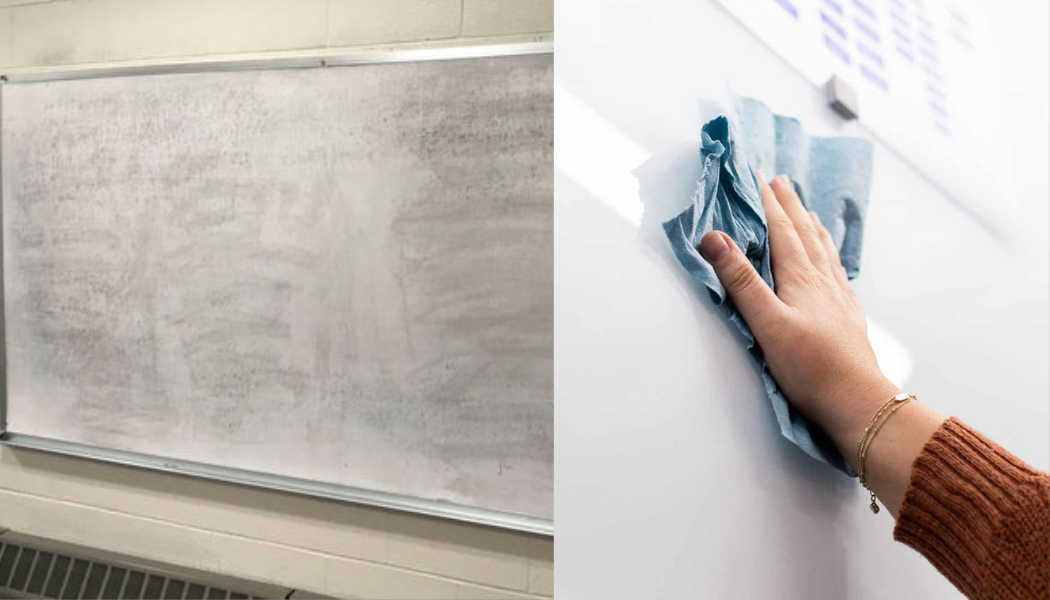
Brock has a whiteboard problem. This year, it seems nearly every whiteboard in every lecture hall is running into the same predictable shortcomings that inevitably befall wall-mounted melamine writing surfaces.
Whiteboards have been the preferred classroom writing surface since the ‘90s. Students and professors alike would be hard-pressed to find a lecture hall or seminar room still equipped with a chalkboard. Yet despite their widespread adoption, whiteboards have not solved the problems of their predecessor — and in many ways, they have created new ones.
In nearly every practical sense, whiteboards are the inferior teaching surface. The most pressing issue is their extremely short lifespan. Whiteboards vary in quality: lower-end models are made from melamine, a cheap and easily degradable material, while higher-end boards are constructed from porcelain or glass, which are far more durable but significantly more expensive.
Given the current state of many whiteboards on campus, it seems Brock primarily installs cost-efficient and easy to mount melamine boards. The drawback is unavoidable deterioration.
Over time, dry pigment residue and environmental wear degrade the surface, causing boards to erase poorly and leaving behind “ghosting” — smudges, streaks and faint remnants of previous writing that never fully disappear.
Ghosting is more than a cosmetic issue. It’s distracting for students and makes the board difficult to read from any distance. Worse still, the only effective way to remove ghosting involves chemical cleaners, which further accelerate the breakdown of melamine surfaces.
In some of Brock’s busiest classrooms, whiteboards have reached a point where they genuinely slow the pace of learning. Watching professors resort to Lysol wipes or hand sanitizer to clean the board is painful, not because they are careless, but because they are trying to compensate for equipment that is no longer functioning properly. Proper cleaning takes time that simply is not built into a lecture schedule — nor should it need to be.
Even when used correctly, melamine boards are not designed for the sustained, high-volume use demanded by a university environment. Upgrading to higher-end whiteboards or glass panels would improve durability, but it would not address a larger issue: whiteboards themselves may not be the superior teaching tool they were assumed to be.
No matter the brand of dry-erase marker, visibility remains inconsistent. Markers often lack the pigment strength needed for students seated farther away, and poor handwriting becomes even harder to decipher on a slick reflective surface.
Chalkboards rarely suffered from these problems. Though often dismissed as outdated, chalk remains unmatched in its ability to deliver legible, high-contrast instructional material from any viewing angle and across greater distances. Yes, chalkboards were messy, but the lingering chalk dust served as proof that learning had occurred — an aesthetic inseparable from academia itself.
What is most frustrating is that in an era when many students take notes digitally, whiteboards feel increasingly out of step with how learning actually occurs. Professors who use digital white boards can save notes and later post them online.
Rather than simply replacing deteriorating melamine boards with identical ones, Brock should reconsider its approach altogether. Investing in glass boards, reintroducing chalkboards where appropriate, or expanding the use of digital note-sharing platforms. These changes would offer professors flexibility while encouraging greater accessibility for students. As more instructors already post materials online, integrating digital tools into teaching may ultimately solve problems that neither chalk nor whiteboards ever fully addressed.
Whether one prefers whiteboards or chalkboards, OneNote or Notion, one point is clear: Brock — like many universities — still has improvements to make in the teaching materials provided to professors. Innovation in classroom technology should complement, not replace, methods that have long supported clear thinking and engagement.
Technology may change the classroom, but its most powerful instruments remain unchanged: an educator, a willing mind, and a canvas where ideas can be written into understanding.