

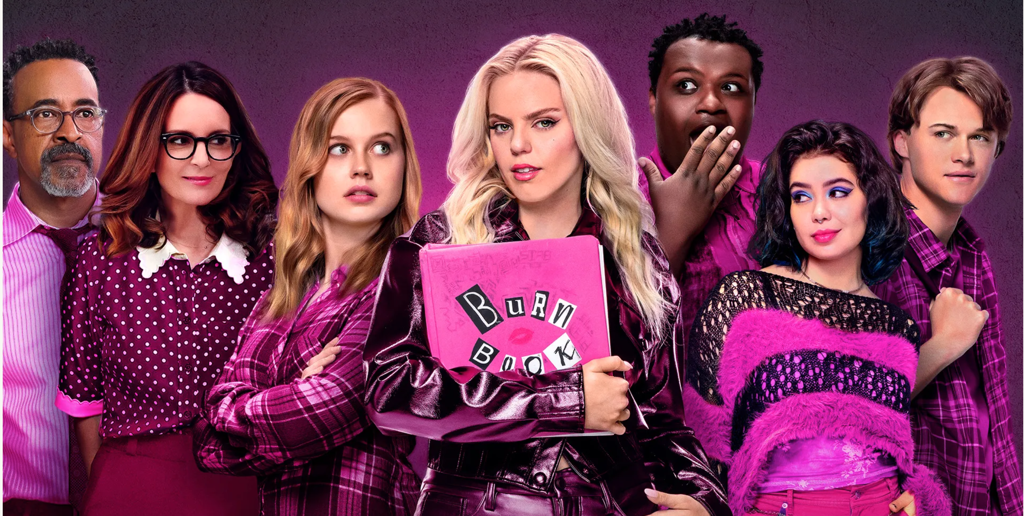
The Mean Girls reboot proves once again that the boundlessly unimaginative machine that is Hollywood never fails to disappoint. Gone are the days of the marketable musical.
Beyond the discourse of continuous live-action reboots of animated Disney classics, the reboot strategy continues to infect the rest of Hollywood. Most recently, the disease has spread to 2000s teen-comedy and cultural staple Mean Girls.
The upcoming reboot written by Tina Fey, author of the original screenplay, stars a cast of new actors. In this lineup is Renée Rapp as Regina George, who also portrayed her in the Broadway Musical rendition of Mean Girls from 2019 to 2020.
This detail provides an inkling of insight into an unadvertised component of the reboot: it’s a musical. To some, this may be a good or bad thing, but in terms of marketing it offers some peculiar questions about how musical films are being marketed in cinema’s current climate.
Aside from a teaser of Rapp’s vocals in the film’s trailer, none of the original music is included or hinted at. This begs the question, why would a pivotal aspect of the film be ignored in its promotion? The answer lies in a few deciding factors. Presumably, fans aware of the musical will recognize Rapp’s performance, but those unfamiliar may find themselves surprised by the inclusion of musical numbers.
The absence of original music in musical trailers has been a recurring trend as of late, most recently with Paul King’s Wonka starring Timothée Chalamet. While choreography reminiscent of stereotypical musical numbers was visible in the trailers, no promotion indicated that the film would be a musical.
The insincere advertising for Wonka and Mean Girls can be compared to 2017’s The Greatest Showman, which incorporated original music and choreography into the film’s promotion. The film managed to be a giant at the box office, grossing a revenue of over 400 million dollars worldwide.
Perhaps where the line can be drawn between the success of The Greatest Showman versus the hidden-musical marketing of current times is the promotion of stars and recognizable content.
In its promotion, Wonka forsakes the implication of its status as a musical in favour of the story of Willy Wonka’s backstory played by the increasingly popular actor Timothée Chalamet. As a result of his popularity, it seems safe to capitalize on him in the role of an already established character.
With Mean Girls, however, the marketing is even less sincere. While Rapp is recognizable to fans of the Broadway adaptation, her status alone is not enough to win over the public. What the trailer does use is iconic imagery like the burn book or the Christmas dance sequence as nostalgia to win over audiences.
The trailer also includes Olivia Rodrigo’s song “get him back,” associating the film with a currently popular song to gain recognition from audiences. Despite relying on nostalgia, the trailer goes on to claim the film is “not your mother’s Mean Girls,” a bizarre touch that may leave a sour taste in audiences’ mouths. This isolating strategy is confusing, yet it is fair to assume the film will still be a box-office success.
As the release of the film plays out this weekend, the misleading promotion is an addition to Hollywood’s lineup of “hidden musicals” and calls for further discussion over why the age of the marketable musical has become obsolete.