

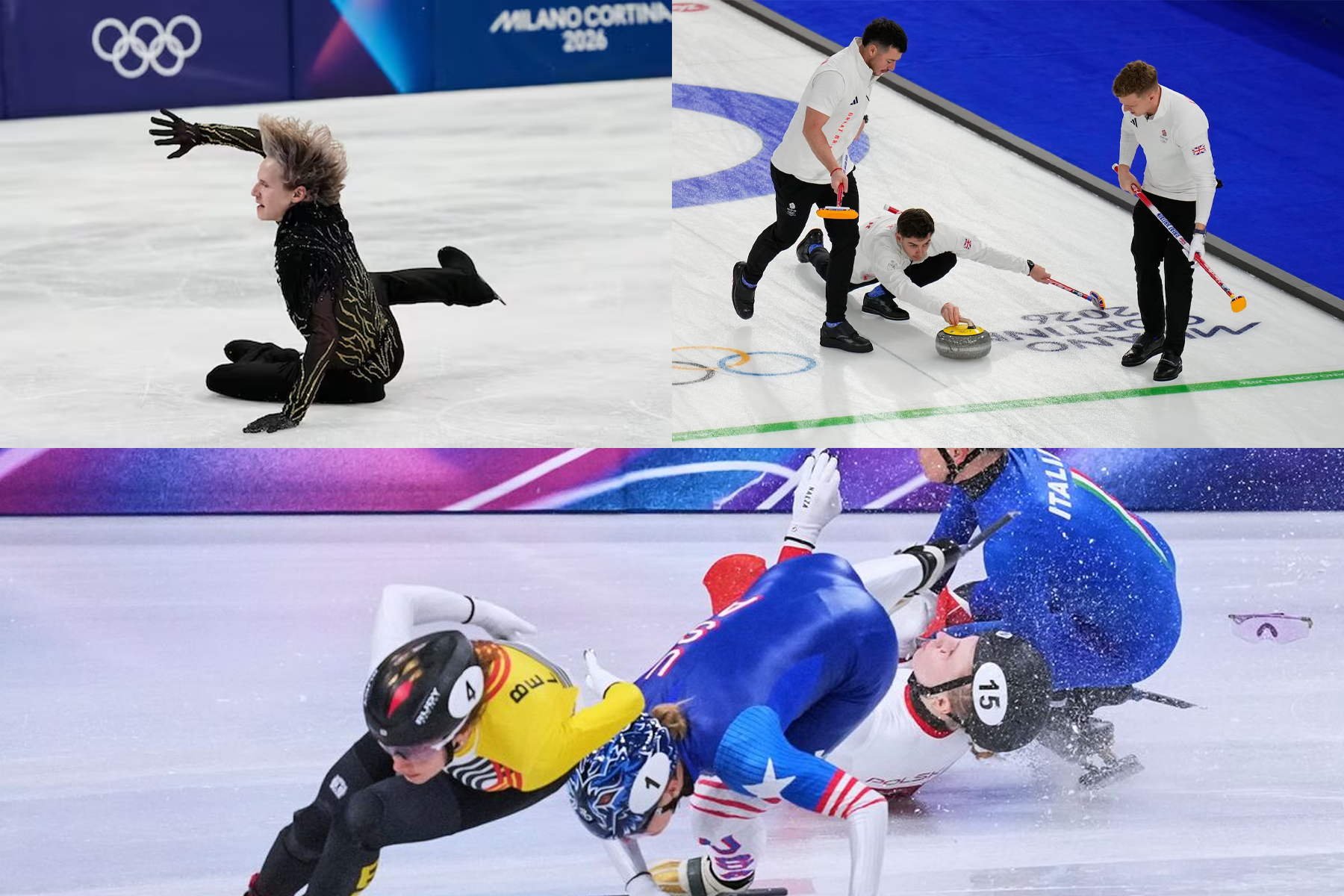
While the Winter Olympics feature a smaller field of athletes competing across fewer disciplines, there’s something about the cold-weather Games that makes them uniquely susceptible to drama, scandal and unforgettable cultural moments.
Records were broken, droughts ended and lifelong dreams were realized, but some of the most captivating headlines from these past 14 days may not be remembered in four years — even if they made this year’s games all the more entertaining. So, before we move on to 2028, let’s take a moment to remember the wild moments from the 2026 Winter Olympics.
A new term for national pride
Team U.S.A. has never struggled to recruit celebrity power to rally its athletes. In past Games, global stars like Beyoncé and Taylor Swift have fronted promotional campaigns. This year, however, their choice sparked unexpected controversy.
Canadian pop star Tate McRae appeared in an NBC commercial endorsing Team U.S.A. ahead of the 2026 Milano-Cortina Winter Olympics. Online backlash from Canadian fans was swift, with accusations of betrayal flooding social media.
What surprised many was McRae’s response. Rather than issuing the expected Notes app apology, the Calgary-born singer posted a childhood photo of herself waving a small Canadian flag, captioned simply: “… y’all know I’m Canada down.”
Careless or clever, the response united Canadians online as the phrase quickly became a rallying slogan, sparking nostalgia for all things Canadian. Though it might take some time for McRae to return to the good graces of Canadians, she proved our Winter Olympics pride cannot be tarnished.
Norwegian honesty
For Norwegian biathlete Sturla Holm Lægreid, a bronze medal in the 20km individual event was not a moment for pure celebration. Shortly after finishing his race, Lægreid became emotional in an interview with Norwegian broadcaster NRK, saying:
“There is someone I wanted to share this with who might not be watching today. Six months ago, I met the love of my life. […] Three months ago, I made the biggest mistake of my life and was unfaithful.”
Once translated, the confession spread rapidly online. Delivered around Valentine’s Day, the emotional admission struck an unexpectedly personal note on the biathlon’s biggest stage.
Norwegian tabloid VG later published an anonymous interview with Lægreid’s former girlfriend, pushing the story further into the spotlight and taking away from the other winners in the sport. While it’s up for debate on whether it was appropriate for the athlete to make such a statement, what’s certain is that biathlon — a sport often overlooked outside Europe — suddenly found itself at the centre of a global conversation.
The deicide of the Quad God
Entering the men’s singles figure skating event as a two-time world champion, Ilia Malinin — the self-proclaimed “Quad God” — appeared nearly untouchable. His technical abilities showcased in prior performances this season meant that even with minor errors in execution, he was all but guaranteed a podium finish.
Malinin led after the short program with 108.16 points, holding a five-point cushion over Japan’s Yuma Kagiyama. But the free skate proved far less predictable.
He opened strongly, landing a quad flip. However, when he attempted his signature quadruple Axel, he under-rotated and popped the jump. Two later falls unraveled the program entirely, dropping him to eighth place overall.
“I blew it,” Malinin told NBC afterward.
Following the disappointing loss, Malinin cited insurmountable pressure in a post explaining his poor performance. But even with mounting pressure from all sides to succeed, no one expected the American front runner to fall so far from the podium. His loss goes to further prove that Olympic champions aren’t crowned on technical skill alone: they are defined by composure under unimaginable pressure.
At just 21 years old and already a two-time world champion, it’s unlikely that this is the last time that the “Quad God” will headline an Olympic Games.
The scandalous world of ice dance
Ice dance has always been a sport rife with politics and bias. At the 2002 Salt Lake City Games, a judging scandal forced the International Skating Union (ISU) to overhaul its scoring system to reduce bias.
This year, that renewed scoring system has been the subject of debate after score sheets revealed discrepancies between French judge Jezabel Dabouis and the rest of the panel, leading to France’s Laurence Fournier Beaudry and Guillaume Cizeron taking gold ahead of Team U.S.A.’s Madison Chock and Evan Bates — three-time reigning world champions.
As of writing, the podium results still stand, but with the controversy about the subjectivity of ice dance reignited, who knows how the sport will change from now until 2030.
One result that surprised no one: Canada’s Piper Gilles and Paul Poirier claimed bronze, becoming the first Canadian ice dance team to medal at the Olympics since Tessa Virtue and Scott Moir in 2018.
Poke gate
Curling, a sport built on self-regulation and etiquette, found itself at the centre of multiple fiery exchanges. Tensions flared when Sweden’s Oskar Eriksson accused Canadian vice Mark Kennedy of “double touching” — illegally making contact with a stone after release. Following the allegation, Kennedy hurled heated words across the ice, a rarity in a sport known for its quiet intensity.
Similar violations surfaced against Rachel Homan’s Canadian women’s team, causing them to forgo a stone.
These controversies against Canadians don’t point to a clear attempt at nationwide cheating. In the days since the allegations, many elite curlers have clarified that slight contact with an already moving stone is most likely a reflex and would do very little to provide any substantial competitive advantage. Still, the scandal and responses from the athletes have cast an unusually dark shadow on Canada’s traditionally respected reputation in curling.
Promiscuous athletes, or interesting souvenirs?
On a lighter note, just three days after the start of the Milano-Cortina games, reports surfaced that the Olympic Village exhausted its initial supply of 10,000 Olympic branded condoms. Questions later circled around the lack of preparedness, given the Paris games had prepared nearly 300,000 condoms.
The tradition dates to the 1988 Seoul Olympics, when condoms were distributed to promote sexual health and STI prevention. After the headline broke, social media was ablaze speculating on the sex lives of the world’s most prestigious athletes. U.S. ski jumper Nick Novak clarified on social media that many condoms are taken home as souvenirs or novelty keepsakes.
If anything, the story serves as a reminder that even under intense global scrutiny, anyone can prioritize safety and responsibility — whether on the ice or elsewhere.
—
While medals won and records broken will come to define Milano-Cortina 2026 in official history, it was the unscripted moments that truly captured the spirit of the Games. The Winter Olympics may feature fewer sports than their summer counterpart, but these Games proved that competition isn’t just about athletic performance. A heartfelt confession, a pop star swept into patriotic controversy and ice rinks that gave way to endless debate kept the Olympics compelling — even when your team didn’t win.
By 2028, and certainly by 2030, many of this year’s scandals may fade from memory. But Milano-Cortina leaves behind a lasting reminder: even in the face of a colossal upset, somewhere else in the Village there’s a moment of humanity, humour, heartbreak or harmless mischief unfolding. In the end, that may be what makes the Winter Games so unforgettable.