
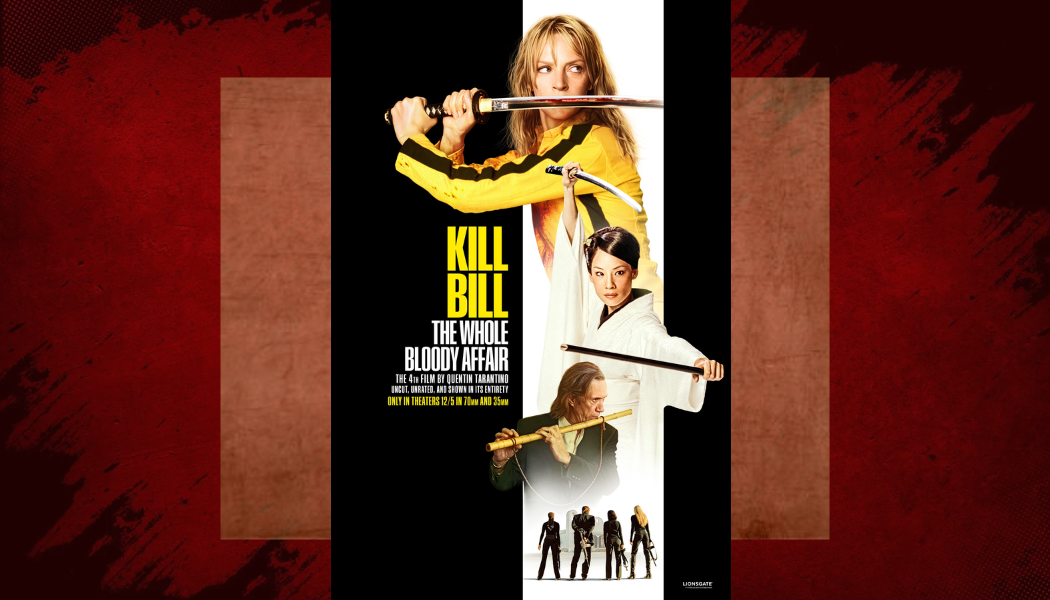
Watching Kill Bill for the first time in a theatre felt like the right way to meet a movie that’s built intentionally around mood, sound and audience reaction. Kill Bill: The Whole Bloody Affair isn’t subtle. It’s style-forward, violent, funny in a dark way and constantly aware of itself as cinema.
The night started with the first reminder that theatres are different from streaming platforms because they require a greater commitment. While the showtime was at 7 p.m., we got to Playhouse Cinema in Hamilton a whole 25 minutes early, and there was already a long lineup outside the front doors. That lineup didn’t just signal “popular screening”; it set a tone. People weren’t casually dropping in. They showed up early on purpose, for a double feature that demands attention. Before the movie had even started, it already felt like an event instead of something to throw on.
That’s a big part of what changes when you watch in a theatre. At home, movies compete with your surroundings: your phone, your notifications, your kitchen or your bed, incentivizing the option to pause and multitask. In a theatre, the environment is designed to remove exits — not physically, but mentally. You sit down, the lights dim and the movie gets the kind of focus that it was made for. And with Kill Bill, that focus matters because the film’s impact is tied to pacing, tone shifts and sound.
As a first-time watch, what stood out most was how controlled the movie is, even when it’s chaotic. Tarantino is doing a lot — genre-switching, playing with time, leaning into stylized violence and pulling in influences from a multitude of film genres including martial arts, spaghetti westerns and anime. But this blend doesn’t feel random; it feels deliberate in the way it sets a vibe and then commits to it.
The Bride’s story is simple at its core, centred around revenge, survival and obsession, but the way the movie tells it is what makes it feel iconic: the structure, chapter-like progression, heightened imagery, as well as the way scenes build tension through music, stillness and sudden bursts. That’s where the theatre amplified everything.
The soundtrack especially felt made for a big room. It doesn’t just decorate scenes, it drives them. In a theatre, the music fills the space and makes the tension physical. You feel the ominous build, the sharp transitions, the moments where a track turns a scene into something you remember. At home, even with decent speakers, sound is still “in your living room.” In a theatre, sound becomes the atmosphere.
The theatre also adds an audience. In a packed room, you don’t just watch the movie, you experience it with your friends, family and strangers. The laughs land harder because they’re shared, the quiet moments feel quieter because everyone is paying attention and the tension is heightened as the social setting demands your focus, rather than if you were alone on your couch with one eye on your phone.
The theatre turns watching into a shared experience, which makes a movie like Kill Bill feel bigger. Not because you need other people to tell you how to react, but because reaction becomes part of the experience.
Then there was the intermission. Between the two parts, we ended up talking to the person sitting next to us, who told us he’d seen both volumes in theatres when they first came out, and he started talking about Tarantino more broadly. That conversation was small and simple, but it felt like what movie culture is supposed to be: passing down context, trading memories and sharing enthusiasm with a stranger because you’re in the same place for the same reason.
It was a great demonstration of how movie theatres are one of the few remaining public places where community forms around something that isn’t productivity nor constant interaction. It’s not home, it’s not work or school and it’s not built around you buying an endless series of things to justify your presence. You buy a ticket, you sit, you share an experience and when it’s over, you leave. These informal gathering spots, outside the home, work or school, where people meet for conversation, companionship and a sense of belonging, have been coined as the “third place” by sociologist Ray Oldenburg.
In a time when so many third places are either disappearing, getting more expensive or moving online, the theatre still offers something physical and simple.
Streaming has made movies more accessible, but it has also made movie-watching more isolated. It turns cinema into content, something you can pause, scroll through, half-watch or break into pieces.
And for some movies, that doesn’t matter much. For Kill Bill, I think it does.
It’s the kind of film that benefits from surrendering to it for a few hours: letting the soundtrack take over, having the tension build without interruption and allowing the crowd’s attention to hold you there.
Watching it for the first time in a theatre made the movie feel like what it probably was when it originally came out: not just something people passively watched, but something people went to see. The lineup outside, the packed room, the shared reactions, the small moment of audience-enforced etiquette and the conversations with strangers during intermission were all integral parts of experiencing the movie.
Theatres don’t just show movies. They protect a way of experiencing them: together, uninterrupted and public. As third places are shrinking and much of our culture is becoming individualized and digital, a night like this is a reminder that community can still be built around something as simple as sitting in the dark with strangers and letting a story take over the room.