

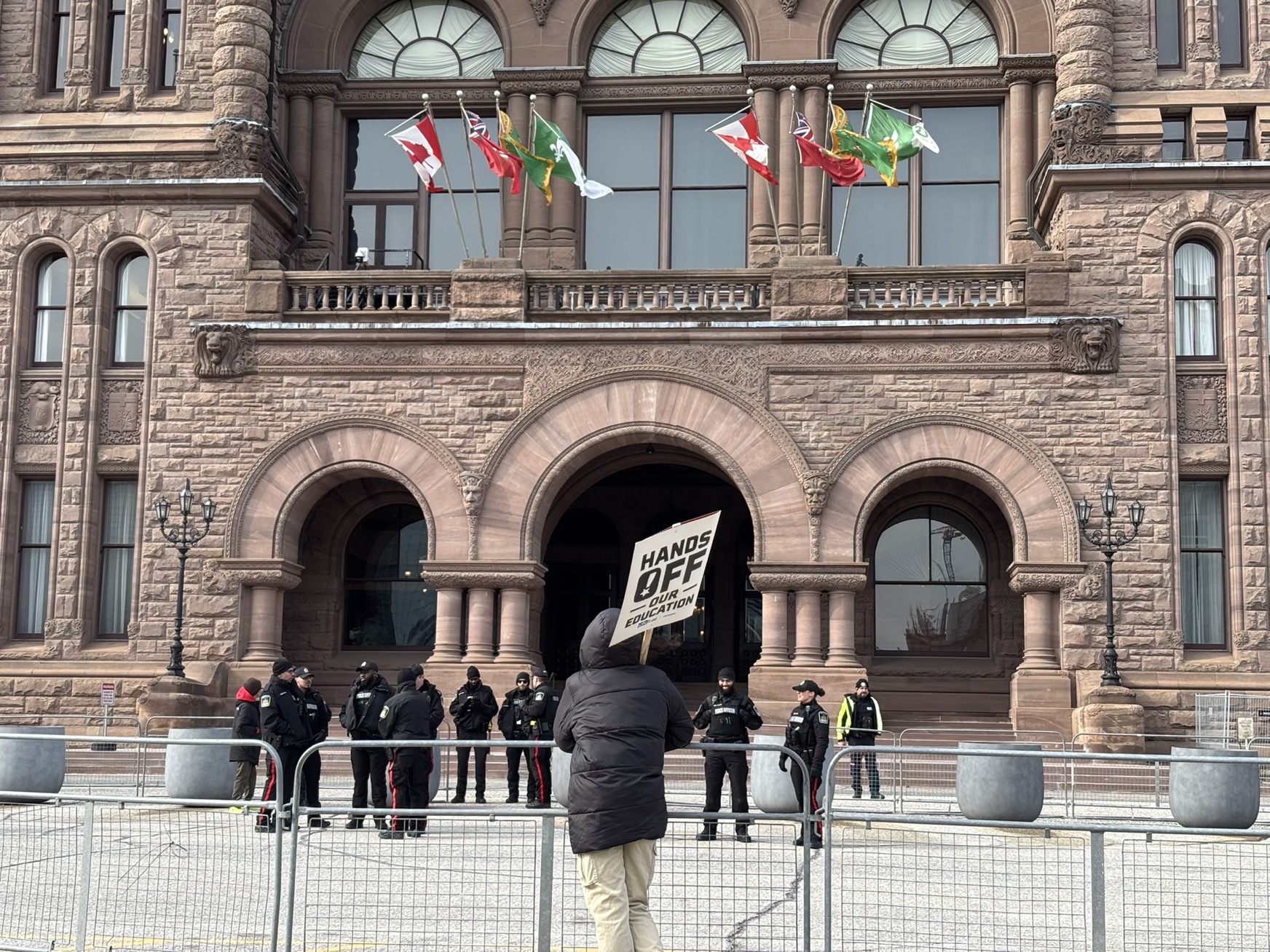
Following the protest on March 4, the second rally in the “Hands Off Our Education” campaign took place at Queen’s Park on March 24, with thousands of students, educators and community members gathering to protest growing concerns over the accessibility and affordability of postsecondary education in Ontario.
Upon exiting Queen’s Park station, the presence of the rally was immediately evident. Protesters assembled behind newly installed barriers, facing a visibly increased police presence compared to earlier in the month. Fencing restricted access to areas in front of the Legislative Assembly building, statues on the grounds were covered and cordoned off, dozens of police officers were stationed in cars surrounding the perimeters, peace officers were lined up in front of the legislative assembly and other officers in various uniforms were stationed throughout the park. A camera was also positioned on the Legislative building’s balcony, a measure not observed during the March 4 demonstration.
The March 4 protest had escalated after a few individuals vandalized the George Brown statue with messages critical of Premier Doug Ford, leading to brutal force by the police. This further enraged students and two arrests — both of whom were later released without charges. Organizers and attendees at the March 24 rally said the heightened security measures created a restrictive and intimidating atmosphere.
Despite these conditions, demonstrators gathered to voice concerns about what they described as a growing crisis in postsecondary education.
The event began with Cyrielle Ngeleka, Chairperson of the Canadian Federation of Students Ontario (CFSO), who pointed to long-term funding challenges in the education system. She noted that recent changes to OSAP shifted the balance from more grants to more loans and referenced earlier reductions of $1 billion to the program’s funding.
“At a time when students are already navigating a cost-of-living crisis,” Ngeleka said, “this government is telling students that the price of keeping the education system afloat is more debt.” She added that the effects are visible across institutions, via “colleges across the province facing program closures and mass layoffs and instability,” “universities relying on exploitative international fees just to keep their doors open” and “we see it in students who are working longer hours, taking on more loans and questioning whether they are able to finish — let alone begin — their studies.”
Omar Mousa, National Executive Representative with the same organization, said students are concerned about decision-making processes that exclude their input. “These choices are not made in our interests,” he said. “They are made in the interest of profit.”
Labour representatives also addressed the crowd, connecting education funding to broader economic conditions. Ahmed Gaied of the Ontario Federation of Labour described the situation as part of a wider set of policy decisions affecting multiple sectors, including healthcare and housing.
Political leaders were also present. Ontario NDP Leader Marit Stiles addressed the crowd, sharing that she has heard from students across the province who are reconsidering their educational plans due to financial pressures. She characterized recent policy decisions as choices that could be revisited through government action.
Ayesha Ali, a first-semester student at Humber Polytechnic, said financial barriers are already shaping students’ decisions about their futures. She noted that some of her peers are reconsidering continuing their studies due to affordability concerns. “It’s limiting access for lower-income students,” she said. “A lot of people I know are now thinking about not pursuing or have decided not to pursue the rest of their post-secondary education because it’s not feasible for them anymore.”
Others echoed the sentiment that financial aid alone does not address broader systemic challenges. York University student Abeeha Kidwai described OSAP as “a Band-Aid to the problem,” adding that the rising cost of tuition and living expenses continues to outpace available support. She also reflected on her experience at the March 4 protest, saying the police response affected her sense of safety. “The protest no longer felt safe,” she said. “Now, you can feel how they’re trying to suppress us.”
Participants repeatedly linked education affordability to wider economic pressures, including housing costs, food prices and employment instability. Community member Phoenyx Wuetelainen questioned how students are expected to succeed without adequate financial support. “If we can’t get our education, if we can’t pay for it, how are we supposed to get a job? How are we supposed to live?” they said.
High school students also attended the rally, expressing uncertainty about their futures. Taiyo Spark, a senior high school student, said the current climate is influencing how students view postsecondary pathways. “There are so many students […] that are starting to think maybe this isn’t the right idea,” they said. “Those dreams are being crushed right as we speak.”
Throughout the rally, speakers and attendees repeatedly emphasized that the issue extends beyond OSAP alone. Concerns raised included tuition increases, student debt, institutional funding models and broader socioeconomic conditions affecting students’ ability to pursue and complete their education.
Chris Chandler of the Ontario Secondary School Teachers’ Federation summarized the stakes in practical terms. “When we talk about OSAP, we are talking about whether a student in a high school today can say yes to a university acceptance,” he said. “We are talking about whether a student in college can say yes to another semester.”
As the rally concluded, organizers stressed that the demonstration marked a continuation rather than a conclusion of student advocacy efforts. Participants marched out of Queen’s Park chanting calls to protect education access and funding.
The March 24 protest highlighted a growing sentiment among students and educators that the challenges facing postsecondary education are complex and interconnected. While financial aid remains a focal point, many participants described the issue as part of a broader systemic landscape — one that, they argue, will require coordinated responses beyond a single policy or level of government.