
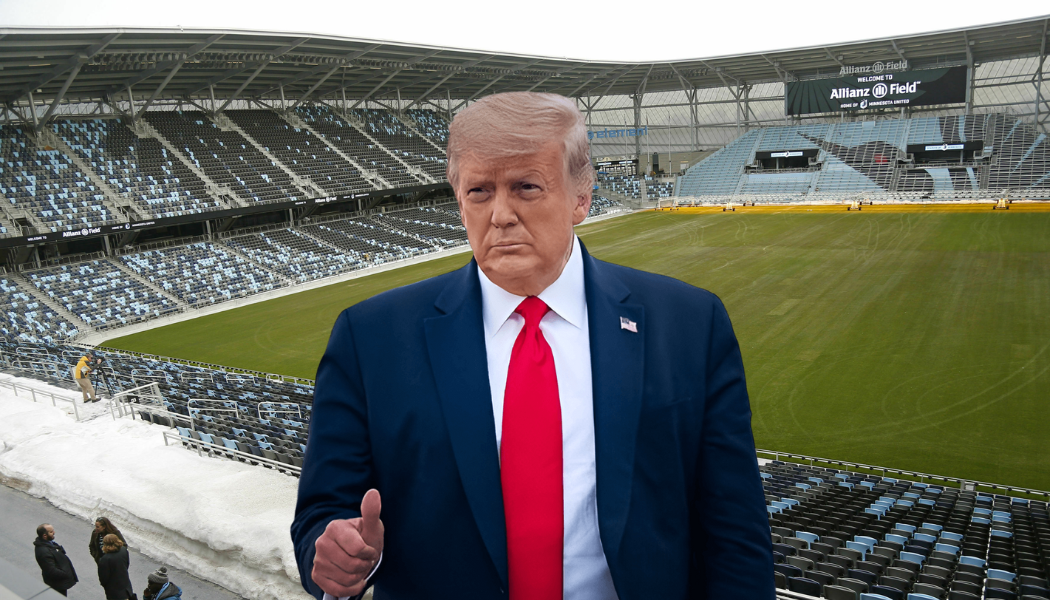
On Oct. 14, President Donald Trump raised the possibility of removing 2026 FIFA World Cup matches from the Boston region, citing public safety concerns and criticizing Boston’s municipal leadership. While matches in Massachusetts are slated for Gillette Stadium in Foxborough rather than in the city’s proper, Trump’s remarks have reignited debate over the balance of political influence and contractual authority in global sporting events.
During a White House press event, Trump responded to questions about a recent “street takeover” in Boston that reportedly involved attacks on police and property damage. When asked whether this could jeopardize Boston’s role as a World Cup host, he replied, “we could take them away.” He added that he would call FIFA President Gianni Infantino and propose relocating matches “if I feel there are unsafe conditions.” Trump characterized his approach as simple to execute, asserting that he has the capacity to act decisively.
Though the remark targeted Boston, it followed earlier threats toward other cities — particularly those led by opposition parties — where Trump has linked public safety, crime and political control in his critique of municipal governance.
Trump’s statement raises a big question: what power does the U.S. president actually wield over World Cup venue assignments? The short answer: very little, at least unilaterally. Host cities and match allocations were determined by FIFA and affiliated local organizing bodies in contracts finalized in 2022. Those agreements embed obligations and protections that cannot be easily overridden by a sitting or former president.
Although the federal government retained roles in immigration, border control and national security provision, the relocation of matches would require consent at multiple levels: FIFA’s governing organs, national and municipal governments, and local organizing committees. Reuters quotes organizers as saying relocation remains “unlikely despite rhetoric.”
Trump might attempt indirect pressure — threats to withhold federal funding, conditioning security support or leveraging personal ties to Infantino — but such influence would operate outside established legal frameworks. FIFA vice president Victor Montagliani dismissed the threat, reiterating that “FIFA has jurisdiction over the tournament and makes those decisions.”
Boston Mayor Michelle Wu pushed back immediately. She dismissed the notation that a single individual could undo the hosting agreements, noting that the process is “locked down by contract” and not subject to arbitrary removal.
FIFA, for its part, has framed security responsibility as resting with governmental authorities. It has highlighted the importance of host city readiness but refrained from overt engagement with Trump’s threat. Their reticence reflects the federation’s preference to maintain distance from overt political interventions.
This confrontation highlights inherent tensions in transnational sport. First, it exposes how public safety claims can be deployed as a pretext for political intervention into autonomous institutions. Second, it underscores the limits of national power when confronted with binding international contracts and technically independent governing bodies. Third, the episode may set a precedent: if political figures believe they can veto or reshape major sporting events, the integrity of host city planning becomes more vulnerable to rhetorical overreach.
The political framing of “unsafe cities” risks conflating urban governance challenges with symbolic control: Trump’s targeting Boston suggests selective threats keyed to partisan alignment rather than empirical venue risk.
Trump’s threat to remove World Cup matches from Boston offers a vivid test case at the intersection of politics and sport. While his rhetoric highlights identifiable tensions — security, municipal control and federal leverage — the formal architecture of FIFA agreements and municipal contracts heavily restricts his ability to act. The necessary coordination, legal obligations and institutional resistance ultimately make relocation unlikely.