

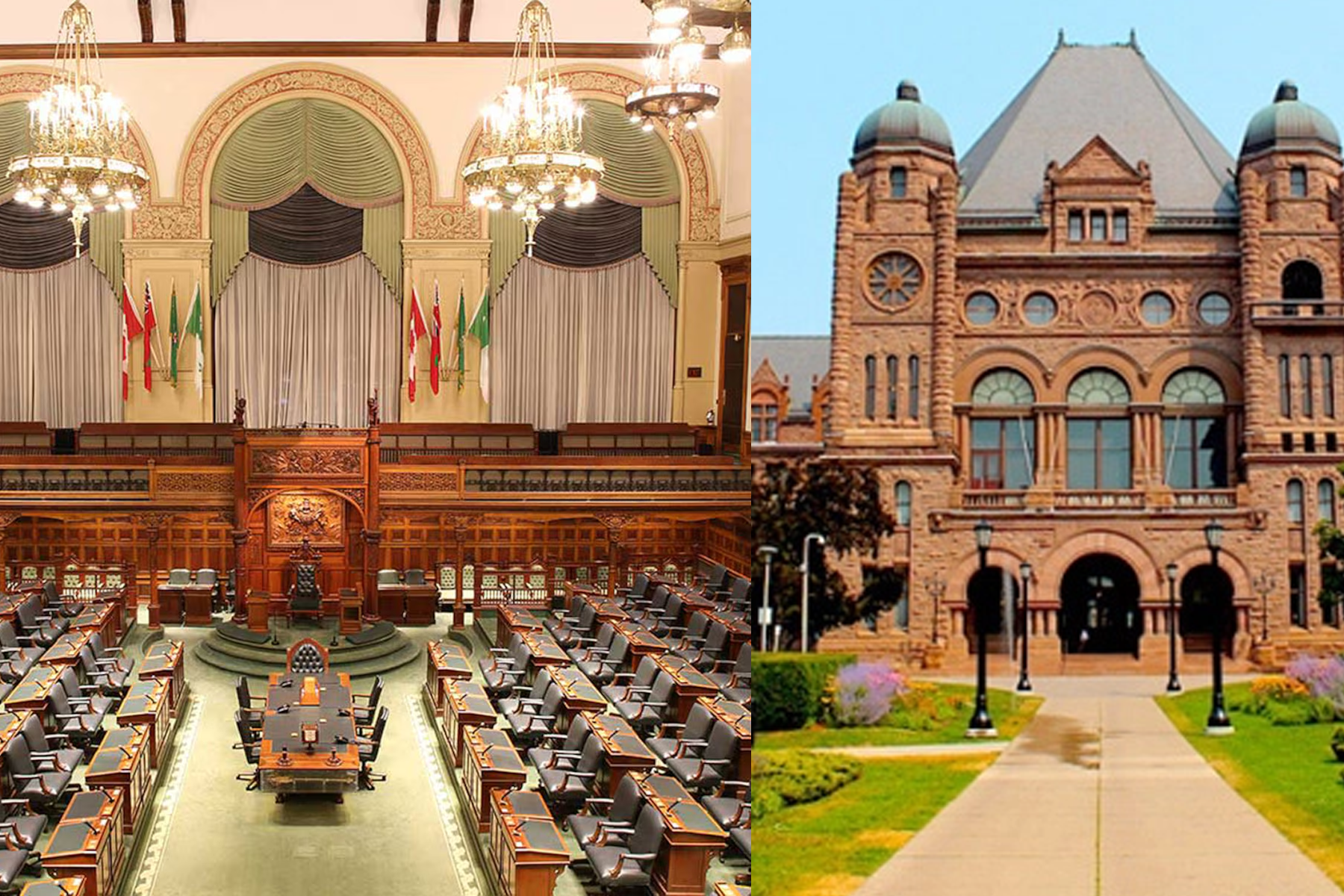
For the past decade, Ontario’s provincial opposition has been non-existent at best. The lack of any meaningful opposition may be due to Doug Ford’s historic third-consecutive majority run government this past decade — yet, it does not have to be this way.
Doug Ford has done some good as Premier for Ontario — especially in transit development, as his Premiership marked the beginning of serious shovels in the ground which had stalled under previous governments.
However, Ford’s share of the vote in Ontario — a province with an already low voter count — does not represent most Ontarians. Unfortunately, nearly 50 per cent of Ontarians do not participate in provincial politics.
The reasons behind why this group does not vote could be vast if studied sociologically, but politically, it’s simple: the current parties are simply not engaging with nearly half of Ontario’s voting-eligible population.
It is foolish to disregard this group of people who are not engaging with politics, as groups like this can, and have, swung elections.
The most well-known examples of this would be with the elections of U.S. President Donald Trump in 2016 and New York City’s Mayor, Zohran Mamdani, in 2025.
Though not Canadian examples, both elections show us that it is possible to revive interest in your political party, no matter which side of the political spectrum your party sits on.
While President Trump has been disastrous for democracy and the Western world order, it’s important to learn from his style of campaign engagement even if only for the fact that it works, and elements of it can, and should, be used by other political stripes because like it or not, political campaigning has changed.
Both of these candidates brought in significant amounts of first-time voters by connecting with them on issues they care about while acknowledging the feeling that these voters had historically been ignored by both political parties.
The key point of interest with both Trump and Mamdani is the effect of personal branding. While both either ran under or were associated with legacy political parties, the Republicans and Democrats — though the Democratic Party was largely hostile towards Mamdani’s efforts — the weight of their political ideologies was not carried by their parties.
Personal branding involves clear and distinct logos, communication styles and simple-to-understand campaign promises that are directed at what has often been ignored for the targeted voter base.
Mamdani, for example, touted free buses and universal childcare to target the affordability crisis affecting the majority of New York’s working class. This picked up on an under-current of elitist alienation in an emerging K-shaped economy.
Mamdani’s campaign also picked up on a sense of hopelessness defined by the rich getting richer while everyone else gets poorer, spreading the message that New York will not become an exclusively elite citylike many hollowed out, gentrified cities often become.
His campaign iterated that New York belongs to its working class, confirming that they have a right to be able to afford to live in a city they helped build. In doing this, Mamdani renewed interest in social democratic politics and set a precedent for its viability.
Mamdani was distinct from the run of the mill democratic establishment candidate Andrew Cuomo, and it’s fair to say that his election should shift other Democrats more towards social democracy where it would garner votes.
Shifting to Donald Trump, his 2016 election bid was also distinct from former Republicans as he openly engaged in rhetoric that was deemed unacceptable, like unapologetic racism.
Trump has tapped into economic issues too, albeit more subtly. His campaign ran on white American exceptionalism which shifted the Republicans to a place where, during his second presidency, it’s fair to say that Republicanism has been redefined as blindly following Trump.
Trump’s style of politics may be classified as morally wrong, but it is more a symptom of a rot in American society that has always been there, and has only recently been tapped into.
On a purely pragmatic note, a good politician is the one who can get elected by any means available. The fact that Trump’s style of politics proved popular is not because of Trump himself, but because of decades-old external factors that primed the American psyche to be receptive to it.
We are in a time of heavy change, amidst economic struggle, geopolitical uncertainty and a general sense of hopelessness. It simply is not enough for opposition leaders to wait for the population to become tired of the incumbent.
When opposition leaders fail to set out distinctive political agendas that are substantial in nature, they breed apathy in those who would have voted for them which results in that voting group simply abstaining from democracy.
Doug Ford does a fantastic job of resonating with his base voters. Ford uses his personality to build a folksy persona that is vehemently supportive of local producers, to the point of pouring out Crown Royal whiskey bottles, and speaks passionately about supporting industries with strong unions such as steel, oil and gas.
While it might seem silly, this strategy builds favour with a base of voters that are sure to support him in the next election. Crucially, Ford does not antagonize his opposition’s base by commenting on social politics.
This creates a neutral feeling towards Ford from not specifically the opposition base camp but more importantly the swing voters who generally decide elections.
It is essential, then, for opposition leaders to create a distinct political ideology that does not make the public think, “great, not another generic candidate from Y party.”
To do this, opposition leaders must tap into the currently apathetic voting population. Current voters are often already decided and, seeing as the Ontario Progressive Conservatives have a large and strong base, trying to be more Conservative will not work since you fundamentally cannot beat the original.
Understanding why the majority of voters are apathetic is crucial as it could serve to create core pillars in an opposition leader’s political ideology.
The lack of affordable housing, overcrowded transit, return to office policies and lack of competition in essential staple markets such as groceries, cell phone plans and internet resulting in unfair unilateral price setting powers (as seen with the bread price fixing scandal) are all potential areas that are unaddressed by the current provincial government.
It is not feasible to run as simply “not the current incumbent” or “better than Y politician” as most voters are fundamentally apathetic or actively distrustful of regular politicians.
Opposition leaders must tap into the politics of the apathetic when creating their political ideology to gain trust with that group. Furthermore, the opposition must not attack the swing voters who vote for the incumbent or policies that inherently benefit swing voters or powerful voting blocks, as that may alienate them from those swing votes.
In general, put in some effort, don’t be a jerk and create a distinct political ideology that is not simply waiting on voter fatigue.