
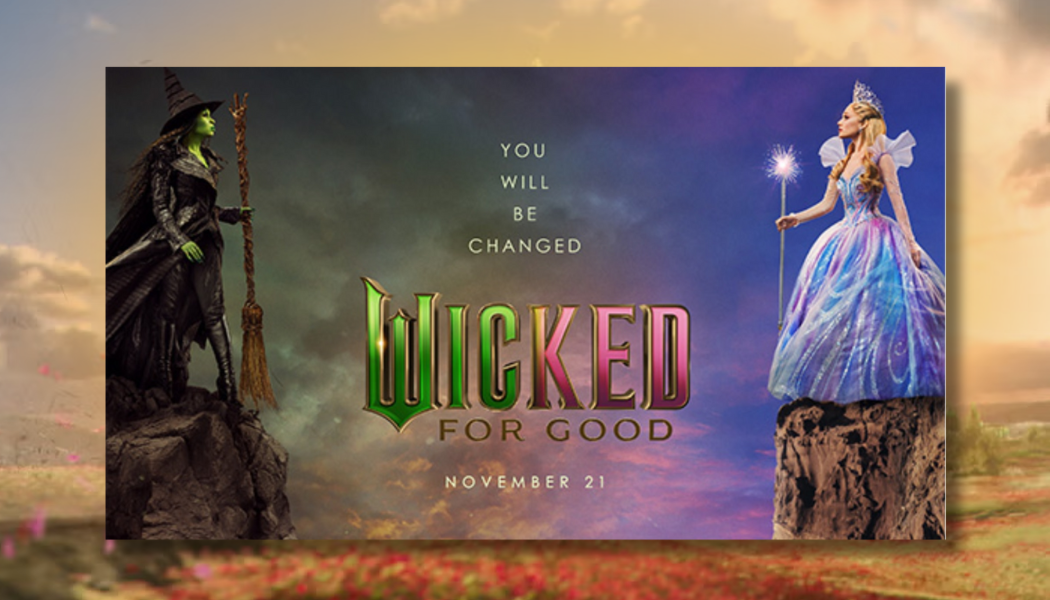
This review contains spoilers for Wicked: Part One, Wicked: For Good and Wicked, the Broadway musical.
More than 22 years ago when Wicked first opened on Broadway, no one could’ve predicted the cultural force it would become. What started as a dark, politically charged fantasy novel, Wicked: The Life and Times of the Wicked Witch of the West, could never have been expected to define a generation of theater goers. Gregory McGuire’s book reimagined Oz as a fractured world of propaganda, authoritarian power and moral ambiguity. When Universal acquired the rights to the book, their first instinct was not to turn Wicked into a musical, but a feature film. However, the book to film rights sat collecting dust for years.
It took producer Mark Platt and composer Stephen Schwartz to boldly argue that Wicked belonged on stage before the screen. When the show finally premiered in late 2003, its success was immediate. Since then, Wicked has become the fourth longest running Broadway musical and the second most profitable in Broadway history, earning $1.8 billion in New York alone and nearly $5 billion worldwide. Its influence has spread far beyond the Gershwin theater.
The Wicked films stand as rare experiments in adaptation: one half overflowing with possibility, the other forced to live in the shadow of a climax that already happened. On screen, that imbalance becomes impossible to hide as one film soars while the other tries to land the plane. Taken together, the films illustrate both the possibilities and inherent constraints of bringing Wicked to the screen.
The on-stage popularity of Wicked only added to Universal’s push to adapt the musical into a film. Official plans began in 2012 and sat in developmental limbo for over a decade, with each new set of casting rumors — from Lady Gaga to Shawn Mendes — stirring up more fandom hype.
The real breakthrough didn’t come until 2021, when John M. Chu formally stepped in to direct the musical, splitting it into two films. For some, this was a bold claim of artistic ambition; for others, it was a commercial calculation dressed as necessity. But given the three-hour runtime of the stage musical and the density of the source material, the logic was hard to ignore.
After seeing Wicked: Part One last year, it became clear that the expanded structure was not just justified, but essential. The added hour and 20 minutes of the first act allowed the story to breathe, gave characters more definition and sharpened motivations. Elphaba and Glinda’s arcs, often rushed and overshadowed in the musical, finally had room to grow. The two-part format insured nothing from the first act was sacrificed.
Chu’s decision to film both parts simultaneously further reinforced the continuity. The wonderful world of Oz requires coherence in all aspects of colour, visual tone, architecture and emotional rhythm. Shooting the parts together gave the production and actors the consistency needed to bring a unified vision fitting for such a sprawling universe.
Universal never positioned the adaption of Wicked to be a low-budget venture. With the combined production budget covering close to $300 million, it’s clear that for a story as sprawling, politically tangled and visually ambitious as Wicked, no expense could be spared. If Oz was going to feel like a real place rather than a VFX hellscape, the film needed scope, texture and a sense of grandeur that carried the emotional weight of the 20-year-old Broadway phenomenon.
Adding to the complexity were the enormous discrepancies between the 1939 film, The Wizard of Oz, the novel and the stage musicals’ respective source material. In the 1940s, the technicolor world of Oz defined a new era of movie making, while Gregory Maguire’s original book was dark and gritty, showing the land of Oz divided by authoritarian rule, propaganda and prejudice. The Broadway musical by contrast softens those edges, opting for a brighter and dreamier interpretation of Oz. Its choice to anchor the production around friendship, romance and personal awakening is one that made the show what it is today but that falls short of the lessons the book seeks to tell.
These three artistic visions created a problem that the film could never fully escape: Which Wicked was it adapting, and whose Oz were we meant to see?
Despite the three competing visions, the decision to split the story into two films did hold space for the complex elements of the novel to seep back into the story. Though Wicked: Part One is led by its soundtrack, youthfulness and the spark of friendship, Wicked: For Good shifts into darker territory, leaning heavily into political tension, fascism and the effects of Elphaba’s choices. Elphaba and Glinda have grown up and the idealism that coloured their lives in Part One has evaporated. Their vibrant and enchanting understanding of Oz has been stripped away, revealing the lies and manipulation its citizens choose to ignore.
In many ways, Wicked: Part One was always the easier act to adapt. The film’s structure is nearly identical to act one of the stage show. Act one also features nearly every iconic musical number including “Popular,” “The Wizard and I,” “One Short Day,” and of course, “Defying Gravity.” These songs aren’t just recognizable, they carry the narrative forward in clear arcs of growth, discovery, friendship, wonder and risk.
The foundation of Wicked: Part One is built on this momentum. It creates an enchanting and idealistic world that viewers can connect with. Through Elphaba’s eyes, we’re shown the beauty of Oz and all it can offer. It’s a world that seems magical because she believes that it is.
Even with its bloated two hour and 40-minute runtime, Wicked: Part One uses its expanded structure wisely. The added scenes create emotional stakes that the stage version could only hint at. The story feels grounded. The friendship feels earned. The political machinery of Oz is unveiled slowly rather than crashing into the story. Because the film allows the world to breathe the final “Defying Gravity” sequence hits with undeniable force. It’s climactic, goosebump inducing, definitive and effortlessly cinematic.
But the strengths of Part One also expose the structural challenges waiting for its companion piece. If the first film thrives on the characters’ growth and discovery, Wicked: For Good must live in the shadow of choices and consequences that the musical itself never resolved cleanly.
On stage, the second act exists entirely to wrap up loose ends. The show’s emotional climax occurs at the end of act one, which leaves act two with a burden to finish everything the first act set up without a major peak of its own.
The musical’s runtime reflects that imbalance — act one runs nearly 90 minutes while act two barely reaches an hour. That disparity becomes even more glaring when stretched into two separate films. With so little narrative structure to work with, Wicked: For Good was left facing an uphill battle.
On screen, this becomes impossible to ignore as Wicked: For Good never finds a cohesive narrative crescendo. Instead of building toward a single emotional or thematic apex, the film drifts. There are stretches where the story seems to be moving with purpose only to pivot unexpectedly and undercut its own momentum. Scenes feel disconnected as if the film is trying to maintain the emotional heartbeat of Wicked: Part One while racing to resolve the conflicts of the story. Even in its most pivotal moments, it’s difficult to tell whether the movie is truly coming to an end or simply checking items off the list.
The musical numbers further reflect this unevenness. While Wicked: For Good includes powerhouse songs like “No Good Deed,” it lacks the once in a generation impact of “Defying Gravity,” or the Galindafied charm of “Popular” from Part One. The momentum and weight of Wicked: Part One is heavily influenced by the songs. With part two given a far weaker soundtrack to work with, it further adds to the imbalance.
Worse yet, the soundtrack is weighed down by new editions and two new songs that feel unnecessary and stretch the pacing without adding much to the story. At times it feels like an attempt to recapture the moment with reprises to songs from Wicked: Part One rather than deepen the tone of Wicked: For Good.
Performances also suffer from the structural imbalance. Wicked: Part One gives its actors room to grow emotionally and musically. Erivo and Ariana Grande flourished in that space building a dynamic that felt organic and fully lived in. In Wicked: For Good they remain exceptional, giving committed, nuanced and vocally unmatched performances, but with a script that gives them far less to work with. Glinda’s comedic relief that stole the show in Part One is almost entirely absent, being replaced with political turmoil and grief. Elphaba’s moral journey feels rushed and poorly developed. The emotional beats consistently fail to stick the landing because the film never gives them the air to breathe.
Supporting performances fair even worse. Jeff Goldblum, with a larger presence as the Wizard, never quite integrates into the tone of the film. His performance feels oddly placed and often phoned in. Michelle Yeoh as Madame Morrible gives a commanding and domineering performance but struggles with the vocal demands of her role. Key musical moments are shortened, softened or cut entirely, leaving her character feeling both underutilized and miscast. In scenes that require vocal authority, the film simply moves on before the audience has a chance to recognize its absence.
Cinematography becomes another point of divergence between the two films. Wicked: Part One received significant criticism for its digital washed-out pallet. Wicked: For Good shifts dramatically in the opposite direction, the darker tones, heavier VFX work and sharper contrasts give the film a different visual language. This change is somewhat justified as the story itself darkens, but visually it gives the appearance of an disjointed world. Wicked: For Good often looks more like a Marvel movie than an extension of the 2024 release. Despite being shot at the same time, the two films rarely share a cohesive aesthetic beyond set design.
Narratively Wicked: For Good must shoulder several major responsibilities: Dorothy’s arrival, the death of the Wicked Witch of the East, the wizard’s departure and Elphaba’s presumed death. These story beats serve as the connective tissue between Wicked and The Wizard of Oz, though the film struggles to give any of them the weight that they deserve. Throughout the film, the pacing feels rushed with emotional stakes diluted by their sheer volume. The result is a finale that feels more obligatory than triumphant.
Yet within this uneven landscape, Ariana Grande delivers a showstopping performance unlike anything seen in Wicked: Part One. Her evolution, becoming “Glinda the Good,” offers less comedic relief but shows the consequences of letting yourself be misshaped by power and expectations. As the façade cracks, Glinda becomes the emotional centre of the story and in many ways, the film becomes about her rather than learning about the cost of being good.
But the strength of these individual performances only serves to highlight the larger imbalance. The two-part structure pulls apart a story designed to rise and fall in a single sweep. Part One thrives under that freedom with nothing rushed or sacrificed, while For Good inherits a structure that was never meant to stand on its own.
That’s the real friction running beneath this adaptation. Wicked has always been a story about the narratives people cling to and the truths they overlook. Splitting the musical gave Universal the chance to honour that world with scale and spectacle, but it also revealed how fine the original balance really was.
Decades from now, when the dust settles in the hype fades, I can hope that audiences rejoicify and look back on these films with a kind of clarity. Part One might stand as a moment where Wicked finally found its cinematic form, while For Good risks being remembered as the film that tried ambitiously to complete the story whose emotional climax had already occurred.
The ending of Wicked was never built to dazzle. It was meant to linger, and that’s where the film ultimately leaves us not with the catharsis many expected coming from the first film, but with an uneasiness of a story that aimed big, stumbled, yet still manages to echo after the curtain falls.