

On June 2, 2015, the Truth and Reconciliation Commission of Canada released the 94 Calls to Action.
The Calls to Action are a roadmap for all levels of Canadian government to amend the legacy of residential schools and advance the process for reconciliation in Canada.
Over the past 11 years, 13 of the 94 calls have been completed, with the most recent having been completed in March 2025.
11 years have passed since the Calls to Action were released. Althoughpolitical conversation centres around reconciliation — as seen via prime ministers, premiers and ministers issuing apologies, commemorating residential school Survivors and pledging action — only 13 of the calls have been completed, with no intent shown by the government on completing the remaining 81.
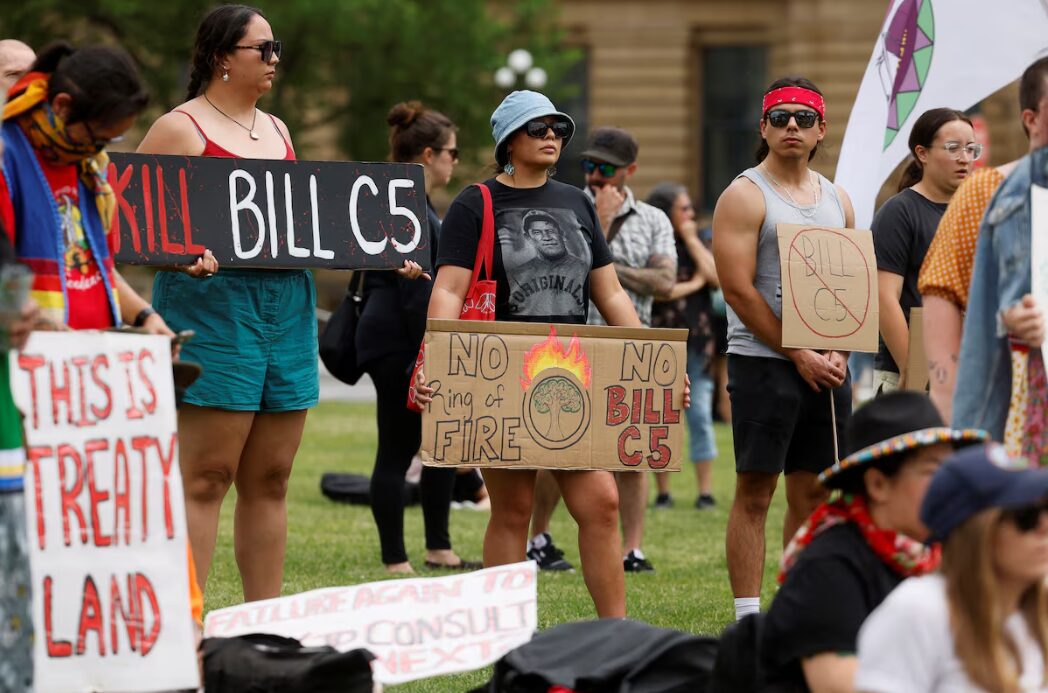
With 81 calls at a stand-still or untouched, the Canadian federal government passed Bill C-5, One Canadian Economy, 2025. The Bill grants cabinet members the power to bypass environmental safeguards, cultural reviews and constitutionally required consultations, in the name of fast-tracking industrial and infrastructure projects.
On June 6, 2025, Prime Minister Mark Carney’s liberal government conducted their first reading of Bill C-5, which was met by strong opposition by the Chiefs of Ontario, regarding “both the content of the Bill and the undemocratic process being used to rush it through Parliament without meaningful consultation or study.”
Regardless of the opposition, Bill C-5 was passed on June 26, 2025.
Section 35 of the Constitution Act recognizes and affirms “Aboriginal and treaty rights,” as supreme law. It requires the Crown to act honourably through robust consultation and accommodation before any decision that could adversely impact traditional lands.
As well, Section 25 of the Charter of Rights and Freedoms guarantees that no other legislative or individual rights can abrogate or derogate from underlying protection.
Bill C-5 deploys procedural workarounds that treat these sections as an obstacle to bypass rather than an obligation to uphold.
At the federal level, Bill C-5 introduces sweeping “deeming” provisions. Once the federal cabinet designates an infrastructure or extraction corridor as being of “national interest,” critical statutory finding and authorizations are legally deemed to have been granted in favour of the project. By replacing site-specific, iterative regulatory assessments with cabinet decrees, the federal government remove administrative settings where Indigenous people can present evidence, assess cumulative environmental impacts and exercise their constitutional rights.
The Bill itself explicitly states that the expedited two-year reviews will focus on “‘how to get the project built, instead of whether it should be built.” By statutorily predetermining that a project will proceed regardless of concerns and opposition, the federal government negates Section 35.
The government argues the Bill does abide by Section 35 due to the Building Canada Act, enacted via Bill C-5. The Act centralizes authority over nation-building corridors under the newly created Majors Projects Office (MPO).
The MPO is responsible for designating a project as “national interest,” and before a project receives a formal listing that triggers the statutory “deeming” provisions, the MPO must evaluate candidates against five primary statutory criteria regarding whether a development will (1) advance the interests of Indigenous peoples; (2) strengthen Canada’s autonomy, resilience and security; (3) provide economic or other substantial benefits to Canada; (4) demonstrate a high likelihood of successful execution; and (5) contribute to clean growth and Canada’s climate change commitments.
Under this administrative apparatus, once the MPO initiates listing review, the Crown conducts an expedited consultation window with affected Indigenous nations and jurisdictions. The stated objective of the preliminary phase is to advise the minister on whether the project meets the broad definition of “national interest.”
These principles and guidelines in practice have been met with critique.
Tsartlip First Nation member and former B.C. MLA Adam Olsen contends the Act reduces constitutional duty to “consultation theatre.” Olsen cites his experience attending a virtual information session hosted on July 23 by the MPO to discuss the proposed West Coast Oil Pipeline project with Frist Nations. Olsen describes how the MPO’s procedural machinery operates in practice as an elaborate administrative performance designed to reach an outcome that political leaders have already predetermined.
Olsen highlights that in November 2025, months before selecting a proponent, finalizing a route or presenting basic engineering designs, Ottawa and Alberta had already formally committed to the project via a bilateral Memorandum of Understanding.
Furthermore, Olsen describes the administrators of the information sessions rigidly restricting discussions, barring communities from raising substantive environmental, territorial or rights-based concerns, with the discussion limited to whether the concept served the “national interest.”
This was compounded with the MPO demanding a response before Aug. 26, which was later extended to Sept. 18 following pushback from several First Nations communities. This high-compressed set up was also crucially dropped in the middle of summer when Indigenous Council do not typically sit and communities are out harvesting.
Olsen ultimately argues the Crown has reduced constitutional consultation to an empty two-act play, where the sovereign question of whether land can be used with Free, Prior and Informed Consent is decided behind closed doors, and the public process exists merely to manufacture the illusion of procedural compliance.
Olsen’s sentiments regarding this delivery have been echoed by the Union of BC Indian Chiefs. In a letter addressed to Prime Minister Mark Carney and Alberta Premier Danielle Smith, the union explicitly calls on the two governments to “immediately halt efforts to advance the proposed West Coast Oil Pipeline.”
They express their concern with accelerating the expansion of the fossil fuel industry only worsening the impacts of climate change, which has already been detrimental to communities across Canada. As well as the proposal threatening the “inherent rights of First Nations,” specifically with regards to “governments […] making decisions about our lands and waters without us.”
The union furthers Olsen’s argument regarding the predetermined nature of the conversation, stating, “consultation cannot be meaningful if First Nations are invited only to discuss how a predetermined project will proceed” and “equity ownership, loan guarantees, revenue-sharing, employment, or other proposed benefits [cannot] be treated as substitutes for consent.”
The frustration is drawn from the concept and corridor for the project already being developed prior to consultation, as well as the proposal already being submitted, prospective development partners already being named, an Oct. 1 target already being established and public promotion of the project had already begun.
Neither Alberta nor Canada have responded to these objections, and it is reported that “the project continues to advance toward development.”
The pipeline is one of four projects formally initiated by federal ministers in late June, marking the first wave of major projects under the Building Canada Act. The other three include: the Deep Geological Repository, proposed by the Nuclear Waste Management Organization (NWMO), to be built in northwestern Ontario near Wabigoon Lake Ojibway Nation and Ignace area; the Mckenzie Valley Highway Project, intended to establish an all-season overland corridor to the Arctic Coast by building a massive northern transit artery through the Northwestern Territories; and the Grays Bay Road and Port project, designed to link resource-rich mineral belts directly to Arctic shipping lanes by establishing a joint deep-water port and all-season road corridor spanning the Kitikmeot region of Nunavut and the Northwest Territories.
Across each of these corridors, Ottawa insists that the national interest designations bring certainty for capital investor and national resilience. However, for Indigenous communities navigating these accelerated timelines, this maneuver constructs legislative machinery specifically designed to bypass the standard of Free, Prior and Informed Consent.
This legislative strategy runs directly contrary to the core tenets of the Truth and Reconciliation Commission. TRC Calls to Action 43 and 44 urge all levels of government to adopt and implement the United Nations Declaration on the Rights of Indigenous Peoples (UNDRIP) as the framework for reconciliation.
Central to UNDRIP is Article 32, which requires Free, Prior and Informed Consent to be obtained before approving any project affecting Indigenous lands and resources. Instead, Bill C-5 centralizes unilateral decision-making power behind closed cabinet doors, directly violating TRC Call to Action 45, which demands the repudiation of unchecked Crown sovereignty over Indigenous lands.
TRC Call to Action 92 calls on the government and corporate leaders to apply reconciliation principles to economic development by respecting treaty rights and ensuring long-term ecological sustainability. Expediting heavy industrial corridors without meaningful consideration of consent and protecting state actions with statutory immunity is a complete divergence from the call.
The government of Canada has repeated the same narrative for over a decade that they are “working to advance reconciliation and renew the relationship with Indigenous Peoples, based on recognition of right, respect, cooperation and partnership,” yet their actions remain contrary to their words.