

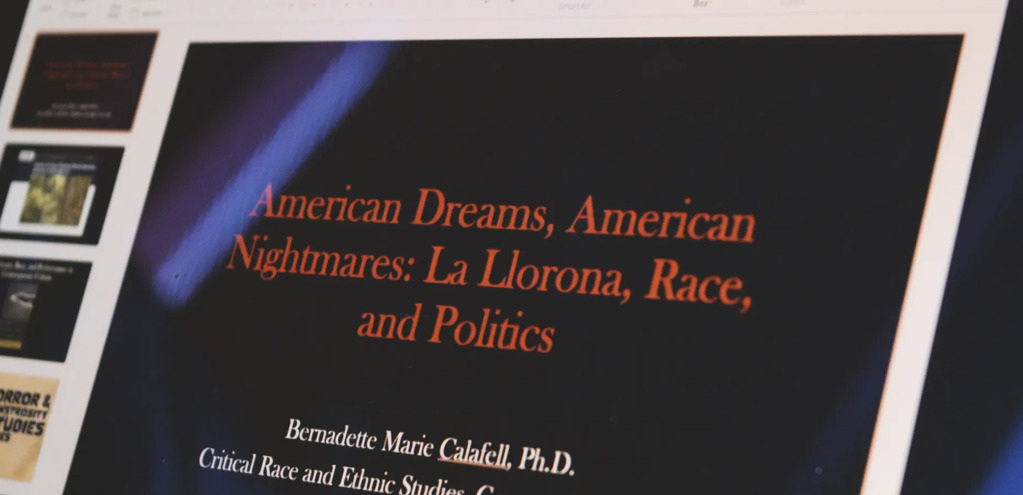
The Hispanic and Latin American Studies Film Club, a subsection of the Department of Modern Languages, Literatures and Cultures, hosted an online discussion on Nov. 4 titled “American Dreams, American Nightmares: La Llorona, Race, and Politics.”
Through the online discussion of The Curse of La Llorona (2019), the film club demonstrated that just because the spooky season is finally over, there’s no excuse to ignore horror films, especially in the context of providing racial and gendered analysis. This type of analysis can be favourable to dismantle the social structures that said films tend to critique or perpetrate subtly.
For this event, Dr. Cristina Santos, an associate professor at Brock University, who specializes in Hispanic and Latin American Studies, invited Dr. Bernadette Marie Calafell, the Chair of Critical Race and Ethnic Studies at Gonzaga University, to talk about the research and film analysis that she has crafted in regards to horror films and the portrayal of pressing political issues that Latinos in the U.S face in the said genre of cinema.
Something notable from Dr. Bernadette’s presentation is that she made sure to tie factual political occurrences to her analysis of the horror genre. For instance, she mentioned during her presentation that many American horror films create monsters partly inspired by historical and political figures that have terrorized the lives of those living on the margins of society.
A striking example she brought up was the comparison between the character “Pennywise” from Stephen King’s It (2017) and the 45th president of the United States; Donald Trump. More specifically, she clarified that in the same way that the character Pennywise terrorizes children, so did Trump’s administration by creating a political climate with a severe distaste for immigrants and brutal carelessness leading to Hispanic children being separated from their families and kept in Immigration and Customs Enforcement (ICE) camps indefinitely.
Although Dr. Bernadette explored various horror films throughout her presentation, most of the emphasis was on examining the subtle racial and gender commentaries seen throughout La Llorona (2019). The film choice is incredibly relevant to examine Hispanic culture, so it makes the most sense to connect the events in the movie with the lived experiences of Latinos in the U.S. and elsewhere.
La Llorona (2019) is a modern reimagination of an old myth prevalent in South America that tells the story of the spirit of a woman that weeps at night near bodies of water in hopes of finding her children that she murdered. Many interpretations of the “weeping woman” myth also portray her as a temptress. She is a questionable mother figure for killing her children and is also perceived as an entity that seduces unloyal, evil men who unknowingly are lured to their death.
Perhaps the most exciting piece of analysis stemming from critiquing the character development choices in La Llorona is that of the perceptions of racialized/Hispanic motherhood placed against societal notions of white motherhood.
Dr. Bernadette explained that in the film, the white mother, Anna, and her white children, are seen as benevolent and morally superior, especially compared to Patricia, a Mexican woman who is seen as an irresponsible mother and an “angry brown woman” in the film. These characterizations, of course, mirror how society perceives mothers of different ethnicities and how patriarchal confinements place women in two boxes: the racialized, bad mother or the white, good mother.
Regrettably, despite the rich analysis provided by Dr.Bernadette during the online presentation, the fast-paced nature of her commentaries left the audience with questions and wanting a deeper understanding of the concepts and political comparisons that the professor was making.
Likewise, the live chat meant for audience members to input their questions needed to be fixed, which is something that the facilitator, as well as Dr. Bernadette, seemed not to be aware of.
For more events hosted by the Department of Modern Languages, Literatures and Cultures at Brock, click here.